

Pyramid Hierarchy Of Project Management And Controlling




Try Before you Buy Download Free Sample Product
 Impress Your
Audience
 100%
Editable
 Save Hours
of Time


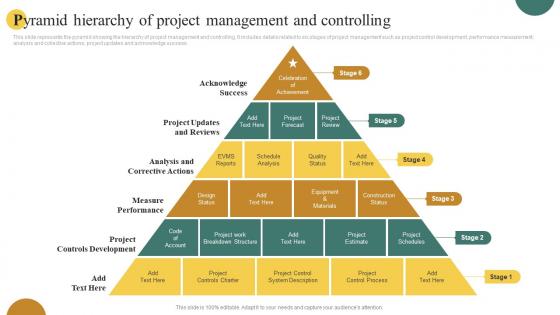
This slide represents the pyramid showing the hierarchy of project management and controlling. It includes details related to six stages of project management such as project control development, performance measurement, analysis and collective actions, project updates and acknowledge success.
People who downloaded this PowerPoint presentation also viewed the following :
Pyramid Hierarchy Of Project Management And Controlling with all 6 slides:
Use our Pyramid Hierarchy Of Project Management And Controlling to effectively help you save your valuable time. They are readymade to fit into any presentation structure.






FAQs for Pyramid Hierarchy Of Project
So imagine a triangle - CEO sits alone at the top, then you've got VPs below that, then directors, managers, and regular employees filling out the bottom. Each person reports to someone above them in a straight line up. More people at each level as you go down, but less actual decision-making power. It's like those dusty org charts from the 90s, except companies still use this structure everywhere. Authority flows downward, info flows upward. Pretty straightforward once you see it - though honestly, it can make things move pretty slow when you need approval for everything.
So pyramid structures are super rigid - there's this clear chain from CEO down to regular employees, and everyone reports to just one person above them. Compare that to flat orgs where people are mostly equals, or matrix setups where you're juggling multiple bosses (honestly sounds like a nightmare). The real kicker is how slow decisions get made in pyramids since everything has to go up the ladder for approval. Other structures move way faster and you can actually collaborate without all the red tape. My advice? Get tight with your direct manager - they're literally your only route upward in this system.
So pyramid structures are perfect for places like the military, big manufacturing companies, or government - basically anywhere you need super clear chains of command. Quick decisions flow down from leadership without confusion. They work great when there's lots of compliance stuff to deal with too. Honestly, if your work is pretty routine and predictable, this setup makes total sense. But creative industries or startups? Way too restrictive. You'd hate it. Large corporations love pyramids because scaling up is easier when everyone knows exactly who reports to whom.
So the biggest win is accountability - everyone knows who reports to who and what they're responsible for. Communication goes up and down way smoother too. Plus it scales really well when you grow since the structure's predictable. Yeah, it can feel stiff sometimes, but honestly that's kinda the point. Budget and authority get distributed clearly at each level, which saves headaches later. Oh, and here's a tip - map out whatever informal hierarchy you probably already have first. You'll be surprised how much structure exists naturally already.
Honestly, the worst part is how everything moves at a snail's pace - decisions have to crawl up and down through all these layers. Your employees at the bottom will feel super disconnected from leadership, which tanks engagement. Information gets twisted as it passes through each level (remember telephone game?). Quick pivots become nearly impossible when markets shift. The rigidity drives me crazy sometimes. Focus on giving your middle managers actual decision-making power instead of making them messengers. Clear communication channels help too, but empowering people is where you'll see real results.
So in pyramid setups, everything goes through your boss, then their boss, etc. Gets filtered at each level which is slow but at least prevents total chaos. Flat structures are way better for getting quick answers - you can just talk to whoever you need. But honestly, sometimes you'll get info overload or accidentally annoy someone by going around them. My advice? If you're stuck in a pyramid, just focus on getting tight with your manager and the people at your level. Makes everything flow way smoother.
Okay so in pyramid structures, leadership calls the shots from the top and pushes decisions down through each level. Different managers have different amounts of power obviously, but they're all trying to turn the big picture into actual work for their people. Info flows down, feedback goes up - makes sense when you think about it. Honestly, I've seen this work really well when everyone's on the same page. If you're stuck in one of these setups, definitely focus on your direct boss relationship. They're basically your lifeline to whatever's happening at the higher levels and can help you get resources when you need them.
Yeah, pyramid structures are the worst for motivation. People get stuck in these rigid layers where they can't make real decisions or feel heard. It's frustrating when you're basically a cog in the machine, you know? Plus career growth takes forever with all those levels to climb. The disconnect from leadership is huge too - no direct communication means people just check out. If you're dealing with this at work, maybe push for cross-level meetings or find ways to give people actual ownership of projects. Even small changes can help within the existing mess of a structure.
Honestly, you need to bust up those department bubbles that always happen in big companies. Try mixing people from different levels on project teams - works way better than you'd expect. Skip-level meetings are solid too, lets the big bosses actually talk to regular employees without going through five managers first. Matrix reporting is another option but fair warning, it can get weird with people having multiple bosses fighting over priorities. The real trick is making sure info flows both ways - up, down, sideways between departments. Maybe start small with one cross-team project to see what clicks with your company's vibe before going all-in.
So basically, pyramid structures work like this - big bosses at the top make the huge strategic calls that affect everyone. Middle managers handle department-level stuff. Then front-line people deal with daily operations and actually know what's going on day-to-day. It's kind of like a filter system, honestly. The higher up you are, the more big picture you get, but you lose the details. Lower levels have way better context about what's actually happening. Your position basically determines what decisions you can make and when you need to bug your boss about something bigger.
Ugh, pyramid structures are the worst for innovation. All those approval layers just kill momentum - by the time a good idea makes it up the chain, the moment's already passed. The people actually talking to customers (who know what's up) are stuck at the bottom while decisions happen way up top. Makes zero sense if you ask me. Quick pivots? Forget about it. Everything moves at a snail's pace when you need three managers to approve changing your email signature. My advice? Build some back-channel relationships across departments. Sometimes you gotta work around the system to get stuff done.
Yeah, pyramid structures are brutal for moving up. There's tons of entry-level jobs, but management spots? Good luck. Higher you climb, fewer chairs at the table - and everyone's fighting for them. Someone above you literally has to quit or get promoted for you to move. Kind of sucks, but at least you know exactly what the next step looks like. My take? Make yourself too valuable to ignore and maybe peek at other departments. Sometimes going sideways first gets you up faster than waiting around. Oh, and networking doesn't hurt either.
Honestly, start with Slack or Teams - email chains are the worst and just create confusion. For tracking stuff, Asana or Monday are solid choices so tasks don't get lost between different team levels. Dashboards are actually game-changers because managers can see what's happening without bugging everyone constantly. Oh, and video calls for one-on-ones work way better than I expected them to. My advice? Pick whatever communication tool your company isn't already sick of using. That's half the battle right there.
First things first - figure out who your natural team leads should be based on who's already got the respect and skills. Don't overthink the hierarchy thing at first, maybe just add department heads or something. Map out who reports to whom and be super transparent about it, otherwise people get weird about changes. Here's the thing though - you'll probably struggle to keep that chill, collaborative vibe once you add layers. That's just reality. Give each new structure like 6 months before you decide if it's working. Oh, and resist the urge to keep adding management roles too quickly. That gets messy fast.
McDonald's is probably the best example - same processes everywhere because info flows from corporate down to regional managers, then store managers, then crew. Military does this too. Works really well for big organizations that need consistency, but honestly you can't just do top-down communication or people get frustrated. Fortune 500 companies use it all the time. Just don't create too many layers or decisions take forever. Keep reporting lines super clear though - that's where I've seen it fall apart before.
-
Excellent products for quick understanding.
-
Thank you for showering me with discounts every time I was reluctant to make the purchase.