


RACI Matrix For Sales And Marketing Team Developing Actionable Sales Plan Tactics




Try Before you Buy Download Free Sample Product
 Impress Your
 Audience
 100%
100% Editable
 Save Hours
 of Time


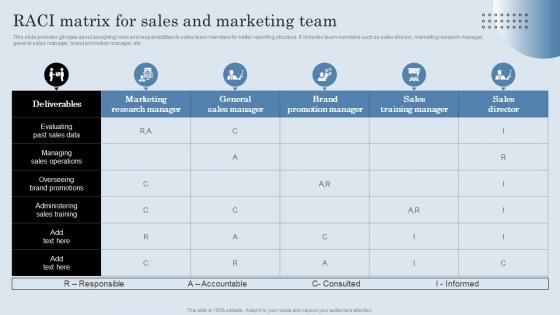
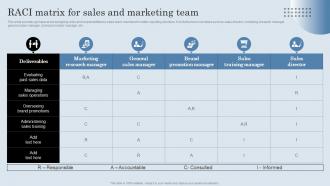
This slide provides glimpse about assigning roles and responsibilities to sales team members for better reporting structure. It includes team members such as sales director, marketing research manager, general sales manager, brand promotion manager, etc.
People who downloaded this PowerPoint presentation also viewed the following :
RACI Matrix For Sales And Marketing Team Developing Actionable Sales Plan Tactics with all 6 slides:
Use our RACI Matrix For Sales And Marketing Team Developing Actionable Sales Plan Tactics to effectively help you save your valuable time. They are readymade to fit into any presentation structure.





FAQs for RACI Matrix For Sales And Marketing Team Developing Actionable
So RACI Matrix - it's like your project cheat sheet for who does what. Responsible = actually doing the work, Accountable = owns the outcome, Consult = you need their input first, Informed = just keep them in the loop. Honestly, I've watched so many teams implode because everyone assumed someone else was handling stuff. Short sentences prevent those brutal "wait, I thought YOU were doing that" moments. Each person gets one role per task, so nothing gets dropped. Draft one early when you start your next project. Get everyone to agree on it upfront - trust me on this one.
Honestly, RACI is way more granular than other tools. Most just say "John owns this task" and call it done. But RACI makes you actually think through the details - like, is Sarah doing the work or just approving it? Yeah, it's kind of a pain to map out initially. But that's exactly why it works better. You get four clear buckets: Responsible (actually does stuff), Accountable (signs off), Consulted (you need their input), and Informed (just keep them posted). Other methods are too vague, which is honestly where most projects blow up anyway. Try it on your next team thing - you'll spot the overlap issues right away before they turn into actual problems.
RACI breaks down into four roles: **Responsible** (actually does the work), **Accountable** (owns the final outcome), **Consulted** (gives input beforehand), and **Informed** (gets updates after stuff happens). The biggest mixup I see? People confusing Responsible and Accountable. You can have multiple people responsible for different pieces, but only ONE person gets to be accountable per deliverable. They're your go-to decision maker. Pro tip - figure out who's accountable first when you're mapping this out. Makes everything else fall into place way easier. Trust me on this one.
Okay so RACI Matrix - it's basically this thing that stops everyone from going "wait I thought YOU were doing that." You map out who's Responsible for actually doing the work, who's Accountable for results, who to Consult, and who just needs updates. Game changer honestly. Once people know their exact role on each task, they actually do their part instead of hoping someone else handles it. We started using one last quarter and our meetings got way less chaotic. You should try it on your next project - I bet your standups will be so much cleaner.
Honestly, just brain-dump everyone first - grab a whiteboard and write down literally anyone who touches your project. Gets messy but you'll catch way more people that way. Look at each piece of work and ask who approves it, who's actually doing it, who gives input, and who just needs updates. You'll probably forget about legal or finance at first (everyone does), but add them later. End users too if they're affected. Once you've got your full list, that's when you can figure out the whole RACI thing for each task.
Oh man, don't put multiple people as "Accountable" - you need exactly one person who owns it, period. Also your matrix will be useless if you make it crazy detailed (seriously, no one cares about tracking every tiny subtask). Get your team's input first too, because people get pissed when they find out their job duties from some random spreadsheet. Avoid making everyone "Consulted" or you'll never get decisions made. I learned this one the hard way lol. Keep each row simple with one clear owner who can't wiggle out of responsibility.
Dude, remote RACI matrices need way more detail than the usual stuff. Add columns for how people want to be contacted, their working hours, and how fast they'll respond. Sarah being "Responsible" means nothing when she's in Singapore and you're panicking at 2am! I learned this the hard way last year. Break big tasks into smaller pieces too since everything takes forever when you're all async. Just slap timezone info next to everyone's name - seriously, that one thing prevents so much chaos. You'll end up over-communicating but that's better than everyone being confused.
Okay so first thing - list out all your project stuff and figure out who's involved. RACI is pretty straightforward: who does the work (Responsible), who's on the hook if it fails (Accountable), who you gotta check with (Consulted), and who just needs a heads up (Informed). Fair warning though, this gets messy fast with big projects! Draft it up, then definitely run it by your team because you'll miss something obvious. The trick is actually using the damn thing - bring it up in meetings when people start the whole "wait, whose job is this?" dance. Otherwise it's just another useless document gathering digital dust.
First, get everyone in a room and go over what RACI actually means - Responsible does the work, Accountable owns the outcome, Consulted gives input, Informed just needs updates. Honestly, I can't tell you how many times I've watched teams mess this up because they think those first two are the same thing. Go through each task one by one. Make sure people actually agree on who's doing what. Write down any pushback you get - trust me on this. Then send out the final version with concrete examples for your project specifically. Oh, and definitely do a follow-up meeting after a week because there's always confusion once people start actually working.
Honestly, update that RACI matrix whenever someone leaves or joins the team - I got burned when our PM quit and we didn't adjust anything. Total mess. Monthly check-ins work pretty well to make sure responsibilities still align with reality. Scope changes? Update it right away and tell everyone. Also stick it somewhere visible - like your project dashboard or whatever - so people actually look at the thing instead of letting it collect digital dust. The whole point is keeping it current as stuff shifts around, which it always does.
Honestly, RACI matrices are game-changers for this stuff. You map out who's Responsible, Accountable, Consulted, and Informed for each task, and suddenly all those fuzzy project boundaries become crystal clear. It's weird how forcing yourself to assign specific roles makes you realize what deliverables you're actually missing or doubling up on. The best part? You can't BS your way through defining what "done" looks like anymore since someone has to own each piece. I always do these at project kickoffs now - saves so much drama later when people start pointing fingers about who was supposed to handle what.
Yeah for sure! RACI works great for regular stuff too, not just big formal projects. I've seen people use it for monthly reports, onboarding new employees, customer complaints - honestly even planning office parties (though someone still screwed up the catering last time). Works best when multiple people are involved and there's confusion about roles. Just break down your process steps and assign the usual R-A-C-I roles. Give it a shot on whatever workflow is bugging you - I bet it'll clear up more confusion than you think.
Honestly, Excel or Google Sheets works perfectly fine for RACI matrices since it's just a basic grid. If your team needs real-time collaboration though, Smartsheet or Monday.com are pretty solid options. Lucidchart's nice if you want something more visual - I've used it before and the drag-and-drop stuff is actually helpful. Asana works too. Microsoft Project makes sense if you're already running your project there anyway. The real trick? Pick whatever tool your team will actually use and update regularly. I've seen too many fancy setups that just collect dust because nobody touches them after the initial setup.
Here's how I'd track if RACI is actually working. Decision speed is huge - projects should move way faster once everyone knows their role. Those annoying "wait, who's handling this?" questions should basically disappear. Survey your team after a month to see if they feel clearer about responsibilities. Track project completion times too. Honestly, the biggest sign is when your meetings stop being total chaos - people actually know what they're supposed to contribute. You'll also notice less duplicate work, which is such a relief. If stakeholders aren't second-guessing themselves constantly anymore, you're on the right track.
Microsoft cut their Office 365 migration delays by 30% using RACI matrices - basically helped everyone figure out who was actually responsible for what. Toyota's been doing this forever with their manufacturing (they're pretty nuts about process stuff, but whatever works I guess). IBM did something similar when they reorganized their cloud division. Honestly, the best approach is just picking one small project team first. Track how confused everyone was before vs after. Then you've got your own proof it works instead of just telling people about other companies.
-
Informative design.
-
The team is highly dedicated and professional. They deliver their work on time and with perfection.