


Request For Proposal Compliance Matrix Best Practices




Try Before you Buy Download Free Sample Product
 Impress Your
 Audience
 100%
100% Editable
 Save Hours
 of Time


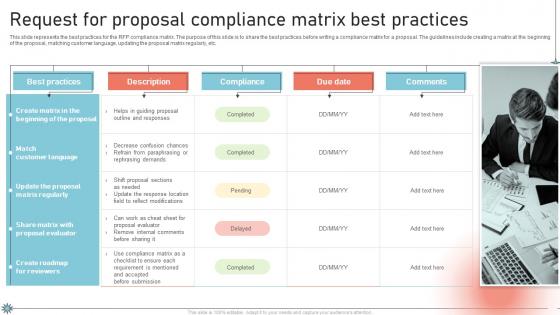
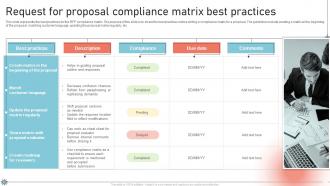
This slide represents the best practices for the RFP compliance matrix. The purpose of this slide is to share the best practices before writing a compliance matrix for a proposal. The guidelines include creating a matrix at the beginning of the proposal, matching customer language, updating the proposal matrix regularly, etc.
People who downloaded this PowerPoint presentation also viewed the following :
Request For Proposal Compliance Matrix Best Practices with all 6 slides:
Use our Request For Proposal Compliance Matrix Best Practices to effectively help you save your valuable time. They are readymade to fit into any presentation structure.





FAQs for Request For Proposal Compliance
You'll want requirement numbers, the exact text they wrote, where you answered it (page numbers work), and whether you're compliant or not. Honestly, I always throw in a summary column because some of these requirements are written like garbage and need translating. Don't skip the obvious stuff like "submit on time" - trust me, evaluators check every single box. Color-coding helps too so you can catch gaps before you send it off. The whole thing becomes your cheat sheet to prove you didn't miss anything important.
So basically, an RFP compliance matrix saves you from total chaos when evaluating proposals. You list all the requirements in rows, then score how well each vendor meets them in columns. Trust me, when you're staring at those monster 200-page proposals, having this checklist keeps you sane. Plus it covers your butt later - stakeholders love questioning decisions, and you'll have a clear audit trail showing exactly why you picked vendor A over vendor B. Honestly beats trying to remember everything in your head. Just makes the whole process way more systematic and nobody misses anything important.
Dude, don't leave ANY requirement unmapped - reviewers will definitely spot the gaps. Being vague kills you too. One thing that drives me nuts is when people cram like 3 requirements into a single row instead of breaking them out. I've literally watched teams get dinged for writing "Section 3" rather than the actual page number. Specificity is everything. Don't just copy their requirement language word-for-word as your response either - that screams "we didn't actually read this." Oh, and get someone else to review your matrix before you submit. You'll miss stuff that's super obvious to fresh eyes.
So basically, a compliance matrix becomes this shared roadmap where everyone can see what needs to get done and who's doing it. No more writers accidentally doing the same work twice or - even worse - completely missing stuff. Think of it like a master checklist that saves you from those 2am "oh crap, did anyone handle the cybersecurity part?" moments right before deadline. Honestly, those late-night panics are the worst. Get a shared version set up early and keep updating it so your whole team stays on the same page. It'll show you exactly where you stand progress-wise throughout the entire process.
Dude, automated extraction tools are a game changer - they pull requirements directly from RFPs so you don't have to copy everything by hand. Way fewer mistakes that way. Collaboration platforms let everyone work on the matrix at once, which is pretty sweet. You can even set up workflows that automatically send sections to your subject matter experts. Oh, and some tools have AI that suggests compliance language or spots gaps you might miss. The time you'll save is honestly ridiculous. I'd start with something that plays nice with whatever proposal software you're already using - you'll see results right away.
You really can't skip getting your team involved in the compliance matrix. Subject matter experts will catch technical stuff you'd totally miss, and procurement people know exactly what evaluators are looking for. I learned this the hard way on my first big proposal - thought I could handle it alone and missed three major requirements. Get everyone reviewing your interpretations early on and assign owners for each section. Trust me, it's way better than scrambling at the last minute when someone finally spots a gap you've been staring at for weeks.
Dude, color coding is a game changer - green for compliant, yellow for partial, red for nope. Trust me on this. Throw in some icons like checkmarks or warning triangles too. I've reviewed matrices that were just endless paragraphs and wanted to cry. Alternating row colors help a ton, plus clear headers so evaluators aren't hunting around. Short sentences mixed with longer explanations work better than everything being the same length. The whole point? Don't make reviewers work harder than they need to - if they can't quickly see your compliance status, you're basically shooting yourself in the foot.
Dude, keep that compliance matrix updated constantly - the second requirements change or you get clarification. Version control is huge (seriously, I've watched teams completely mess this up and submit old stuff). Color-code everything: green for done, yellow for working on it, red for missing. Set up regular check-ins with your team to spot gaps early. Always double-check against the original RFP sections. Oh, and assign someone to own each section - otherwise things just disappear into the void. Trust me on the accountability thing, it saves so much headache later.
Look at your debrief notes and loss reports first - they're pure gold for fixing your next matrix. I've watched teams totally redo their whole format after realizing evaluators couldn't even find their past performance examples (which is honestly pretty painful to watch happen). Check for patterns in the feedback. Did they miss your key differentiators? Were your cross-references confusing? Use that info to reorganize how you present everything. The feedback shows you exactly where evaluators got lost, so you can make those sections way clearer next time.
So the compliance matrix is basically your spreadsheet that tracks which section answers what requirement - super boring but you'll thank yourself later. Your proposal outline is more like the story flow, how everything connects together. I always do the matrix first because otherwise you end up scrambling at the end wondering where the hell you put their security requirements. Then build your outline around that matrix so every single thing has a home. Matrix = boring checklist. Outline = your actual document structure. Both matter, but honestly the matrix saves your butt more often.
Honestly, just look at what matters most in your specific industry and build from there. Healthcare RFPs? They're obsessed with HIPAA and patient safety stuff. Government contracts care way more about security clearances and whether you've actually delivered before. Financial services is all risk management, compliance frameworks - you know the drill. What I'd do is grab 3-4 recent RFPs from companies you want to work with. See what keeps showing up in their evaluation criteria. Those patterns will tell you exactly what to emphasize in your matrix. Once you spot the trends, create templates that put those critical compliance areas right upfront where they can't miss them.
Ugh, I know it's boring but you gotta read the whole RFP line by line. Trust me on this - requirements hide in the weirdest places. I like using different colored highlighters for different requirement types as I go. Set up some kind of checklist so you can actually track what you've covered. Have someone else look over your matrix too because you'll definitely miss stuff. Oh, and don't just hunt for the obvious "shall" statements. The evaluation criteria sections are sneaky - they'll have implied requirements buried in there. Once you're done, work backwards through your responses to double-check everything maps to something specific.
Dude, don't just toss that compliance matrix when you're done - it's actually super valuable for analyzing what went wrong (or right). Rate how well you tackled each requirement, then note which ones were a total pain or took forever. Most teams skip this completely, which is honestly pretty dumb. Look for patterns in where you struggled with evidence or couldn't find good examples. Those weak spots? That's what you need to work on before the next proposal. Takes like 20 minutes but saves you tons of headaches later when you're scrambling again.
Check your completion rates first - are people actually filling everything out? Response accuracy matters too since you don't want rejections over dumb compliance stuff. Time-to-completion is probably the biggest one though. If your matrix isn't speeding things up, what's the point? Win rates are where you'll see real value - compare RFPs where you used it versus didn't. Honestly, I'd just throw together a basic spreadsheet and check these monthly. Oh, and track how often your team actually uses the thing - adoption rates tell you if it's even worth having.
Honestly, a compliance matrix is a lifesaver when you're juggling multiple partners on a proposal. It shows exactly who owns what requirements - no more confusion about whether your teammate or the subcontractor is handling cybersecurity stuff. You can track everyone's progress and catch problems before they blow up. Way better than those chaotic email threads where people keep asking the same questions. Schedule quick check-ins so partners can update their sections. Trust me, it keeps people honest and you'll actually hit your deadlines instead of scrambling at the last minute.
-
A library of engaging, customizable and content-ready templates.
-
Impressive templates. Designing a presentation is fun now!