

Responsibility Matrix To Ensure Effective Risk Management Introducing A Risk Based Approach




Try Before you Buy Download Free Sample Product
 Impress Your
Audience
 100%
Editable
 Save Hours
of Time


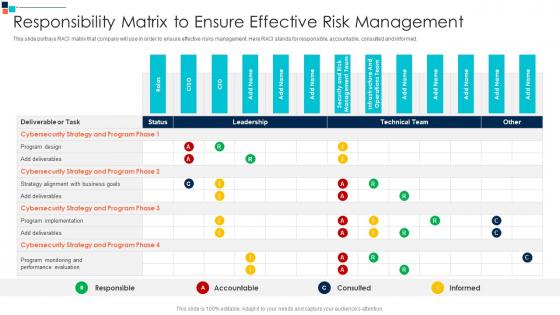
This slide portrays RACI matrix that company will use in order to ensure effective risks management. Here RACI stands for responsible, accountable, consulted and informed.
People who downloaded this PowerPoint presentation also viewed the following :
Responsibility Matrix To Ensure Effective Risk Management Introducing A Risk Based Approach with all 6 slides:
Use our Responsibility Matrix To Ensure Effective Risk Management Introducing A Risk Based Approach to effectively help you save your valuable time. They are readymade to fit into any presentation structure.






FAQs for Responsibility Matrix To Ensure Effective Risk Management Introducing A
Definitely start with clear task descriptions and who's doing what. I'm obsessed with RACI charts - Responsible, Accountable, Consulted, Informed - because nobody gets confused about roles. Add deadlines though, or it'll just collect digital dust. Map out which tasks depend on others finishing first. Oh, and create escalation paths for when stuff inevitably hits the fan. Focus on your biggest deliverables initially. Build everything else around those. Also throw in team member names and their specific roles so there's zero ambiguity about ownership.
You know those moments when everyone's pointing fingers like "wait, wasn't that YOUR job?" A responsibility matrix basically saves you from that nightmare. List out all your tasks, then assign who's doing what - who owns it, who approves, who needs to weigh in. Honestly, it's kind of like having answer key for project chaos. The visual layout helps you catch problems early too. I'd start with your main deliverables and get the team to hash out roles together. You'll be shocked how many "I thought YOU were doing that" moments get sorted out right away.
Don't put multiple people as "Accountable" for one thing - total disaster waiting to happen. Everyone just points fingers when stuff breaks. Keep it simple too, because overly detailed matrices just collect dust on someone's desk. I learned this the hard way on my last project actually. Make sure people can realistically handle what you're giving them, and don't just steal from some random template online. Every project's different. Oh, and update the thing as you go! A month-old responsibility chart is basically useless. Get everyone to agree upfront so nobody can play dumb later.
So basically, responsibility matrix is the umbrella term and RACI is just the most common version. RACI works great when your team already knows what Responsible/Accountable/Consulted/Informed means - saves explaining stuff. But honestly? Sometimes RACI feels way too formal, especially for smaller teams. I've seen people get bogged down arguing whether someone should be "consulted" vs "informed" (spoiler: it doesn't always matter that much). You can totally make your own matrix. Maybe just "Lead/Help/Know" or whatever clicks for your group. The whole point is helping everyone figure out who does what - not impressing anyone with fancy frameworks.
Don't try making a responsibility matrix on your own - that's a recipe for disaster. Get everyone involved from the start because they actually know what's realistic workload-wise and what depends on what. People will buy into responsibilities way more if they helped create them instead of having stuff dumped on them. Run some workshops where folks can hash out who does what and spot problems before they blow up. I've seen too many matrices fail because someone thought they could just decide everything in a meeting room. Make sure the team signs off on the final version before you start using it.
Ditch those boring spreadsheets - project management tools like Asana actually make responsibility matrices useful. Your team gets pinged automatically when their stuff changes, which honestly saves so much back-and-forth. Multiple people can jump in and update things live, plus you'll have dashboards showing who owns what instantly. The real game-changer? It syncs with tools you're already using, so it won't just collect digital dust like those Word docs from 2019. Don't overthink it though. Just pick whatever platform your team's comfortable with and start there.
Honestly, a responsibility matrix is a lifesaver when your team's fighting over who should do what. You literally just point to it and say "remember, we all agreed Sarah handles X and Mike does Y." No more finger-pointing or awkward situations where everyone assumes someone else will take care of something. The visual makes boundaries super obvious - way better than trying to remember random conversations from three weeks ago. When conflicts pop up, you've got this neutral thing to reference instead of arguing about what people think they heard. Just update it regularly and actually use it in meetings, otherwise it'll collect dust.
Honestly, check it whenever something major shifts - new people join, someone leaves, or scope changes. Monthly reviews work for most projects, but if things are crazy busy, you might need weekly check-ins. I learned this the hard way when half my team was buried in work while others had nothing to do. Major milestones are obvious times to revisit it too. The worst thing? Letting it sit there collecting digital dust. Just throw a recurring reminder on your calendar during regular meetings. Trust me, it's way easier than scrambling to figure out who's supposed to do what when deadlines hit.
Track your project completion rates and timeline stuff - that's the obvious starting point. But honestly? The biggest tell is decision-making speed. If people are still passing the buck on who decides what, your matrix isn't working. I'd also throw out quick surveys about role clarity and whether workloads feel balanced. Oh, and measure communication overhead - are teams wasting less time in those endless "wait, whose job is this?" meetings? Check these monthly. The real test though is pretty simple: can someone immediately answer "whose responsibility is this?" without that awkward pause where everyone looks around the room.
Honestly, responsibility matrices are lifesavers for catching resource issues early. You'll spot when someone's drowning in work while another person has basically nothing to do. The visual layout makes it obvious where skills aren't matching up with tasks. Plus it saves you from those panic moments when nobody knows who's supposed to handle something critical. I've seen too many projects crash because of unclear ownership – it's painful to watch. Start by writing down who's doing what right now. Then look for the weird gaps or places where people are stepping on each other's toes.
Honestly, skip the fancy templates at first. Just explain what problem it's solving - nobody cares about new processes unless they see the point. Grab a recent project everyone remembers and map it out together. Who was responsible? Who needed to approve stuff? That kind of thing. Getting everyone to build it with you is way better than showing up with something already done. Oh, and here's the thing that trips people up - you actually have to use it in your next few meetings or it'll just sit there being useless. I've seen so many teams create these things and then forget they exist.
Oh totally - culture plays a huge role in how people expect responsibility to work. Some folks want everything super collaborative while others are like "just tell me what to do." Hierarchy expectations are all over the place too. I'd be really explicit about roles since what seems obvious to you might not be to someone else. Also maybe check with a few different team members before you lock anything in? I learned this the hard way once - thought I was being clear but accidentally stepped on some cultural toes around authority stuff. It's trickier than it looks!
Start with a hands-on workshop where everyone builds a matrix using one of your actual projects. Role-playing feels ridiculous at first but honestly works really well - people finally get why "consulted" isn't the same as "informed" when they act it out. Walk through real examples instead of just theory. I'd create some templates afterward for your most common project types so teams aren't reinventing the wheel every time. The whole point is making it interactive. Let people screw up and ask dumb questions - that's where the learning happens.
Dude, you HAVE to get your team to look at this thing before you finalize it. They're the ones actually doing the work, so they'll spot stuff you missed - like when you've made someone responsible who's already swamped, or forgot about a stakeholder who needs to weigh in. I've watched so many of these matrices look great on paper then completely bomb in real life. Seriously, sit everyone down together and let them tear it apart. They'll catch overlaps and gaps you never would've noticed. Your team knows way better than you do if that person actually has the authority you think they have.
Google uses RACI charts for product launches - like who handles dev vs marketing vs legal stuff. Healthcare systems are obsessed with them for patient workflows between doctors and nurses. Manufacturing does quality control this way too. Oh, and weirdly enough, movie productions use them from start to finish. I swear they're literally everywhere once you notice! Don't reinvent the wheel though. Find someone doing something similar to your workflow and just steal their structure. Way easier than building one from nothing.
-
“I required a slide for a board meeting and was so satisfied with the final result !! So much went into designing the slide and the communication was amazing! Can’t wait to have my next slide!”
-
A library of engaging, customizable and content-ready templates.