

Retail Store Visit Checklist To Ensure Efficiency




Try Before you Buy Download Free Sample Product
 Impress Your
 Audience
 100%
100% Editable
 Save Hours
 of Time


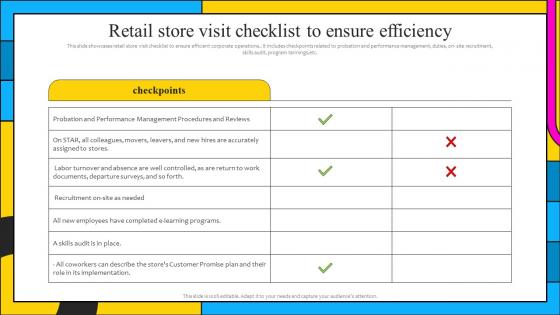
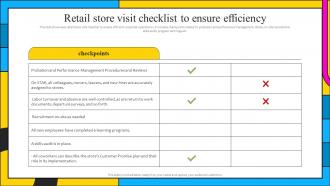
This slide showcases retail store visit checklist to ensure efficient corporate operations..It includes checkpoints related to probation and performance management, duties, on site recruitment, skills audit, program tarinings,etc.
People who downloaded this PowerPoint presentation also viewed the following :
Retail Store Visit Checklist To Ensure Efficiency with all 6 slides:
Use our Retail Store Visit Checklist To Ensure Efficiency to effectively help you save your valuable time. They are readymade to fit into any presentation structure.





FAQs for Retail Store Visit Checklist
Key retail efficiency KPIs include inventory turnover ratio, sales per square foot, customer conversion rates, average transaction value, and labor productivity metrics. These indicators streamline operations by identifying bottlenecks, optimizing stock levels, and enhancing customer experiences, with many retailers finding that tracking these metrics simultaneously delivers improved profitability and competitive advantage.
Store layout optimization enhances customer experience by creating intuitive navigation, reducing wait times, strategically placing high-demand products, and improving traffic flow throughout the space. Through data-driven design, retailers streamline shopping journeys, minimize bottlenecks, and maximize product visibility, with many stores finding that optimized layouts increase sales conversion rates while reducing operational costs and enhancing overall customer satisfaction.
Employee training enhances retail operational efficiency by improving customer service skills, streamlining inventory management processes, and reducing operational errors. Well-trained staff in retail environments can handle transactions faster, resolve customer issues more effectively, and optimize stock handling procedures, ultimately delivering improved customer experiences, reduced costs, and increased sales productivity across store operations.
Effective inventory management techniques reduce waste by implementing just-in-time ordering, automated reorder points, demand forecasting analytics, ABC classification systems, and regular cycle counting procedures. These approaches streamline stock levels by minimizing overstock situations, preventing product expiration, and optimizing storage costs, with many retail organizations finding that strategic inventory control ultimately delivers 20-30% waste reduction and significantly faster turnover rates.
Effective methods for analyzing customer foot traffic include heat mapping technology, infrared sensors, Wi-Fi analytics, video surveillance systems, and mobile app tracking. These technologies streamline retail operations by identifying peak shopping times, optimizing store layouts, and enhancing staff scheduling, with many retailers finding that strategic foot traffic analysis ultimately delivers improved customer experiences and increased sales conversions.
Technology integration through POS systems enhances retail efficiency by automating transactions, tracking inventory in real-time, and generating detailed sales analytics for strategic decision-making. These systems streamline operations by reducing manual errors, accelerating checkout processes, and enabling seamless integration with supply chain management, ultimately delivering faster customer service and improved inventory control across multiple store locations.
Strategies to reduce checkout times include self-service kiosks, mobile payment integration, barcode scanning optimization, staff cross-training, and queue management systems. These technologies streamline operations by automating transactions, minimizing manual processes, and enabling flexible staffing, with many retailers finding that strategic combinations ultimately deliver faster customer experiences and improved operational efficiency.
Data analytics enhances purchasing decisions by analyzing historical sales patterns, predicting demand fluctuations, identifying seasonal trends, and optimizing inventory turnover rates. Through predictive modeling and real-time market analysis, retailers can minimize overstock situations, reduce carrying costs, and improve cash flow management, ultimately delivering better profit margins and customer satisfaction.
Effective merchandising significantly enhances retail efficiency by optimizing product placement, streamlining inventory turnover, and maximizing space utilization across store layouts. Through strategic visual displays and data-driven positioning, retailers accelerate sales velocity, reduce stock holding costs, and improve customer flow patterns, with many retail chains finding that well-executed merchandising delivers measurable increases in revenue per square foot.
Retailers leverage supply chain management by implementing demand forecasting, inventory optimization, vendor relationship management, automated ordering systems, and real-time tracking technologies. These approaches streamline operations by reducing stockouts, minimizing excess inventory, and accelerating delivery times, with many retail organizations finding that integrated supply chain solutions ultimately deliver lower operational costs and enhanced customer satisfaction.
Customer feedback can be utilized to identify service bottlenecks, streamline checkout processes, optimize staff allocation, enhance product placement, and refine inventory management systems. Through systematic feedback analysis, retailers can reduce wait times, improve staff training programs, and automate repetitive tasks, with many stores finding that targeted improvements deliver faster customer service and increased operational efficiency.
Omnichannel retail strategies deliver enhanced inventory visibility, streamlined customer data integration, reduced operational silos, improved resource allocation, and consistent brand experiences across all touchpoints. These approaches enable retailers to optimize stock levels, accelerate order fulfillment, and minimize customer service redundancies, with many organizations finding significantly improved operational efficiency and competitive advantage.
Retailers can address operational bottlenecks by streamlining inventory management, optimizing staff scheduling, enhancing checkout processes, implementing automated reordering systems, and improving supply chain coordination. These approaches enable faster product turnover, reduce customer wait times, and minimize stockouts, with many retail organizations finding that strategic automation ultimately delivers improved customer experiences and increased profitability.
Logistics innovations significantly impacting retail efficiency include automated warehousing systems, predictive analytics for demand forecasting, drone delivery networks, AI-powered inventory optimization, and real-time supply chain visibility platforms. These technologies streamline operations by reducing fulfillment times, minimizing stockouts, and optimizing delivery routes, with many retailers finding that strategic automation ultimately delivers faster customer service and substantial cost reductions.
Staff scheduling optimization enhances service and efficiency by aligning workforce availability with customer demand patterns, reducing wait times, and ensuring adequate coverage during peak periods. Through strategic scheduling software and data analytics, retailers streamline labor costs, minimize overstaffing expenses, and maximize customer satisfaction, with many stores finding that optimized schedules ultimately deliver faster service and improved operational performance.
-
No second thoughts when I’m looking for excellent templates. SlideTeam is definitely my go-to website for well-designed slides.
-
Well-designed and informative templates. Absolutely brilliant!