

Steps To Construct Retail Store Visit Report




Try Before you Buy Download Free Sample Product
 Impress Your
 Audience
 100%
100% Editable
 Save Hours
 of Time


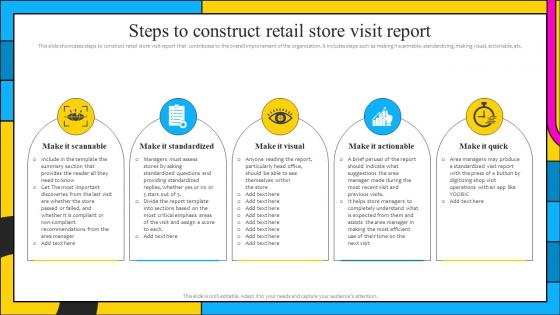
This slide showcases steps to construct retail store visit report that contributes to the overall improvement of the organization.It includes steps such as making it scannable, standardizing, making visual, actionable, etc.
People who downloaded this PowerPoint presentation also viewed the following :
Steps To Construct Retail Store Visit Report with all 6 slides:
Use our Steps To Construct Retail Store Visit Report to effectively help you save your valuable time. They are readymade to fit into any presentation structure.





FAQs for Steps To Construct Retail
Key metrics during retail store visits include customer traffic patterns, conversion rates, average transaction values, inventory turnover, staff performance indicators, and competitor pricing analysis. These measurements enable retailers to optimize store layouts, enhance customer experiences, and identify operational inefficiencies, with many retail chains finding that systematic tracking ultimately delivers improved sales performance and strategic competitive advantage.
Employee interactions significantly influence customer satisfaction and sales by creating positive experiences, building trust, providing personalized recommendations, and addressing concerns effectively. Through knowledgeable assistance and genuine engagement, retail staff enhance customer loyalty, increase average transaction values, and drive repeat business, with many stores finding that well-trained employees directly correlate with higher conversion rates and improved brand perception.
Effective in-store customer journey layouts include clear sightlines, intuitive wayfinding, strategic product placement, comfortable traffic flow patterns, and accessible checkout locations. These design elements streamline navigation by reducing confusion, minimizing bottlenecks, and enhancing product discovery, with many retailers finding that optimized layouts increase dwell time, boost sales conversions, and ultimately deliver improved customer satisfaction.
Visual merchandising significantly influences consumer behavior by guiding customer flow, creating emotional connections, highlighting key products, and encouraging impulse purchases through strategic product placement and atmospheric design. Retailers like Target and Zara use color psychology, lighting, and display positioning to increase dwell time and basket size, with many finding that effective merchandising boosts sales conversion rates by 20-30% while enhancing overall shopping experiences.
Inventory management observations should include stock levels, product placement effectiveness, turnover rates, stockout incidents, and replenishment processes. Through systematic tracking, retail managers can identify slow-moving merchandise, optimize shelf space allocation, and streamline supply chain operations, with many stores finding that detailed inventory analysis reduces carrying costs while improving customer satisfaction and sales performance.
Technology integration can be assessed by evaluating point-of-sale systems, inventory management software, customer relationship management tools, mobile payment options, and digital signage effectiveness. Through comprehensive audits, retailers can streamline checkout processes, enhance inventory accuracy, and improve customer experiences, while identifying gaps in their technological infrastructure, ultimately delivering operational efficiency and competitive advantage in an increasingly digital retail landscape.
Promotional displays significantly influence customer behavior by creating visual focal points, increasing product visibility, and encouraging impulse purchases through strategic placement and eye-catching designs. In retail environments, well-positioned displays near store entrances, high-traffic aisles, and checkout areas can boost product sales by 20-30%, with many retailers finding that seasonal and themed displays ultimately drive both immediate purchases and brand awareness.
Store cleanliness and organization significantly enhance customer satisfaction by creating welcoming environments, reducing shopping time, and building brand trust. Well-organized retail spaces, from grocery stores to fashion outlets, streamline customer navigation while maintaining hygiene standards, ultimately delivering improved customer loyalty, increased dwell time, and higher sales conversion rates for retailers.
When evaluating customer service training programs in-store, consider training content relevance, staff engagement levels, practical application methods, measurement metrics, and ongoing reinforcement strategies. Retail environments like department stores and electronics retailers find that programs combining role-playing scenarios, customer interaction techniques, and product knowledge assessments deliver improved customer satisfaction scores, reduced complaint rates, and ultimately enhanced sales performance through better customer experiences.
Competition can be analyzed during retail store visits by evaluating product assortments, pricing strategies, store layouts, customer service quality, and promotional displays. Through systematic observation and comparison, retailers can identify market gaps, benchmark operational efficiency, and assess customer engagement tactics, with many finding that competitor insights ultimately enhance their own merchandising decisions and competitive positioning.
Effective customer observation practices include positioning staff strategically throughout store sections, tracking peak traffic patterns, documenting age groups and shopping styles, recording dwell times at displays, and noting purchase decision factors. These methods enable retailers to optimize store layouts, adjust product placements, and enhance customer experiences, with many retail chains finding that systematic observation delivers improved conversion rates and targeted merchandising strategies.
Seasonal product placement significantly influences sales by creating urgency through limited-time availability, positioning items in high-traffic areas, and leveraging emotional connections to holidays or weather patterns. Retailers strategically place seasonal merchandise near entrances, checkout counters, and endcaps, with many stores finding that these prime locations can increase seasonal sales by 15-30% compared to standard shelf positioning.
Evaluating checkout processes and wait times reveals customer flow patterns, staff efficiency levels, technology integration gaps, peak hour bottlenecks, and payment method preferences. These insights enable retailers to optimize staffing schedules, implement faster payment systems, reduce customer abandonment rates, and enhance overall shopping experiences, with many stores finding that streamlined checkout processes significantly increase customer satisfaction and repeat visits.
Social media presence can be assessed through engagement metrics, promotional post reach, hashtag performance, user-generated content volume, and cross-platform consistency with in-store campaigns. Retail brands increasingly track social media mentions during promotional periods, monitor customer check-ins and tagged locations, and analyze conversion rates from social traffic to in-store visits, ultimately delivering integrated marketing insights and enhanced customer engagement strategies.
Strategies include optimizing store layout and product placement, enhancing visual merchandising and signage, implementing targeted promotional campaigns, improving staff training and customer service, and leveraging data analytics for inventory management. Through strategic positioning and customer experience enhancements, retailers streamline shopping journeys, reduce friction points, and create compelling environments that drive conversions, with many stores finding significant increases in both traffic and sales performance.
-
Designs have enough space to add content.
-
Colors used are bright and distinctive.