


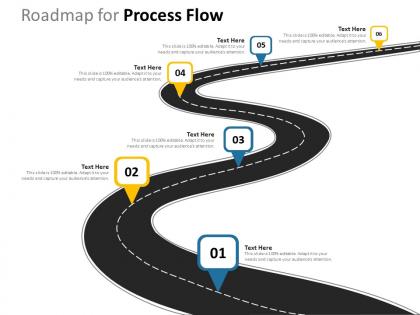
Roadmap for process flow a818 ppt powerpoint presentation icon example file




Try Before you Buy Download Free Sample Product
 Impress Your
 Audience
 100%
100% Editable
 Save Hours
 of Time


Assess alternatives intelligently with our Roadmap For Process Flow A818 Ppt Powerpoint Presentation Icon Example File. Get to establish an ideal balance.
People who downloaded this PowerPoint presentation also viewed the following :
Roadmap for process flow a818 ppt powerpoint presentation icon example file with all 5 slides:
Get to establish an ideal balance with our Roadmap For Process Flow A818 Ppt Powerpoint Presentation Icon Example File. Intelligently assess all the alternatives.


FAQs for Roadmap for process flow a818 ppt powerpoint presentation
Key components of an effective process flow roadmap include clear milestone definitions, timeline frameworks, resource allocation maps, stakeholder responsibility matrices, and performance measurement criteria. These elements work together by providing strategic visibility, streamlining project coordination, and enabling proactive risk management, with many organizations finding that comprehensive roadmaps reduce implementation timelines while enhancing cross-functional collaboration and deliverable quality.
Visual elements enhance process flow roadmap understanding by simplifying complex workflows, highlighting critical decision points, establishing clear hierarchies, and using color coding to distinguish different stages or responsibilities. Through strategic use of icons, arrows, and visual connectors, organizations streamline communication across departments, reduce training time, and minimize process errors, with many finding that visual roadmaps improve team alignment and accelerate implementation timelines.
Manufacturing, healthcare, financial services, logistics, and technology companies benefit most from process flow roadmaps due to their complex, multi-stage operations requiring precise coordination. These industries leverage roadmaps to streamline production cycles, patient care workflows, loan processing, supply chain management, and software development, ultimately delivering improved efficiency, reduced costs, and enhanced service quality while maintaining regulatory compliance.
Stakeholders can be effectively engaged through collaborative workshops, regular feedback sessions, cross-functional team integration, and transparent communication channels throughout roadmap development. By involving department heads, end-users, and leadership in mapping exercises, organizations ensure comprehensive input and buy-in, while iterative review cycles enable continuous refinement, ultimately delivering a roadmap that reflects actual operational needs and secures organizational commitment.
Common challenges when creating process flow roadmaps include unclear stakeholder requirements, incomplete process documentation, resistance to change, unrealistic timelines, and insufficient cross-departmental coordination. These obstacles can be overcome by conducting thorough stakeholder interviews, mapping existing workflows comprehensively, implementing phased rollouts with clear communication strategies, and establishing regular review checkpoints, ultimately delivering streamlined operations and enhanced organizational alignment across all business units.
Technology tools streamline process flow roadmap design by offering drag-and-drop interfaces, real-time collaboration features, automated workflow validation, and integrated analytics capabilities. Through platforms like Lucidchart, Visio, or specialized process mapping software, organizations enhance visualization accuracy, reduce design time, and enable cross-functional teams to collaborate seamlessly, ultimately delivering more precise roadmaps and faster implementation cycles.
Data analysis plays a crucial role in refining process flow roadmaps by identifying bottlenecks, measuring performance metrics, revealing inefficiencies, and providing insights for optimization opportunities. Through comprehensive analytics, organizations can streamline workflows, reduce cycle times, and enhance operational efficiency, with many companies in manufacturing and financial services finding that data-driven refinements ultimately deliver significant cost savings and improved customer experiences.
Process flow roadmaps facilitate continuous improvement by identifying bottlenecks, measuring performance metrics, and establishing clear optimization pathways across organizational workflows. Through systematic analysis and regular updates, companies streamline operations, reduce cycle times, and enhance resource allocation, with many manufacturing and service organizations finding that visual roadmaps enable data-driven decisions, ultimately delivering measurable efficiency gains and competitive advantage.
Best practices for presenting process flow roadmaps include tailoring complexity to audience expertise, using clear visual hierarchies, highlighting key milestones and decision points, and providing context for each process stage. Executive audiences benefit from high-level overviews focusing on strategic outcomes, while operational teams require detailed step-by-step workflows, with many organizations finding that interactive presentations enhance stakeholder engagement and buy-in.
The right level of detail depends on your audience, purpose, and organizational complexity, balancing comprehensiveness with clarity through stakeholder input, process criticality assessment, and intended usage analysis. Many organizations find that starting with high-level workflows and progressively adding granular steps for critical decision points, compliance requirements, and handoff procedures delivers optimal usability while maintaining strategic oversight.
Process flow roadmaps align with project management methodologies by providing visual frameworks for task sequencing, milestone tracking, and resource allocation across project phases. These roadmaps integrate seamlessly with Agile, Waterfall, and hybrid approaches, enabling project managers in software development, manufacturing, and consulting to streamline workflows, enhance team collaboration, and deliver projects on schedule while maintaining clear visibility into dependencies and potential bottlenecks.
Process flow roadmaps emphasize strategic timing, milestones, and resource allocation across extended timeframes, while traditional flowcharts focus on sequential decision points and immediate process steps. Roadmaps enable organizations to visualize long-term transformation initiatives, budget planning, and stakeholder alignment, whereas flowcharts streamline operational procedures, ultimately delivering strategic oversight versus tactical execution guidance.
Process flow roadmaps should be reviewed quarterly for strategic alignment and updated immediately when significant process changes occur, regulatory requirements shift, or performance metrics indicate inefficiencies. Many organizations find that combining scheduled reviews with trigger-based updates ensures optimal accuracy, with industries like healthcare and financial services requiring more frequent assessments to maintain compliance and operational excellence.
A process flow roadmap significantly enhances employee training and onboarding by providing clear visual pathways, standardized procedures, and step-by-step guidance that reduces confusion and accelerates learning. This structured approach enables organizations to deliver consistent training experiences, minimize onboarding time, and improve knowledge retention, with many companies finding that new hires become productive faster while reducing training costs.
A process flow roadmap facilitates better communication by providing visual clarity, standardizing terminology, eliminating information silos, and creating shared understanding across all stakeholders. Through clear documentation and transparent workflows, teams in manufacturing, healthcare, and financial services streamline coordination, reduce miscommunication, and accelerate decision-making, ultimately delivering enhanced operational efficiency and stronger cross-departmental collaboration.
No Reviews