


Role Of Front End Developer In Web And Application Development




Try Before you Buy Download Free Sample Product
 Impress Your
 Audience
 100%
100% Editable
 Save Hours
 of Time


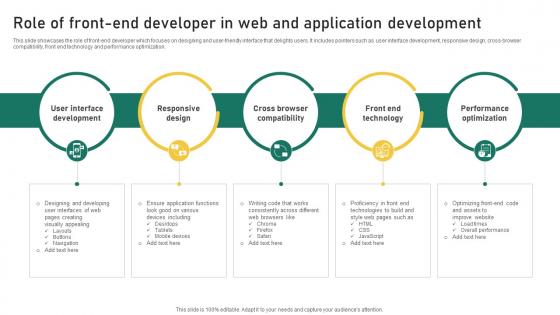
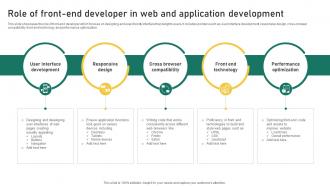
This slide showcases the role of front-end developer which focuses on designing and user-friendly interface that delights users. It includes pointers such as user interface development, responsive design, cross-browser compatibility, front end technology and performance optimization.
People who downloaded this PowerPoint presentation also viewed the following :
Role Of Front End Developer In Web And Application Development with all 9 slides:
Use our Role Of Front End Developer In Web And Application Development to effectively help you save your valuable time. They are readymade to fit into any presentation structure.








FAQs for Role Of Front End Developer In Web
Essential front-end developer skills include HTML/CSS mastery, JavaScript proficiency, responsive design principles, version control systems like Git, and modern frameworks such as React or Vue. These technical competencies enable developers to create seamless user experiences, optimize website performance, and collaborate effectively in development teams, ultimately delivering faster load times and enhanced customer engagement across industries.
Modern web frameworks have transformed front-end developers from basic HTML/CSS coders into full-stack architects who manage complex state management, component libraries, server-side rendering, and API integrations. These developers now leverage React, Angular, and Vue.js to build scalable applications, streamline development workflows, and deliver enhanced user experiences, with many organizations finding that this evolution enables faster deployment cycles and significantly improved application performance.
Cross-browser compatibility best practices include progressive enhancement, CSS normalization, feature detection, responsive design principles, and thorough testing across multiple browsers and devices. These approaches streamline development by ensuring consistent user experiences, reducing maintenance overhead, and maximizing market reach, with many organizations finding that strategic compatibility testing ultimately delivers broader audience engagement and competitive advantage.
Front-end developers manage performance optimization through code minification, image compression, lazy loading, caching strategies, and reducing HTTP requests. These techniques streamline user experiences by accelerating page load times, minimizing bandwidth usage, and enhancing mobile responsiveness, with many e-commerce and media companies finding that optimized performance delivers higher conversion rates and improved customer satisfaction.
Responsive design ensures websites adapt seamlessly across devices, from desktops to smartphones, by using flexible grids, fluid images, and CSS media queries. This approach enhances user experience while reducing development costs, with many e-commerce and financial services companies finding that responsive sites significantly improve conversion rates and customer engagement across all platforms.
Front-end developers collaborate effectively with UX/UI designers by establishing early communication channels, participating in design reviews, and understanding design systems and user experience principles. Through regular feedback sessions and shared prototyping tools, development teams streamline implementation processes, reduce revision cycles, and ensure pixel-perfect execution, with many organizations finding that integrated workflows ultimately deliver faster product launches and enhanced user experiences.
React, Angular, Vue.js, Svelte, and jQuery remain the most widely adopted front-end frameworks and libraries across industries today. These technologies streamline development workflows by offering reusable components, efficient state management, and rapid deployment capabilities, with many organizations finding that React and Vue.js particularly enhance team productivity while reducing long-term maintenance costs.
Front-end developers leverage JavaScript to create interactive elements, manipulate DOM structures, handle user events, implement animations, and manage real-time data updates seamlessly. Through frameworks like React and Vue, developers in e-commerce, banking, and healthcare sectors deliver responsive interfaces, personalized content experiences, and streamlined user journeys, ultimately enhancing customer engagement and operational efficiency.
Front-end developers can utilize Git workflows, branching strategies like GitFlow, pull request reviews, automated testing pipelines, and collaborative platforms such as GitHub or GitLab. These methodologies streamline code management by enabling seamless team collaboration, maintaining project history, and facilitating continuous integration, with many development teams finding that structured version control ultimately accelerates deployment cycles and minimizes conflicts.
Front-end developers ensure accessibility by implementing semantic HTML, proper ARIA labels, keyboard navigation support, color contrast compliance, and screen reader compatibility. These practices streamline user experiences across diverse abilities, with many e-commerce platforms and financial institutions finding that accessible designs ultimately deliver broader market reach, regulatory compliance, and enhanced customer satisfaction.
Common pitfalls include neglecting mobile responsiveness, ignoring performance optimization, poor error handling, inadequate testing across browsers, and failing to follow accessibility standards. These oversights significantly impact user experience and business outcomes, with many organizations finding that addressing performance bottlenecks, implementing comprehensive testing protocols, and ensuring cross-device compatibility ultimately delivers higher conversion rates and customer satisfaction.
Front-end developers integrate APIs to access external data, authenticate users, process payments, manage content, and enable real-time communications through strategic HTTP requests and response handling. These integrations streamline application development by connecting frontend interfaces with backend services, third-party platforms, and cloud resources, ultimately delivering dynamic user experiences while reducing development complexity and accelerating time-to-market for businesses.
Front-end developers contribute to SEO through optimized HTML structure, fast-loading responsive designs, semantic markup implementation, and technical performance enhancements like image compression and code minification. By ensuring clean code architecture, proper meta tags, and mobile-first approaches, developers enable businesses to achieve higher search rankings, increased organic traffic, and ultimately better online visibility in competitive digital markets.
Testing is crucial for front-end development, ensuring code reliability, user experience quality, and cross-browser compatibility through unit testing, integration testing, end-to-end testing, and automated regression testing. These strategies streamline development workflows by catching bugs early, reducing deployment risks, and maintaining consistent functionality across platforms, with many development teams finding that comprehensive testing ultimately delivers faster release cycles and enhanced user satisfaction.
Key trends shaping front-end development include AI-powered development tools, progressive web applications, micro-frontends architecture, serverless computing, and enhanced accessibility standards. These technologies streamline development workflows, improve user experiences, and enable scalable applications, with many organizations finding that strategic adoption delivers faster deployment cycles, reduced maintenance costs, and competitive advantage in increasingly digital markets.
-
Editable, diversified, compatible with MS PPT and Google Slides, and on top of that finest graphics!! I mean in the words of the famous Ross Geller, “What more do you want!”
-
SlideTeam is a great place for PPT templates. They have many templates on a single topic. It has made my life a lot easier.