

Roles and responsibilities ppt presentation






Try Before you Buy Download Free Sample Product
 Impress Your
Audience
 100%
Editable
 Save Hours
of Time


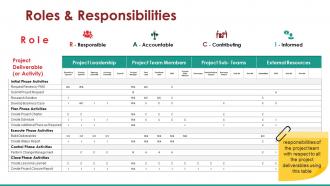
Boost the drive for growth with our Roles And Responsibilities Ppt Presentation. Give greater impetus to generating development.
People who downloaded this PowerPoint presentation also viewed the following :
Roles and responsibilities ppt presentation with all 5 slides:
Get folks involved in combined effort with our Roles And Responsibilities Ppt Presentation. Give them an incentive to join forces.


FAQs for Roles and
Honestly, most of it comes down to just getting people to actually talk to each other - sounds obvious but you'd be surprised how often that's the issue! Set up roles right from the start so nobody's stepping on toes or wondering whose job something is. Weekly check-ins are a lifesaver, plus some kind of shared tracker where everyone can see what's happening. Communication is really everything here. When project goals shift (and they always do), make sure you're the one keeping everyone in the loop. You're basically playing coordinator, making sure all the moving pieces know what the other pieces are doing.
Dude, you gotta define who does what or your team will just keep tripping over each other. Nobody knows whose job it is, so either everyone does it or nobody does - both suck. When people know their specific area, they'll actually make decisions instead of that annoying "let me check with..." dance. I've seen teams move like 3x faster once they figure this out. Oh and write down the main 3 things each person owns. Sounds boring but it works. Trust me, that "whose lane is this?" confusion is a total productivity killer.
Start with a RACI matrix - I know, sounds super corporate but it genuinely helps. Map out who's Responsible, Accountable, Consulted, and Informed for each big task. Regular check-ins are clutch so people can ask "whose job is this?" without it being weird. Also make a simple team charter everyone can actually find - put it somewhere visible in your shared workspace, not buried in some folder. When confusion pops up (it always does), deal with it fast instead of letting people just wing it. Trust me, the upfront work saves so much headache later.
Your main job duties don't really change, but how you actually do them? Totally different story. Communication becomes huge - you can't just walk over and ask a quick question anymore. You'll end up doing way more documentation and managing your own schedule since your boss isn't around to check in. Honestly, the hardest part is probably collaboration - everything needs to be planned out instead of those random brainstorming moments. My advice? Over-communicate like crazy from the start. Set up regular check-ins with your team or you'll be guessing what everyone expects half the time.
RACI matrices are honestly your best bet here - they break down who's Responsible, Accountable, Consulted, and Informed for each task. Way more useful than basic org charts. Swimlane diagrams are cool too if you want something that shows how work actually flows between people. I've used Lucidchart for this stuff before, though Visio works fine too. Hell, even a simple spreadsheet can do the job. Start with RACI though - it'll force you to really think through who does what instead of just winging it. Much cleaner than trying to figure it out as you go.
Honestly, knowing what you're supposed to do at work makes such a difference. You can actually focus on the right stuff instead of just guessing all the time. It's way less stressful too - like, no more wondering if you're screwing up or doing someone else's job. Your confidence goes up because you know exactly how you're being measured. I swear, half the workplace drama I see comes from people stepping on each other's toes because nobody knows their lane. If you're confused about your role, just ask your manager straight up. It'll save you so much headache.
Ugh, overlapping roles are the worst. You'll get confused about who owns what, plus people end up doing the same work twice - such a waste. Tasks slip through the cracks too because everyone thinks someone else has it covered. When stuff goes wrong? Good luck figuring out who's actually at fault since everyone just points fingers. Honestly reminds me of those group projects where half the team brings identical presentations. Map out who does what from the start. Check in regularly so you can catch problems before they spiral.
Ugh, role ambiguity is the worst - it just snowballs into chaos. People start doing the same work twice, deadlines get missed, and stuff literally falls through the cracks because everyone thinks someone else has it covered. Or they just freeze up entirely, not wanting to step on toes. Then you're stuck in meeting after meeting trying to figure out who's supposed to do what (honestly such a waste of time). The blame game afterwards? Even worse. I learned this the hard way - now I always write down who owns what from day one. Check back on it every few weeks too. Trust me, it'll save your sanity.
Honestly, you've gotta spell out who owns what from day one - like actually write it down, not just mention it in passing. I'd create role docs that explain the reasoning behind responsibilities, not just random task lists. Then ask people straight up during one-on-ones: "What's confusing about your role?" and "Where are you bumping into other people's work?" The thing that really makes a difference though? Own your screwups publicly when you drop the ball on something. People notice that stuff. Oh, and do a quick audit this week to see what your team actually understands vs. what you think they know. Trust me on this one.
Honestly, feedback is how you figure out what you should actually be doing day-to-day versus whatever's in your official job description. Your teammates will tell you which tasks you're nailing and which ones someone else might handle better. It's like adjusting everything while you're still working - sounds chaotic but it works. Don't just wait around for your yearly review to find out if you're even focused on the right stuff. Ask people about your role boundaries regularly. I learned this the hard way when I spent months on projects that weren't really mine to begin with.
Don't just throw them the job description and call it good. Walk them through what they'll actually be doing day-to-day and how it fits with everyone else's work. Get them a buddy who really knows the ropes - seriously, this saves so much headache later. Check in with them weekly that first month because small confusions turn into big messes fast. Oh, and write it all down in some kind of reference sheet. They'll thank you when they're sitting there three weeks in wondering if that random task is actually theirs or not.
Check in with your team every 2-3 months, even when everything seems fine. Ask what's actually working vs what's just on paper - people usually know when their job description is total fiction compared to reality. Write down any changes because honestly, teams have the memory of goldfish sometimes. New project scope? Flag which roles get hit right away instead of crossing your fingers. Oh and don't just tell the people directly affected - loop in the whole team or someone will inevitably be confused later. Set a calendar reminder or you'll forget too.
Honestly, delegation works amazing when people feel like you actually trust them with something meaningful. Give them the full picture - the why behind what they're doing, not just a task dump. That's where most managers screw up, tbh. You can't just hand over work without the authority to make decisions. People get resentful fast. Set clear expectations upfront and check in without hovering over their shoulder constantly. When done right, everyone knows exactly what they own and accountability goes way up. It's really about empowering people, not just offloading your to-do list.
Dude, unclear roles will absolutely wreck your startup. People start duplicating work or worse - assuming someone else handled the critical stuff. I've seen teams implode over "wait, wasn't that your job?" arguments. Short bursts of confusion? Fine. But when it drags on, accountability dies and momentum just... stops. Nobody wants to own failures when responsibilities are fuzzy. Write down who does what, even if it's messy. Update it constantly as things shift. Sounds boring but honestly it'll save you from so many headaches down the road.
Oh man, this stuff is tricky but super important. Some people on your team will want the boss to just tell them what to do, while others expect everyone to hash things out together first. What feels like hovering to you might actually be helpful guidance to someone from a different background. Time perspectives are all over the place too - I've seen people get frustrated when teammates want to build relationships before jumping into work. Communication styles? Total minefield. Some cultures are brutally direct, others wrap everything in like five layers of politeness. My advice: have those awkward conversations upfront about how everyone likes to work and communicate. Way better than guessing wrong for months.
-
Presentation Design is very nice, good work with the content as well.
-
The Designed Graphic are very professional and classic.