


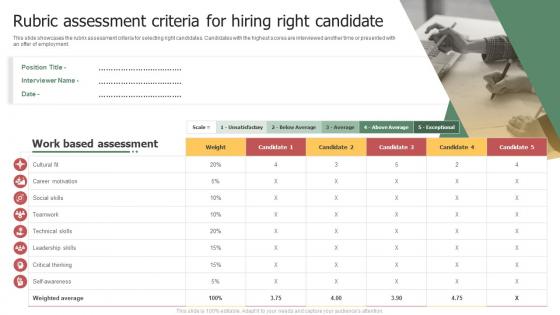
Rubric Assessment Criteria For Hiring Right Candidate




Try Before you Buy Download Free Sample Product
 Impress Your
 Audience
 100%
100% Editable
 Save Hours
 of Time


This slide showcases the rubrix assessment criteria for selecting right candidates. Candidates with the highest scores are interviewed another time or presented with an offer of employment.
People who downloaded this PowerPoint presentation also viewed the following :
Rubric Assessment Criteria For Hiring Right Candidate with all 6 slides:
Use our Rubric Assessment Criteria For Hiring Right Candidate to effectively help you save your valuable time. They are readymade to fit into any presentation structure.





FAQs for Rubric Assessment Criteria For
Okay so you'll need four main things: performance criteria (what you're actually grading), different levels like "awesome/good/needs work," then really specific descriptions for each level. Students should be able to read it and actually get what you want. Honestly, skip the fancy academic language - nobody has time for that. Make the descriptions detailed enough that if another teacher used your rubric, they'd grade the same paper similarly. Oh and start with your learning goals first, then build everything around those. Way easier than trying to jam objectives into a rubric you already made. The whole point is consistency, right?
Honestly, rubrics are game-changers. Students finally know what "good work" actually means instead of just guessing. No more vague "needs improvement" feedback that helps nobody. Give them the rubric upfront when you assign stuff, not just when grading - it's like showing the target before they shoot. They can check their own work against it too. Way better than them turning in random garbage and hoping for the best. Plus your grading becomes so much faster since you're not explaining the same expectations over and over. Trust me on this one.
Look, if people can't understand your rubric, you're screwed - everyone will score differently and get annoyed. Skip vague words like "good" or "adequate." Be super specific instead. Rather than "shows understanding," try "identifies three main causes and explains how they connect." I've watched so many rubrics bomb because they sound like textbooks! You want observable stuff, not fluffy language. Examples help tons too. Show what each level actually looks like. Honestly, think of it as writing instructions for someone who's never done this before. Keep it simple and concrete.
Make your criteria super specific instead of vague - like define what "excellent" actually looks like with real examples. Those rubrics that just say "shows creativity" are the worst, honestly. Get multiple people scoring when you can, and do practice rounds where everyone scores the same samples to make sure you're all on the same page. Weight everything properly too so one section doesn't accidentally take over the whole score. Oh, and definitely test it on a few examples first - you'll catch weird bias issues before it's too late.
So basically, rubrics serve different purposes depending on when you use them. During formative stuff, they're like roadmaps - students get specific feedback they can actually do something with. Like "hey, your analysis needs more evidence" instead of just "good job." Then for summative, you're using that exact same rubric to grade their final work. Honestly, the best approach is sharing the rubric from day one so kids know what you want, then referring back to it during drafts and practice. Same tool, just different goals each time you pull it out.
Honestly, just get them to help you figure out what "good work" actually looks like. I usually start by asking what makes an essay or project awesome - kids are surprisingly tough critics! Then we turn their ideas into rubric language together. Show them some sample work first and let them score it. The discussions get pretty heated, which is perfect. Once they've helped create the standards, they're not just throwing darts in the dark anymore. Even co-creating one tiny section makes such a difference. Try it next time - you'll be shocked how much more they actually care about the work.
Honestly, it depends what you're going for. Holistic rubrics are way faster - you look at the whole thing and slap one score on it. Super handy when you've got like 100 papers to get through (ugh, the worst). But analytic ones break it down by specific skills, so kids actually know what they messed up on. If you just need quick grades and general feedback? Holistic all the way. Want students to improve specific things? Go analytic. I'd probably try both and see what doesn't make you want to pull your hair out.
Honestly, rubrics are a game-changer for differentiated instruction! Create different versions for various skill levels while hitting the same core concepts. Basic students get rubrics focusing on fundamental understanding. Meanwhile, your advanced kids tackle criteria that demand critical thinking and deeper analysis. Give students choices too - let them focus on assignment parts that match their strengths. Just make sure your learning objectives don't shift between versions (learned that one the hard way). Try mapping out 2-3 complexity levels for your next big assignment. It's way less overwhelming than it sounds once you get the hang of it.
Honestly, just start with whatever you're already using - Google Sheets or Excel work fine for basic ones. But if you want to get fancy, Rubistar and iRubric have templates that'll save you so much time. Canvas and Blackboard both have rubric builders built right in too. Oh, and Padlet is actually pretty cool for when you need input from other teachers - didn't expect to like it as much as I do. ForAllRubrics is another solid option. My advice? Don't overthink it at first. Pick something simple, then you can always upgrade to the specialized tools later once you figure out your workflow.
Honestly, I'd check them every semester if possible. Once a year is the bare minimum. Your students change, content shifts, and you'll spot holes in your criteria as you grade more stuff. Quick tip - if students keep asking about the same criteria or you're repeating explanations, your rubric probably sucks. I always do a fast review after big assignments to note what bombed. Sometimes I get lazy and skip it, but I always regret that later. Set a phone reminder to revise before each term starts. Trust me on this one.
Don't use fuzzy words like "good" or "adequate" - they mean nothing to students. Keep it to 4-5 performance levels max because honestly, more than that just confuses everyone. Your rubric needs to match what you're actually teaching (seems obvious but people mess this up constantly). Make everything observable and measurable rather than subjective. Oh, and definitely test it on some sample work first! I learned that one the hard way when my rubric totally missed what I was looking for. Each criterion should be crystal clear so there's no guessing involved.
Honestly, rubrics are a total lifesaver for peer reviews. Students get specific criteria instead of just saying "this is good" or whatever. No more awkward silences when they don't know what feedback to give! They can actually point to performance levels and explain what's working or what needs fixing. Way better than students just going off personal taste or focusing on random surface stuff. I'd definitely use the same rubric you're planning to grade with - makes their feedback so much more helpful and on-target. It's like giving them a roadmap for what actually matters in the assignment.
Honestly, rubrics are game-changers for getting students to actually reflect on their work. Give them detailed descriptions for each level and they can figure out where they stand before turning stuff in. It's basically handing them a cheat sheet for success. They'll start setting their own goals and tracking progress through drafts - builds that critical thinking skill too. The cool part? Students begin internalizing what quality looks like instead of always needing your input. Oh, and definitely have them do a self-assessment with the rubric when they submit. You'll be surprised how much more effort they put in.
So basically you want to give kids different ways to show they know the stuff. Visual learners could make infographics instead of boring essays. Let kinesthetic kids do presentations - honestly makes my job way less monotonous too. For struggling students, maybe weight certain parts of the rubric differently? Or give them sentence starters for writing bits. Big projects work better when you chunk them up smaller. The main thing is don't change what you're actually teaching them - just how they prove they get it. Look at your current rubric and see what's accidentally favoring certain types of learners, then think up alternatives.
Yeah, rubrics are honestly game-changers! Students get way less anxious when they know exactly what you want from them. They can actually check their own work as they go instead of just hoping for the best. I started using them last semester and wow - suddenly I wasn't getting twenty emails asking "is this what you meant?" It's like finally giving them the answer key to success, you know? Their work became so much more focused. The confidence boost alone makes it worth it. Try a basic one next assignment - you'll see what I mean about how targeted their submissions get.
-
Well-designed and informative templates. Absolutely brilliant!
-
SlideTeam is my one-stop destination for templates. Highly recommended!