


Seven Different Types Of Due Diligence




Try Before you Buy Download Free Sample Product
 Impress Your
 Audience
 100%
100% Editable
 Save Hours
 of Time


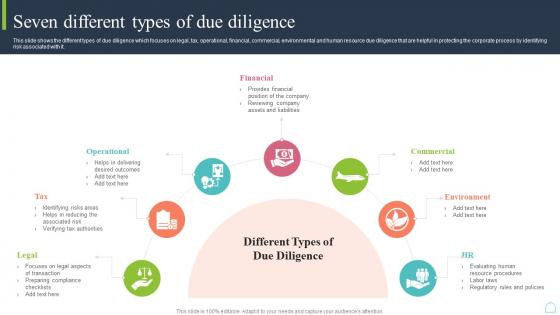
This slide shows the different types of due diligence which focuses on legal, tax, operational, financial, commercial, environmental and human resource due diligence that are helpful in protecting the corporate process by identifying risk associated with it.
People who downloaded this PowerPoint presentation also viewed the following :
Seven Different Types Of Due Diligence with all 6 slides:
Use our Seven Different Types Of Due Diligence to effectively help you save your valuable time. They are readymade to fit into any presentation structure.





FAQs for Seven Different Types
A comprehensive due diligence process includes financial analysis, legal review, operational assessment, market evaluation, and risk analysis. These components work together by examining financial records, contracts, and compliance issues, evaluating business operations and competitive positioning, while assessing potential liabilities, ultimately delivering informed investment decisions and strategic insights for stakeholders.
M&A due diligence involves comprehensive operational, cultural, and synergy assessments across extended timeframes, while other investment scenarios typically focus on financial performance, market positioning, and growth potential within shorter evaluation periods. M&A transactions require deeper integration planning, regulatory compliance reviews, and cultural compatibility analysis, ultimately delivering strategic combinations that enhance market presence and operational efficiency.
Due diligence serves as a critical risk management foundation by identifying potential financial, operational, legal, and reputational threats before they impact business decisions. Through comprehensive analysis of financial records, market conditions, and regulatory compliance, organizations can minimize investment risks, avoid costly partnerships, and make informed strategic choices, ultimately protecting stakeholder interests while enhancing competitive positioning.
Technology streamlines due diligence through AI-powered document analysis, automated data extraction, cloud-based collaboration platforms, and predictive analytics tools. These solutions significantly reduce manual review time, enhance accuracy in risk assessment, and enable real-time stakeholder collaboration, with investment firms and M&A teams finding faster deal closure and improved decision-making capabilities.
Common due diligence pitfalls include insufficient financial analysis, inadequate legal review, overlooking cultural fit, rushing timelines, and failing to verify key assumptions. These oversights can lead to post-acquisition integration challenges, with many organizations finding that thorough stakeholder interviews, comprehensive risk assessment, and detailed operational analysis ultimately deliver better investment outcomes and strategic alignment.
Assessing financial health during due diligence involves analyzing financial statements, cash flow patterns, debt-to-equity ratios, revenue consistency, and profitability trends over multiple years. Through comprehensive financial audits, investors examine operational efficiency, working capital management, and potential liabilities, with many finding that combining quantitative analysis with market positioning assessments delivers the most accurate risk evaluation.
Legal due diligence significantly protects investors by identifying potential liabilities, regulatory compliance issues, pending litigation, and contractual obligations that could impact investment value. This comprehensive legal review enables investors to assess risks accurately, negotiate better terms, and make informed decisions, with many private equity firms and institutional investors finding that thorough legal analysis prevents costly surprises and enhances long-term returns.
Cultural due diligence significantly impacts cross-border M&A by identifying potential integration challenges, communication barriers, management style differences, and employee retention risks that could derail deal value. Through comprehensive cultural assessments, organizations can develop targeted integration strategies, minimize operational disruptions, and preserve key talent, with many multinational companies finding that proactive cultural planning ultimately delivers smoother transitions and higher success rates.
Operational due diligence metrics include revenue growth rates, profit margins, customer acquisition costs, employee turnover rates, and operational efficiency ratios. These assessments enable investors to evaluate management effectiveness, scalability potential, and competitive positioning, with many financial institutions finding that comprehensive operational analysis delivers deeper insights into long-term viability and strategic value creation opportunities.
Effective background checks involve verifying employment history, educational credentials, professional licenses, financial records, and legal proceedings through multiple sources. These comprehensive assessments enable organizations to identify potential risks, validate leadership capabilities, and ensure regulatory compliance, with many financial institutions and healthcare organizations finding that thorough personnel vetting ultimately delivers enhanced operational security and stakeholder confidence.
**INPUT**: What are the ethical considerations involved in due diligence? **OUTPUT**: Ethical considerations in due diligence include data privacy protection, conflict of interest management, transparency in disclosure, respect for confidential information, and fair treatment of all stakeholders. These principles ensure organizations maintain integrity while conducting thorough assessments, with many financial institutions and investment firms finding that ethical frameworks ultimately enhance stakeholder trust and long-term competitive advantage. [Word count: 55 words]
Due diligence for startups emphasizes growth potential, market opportunity, and founder capabilities, while established companies require deeper financial audits, regulatory compliance reviews, and operational assessments. Startups often present limited financial history but stronger innovation prospects, whereas mature businesses offer proven revenue streams and established customer bases, with many investors finding that startup evaluations focus more on future scalability than current profitability.
Industry-specific due diligence resources include trade association publications, regulatory compliance databases, sector-focused research firms, professional services directories, and specialized legal frameworks. These resources enhance due diligence accuracy by providing regulatory insights, market benchmarks, and risk assessment protocols, with organizations across healthcare, financial services, and manufacturing finding that targeted industry knowledge streamlines transactions and minimizes oversight risks.
Financial modeling aids due diligence by validating business assumptions, projecting future cash flows, assessing valuation accuracy, and identifying potential risks through scenario analysis. These comprehensive models enable investors and acquirers to evaluate target companies' financial health, optimize deal structures, and make informed investment decisions, ultimately reducing uncertainty while maximizing strategic value in transactions.
Best practices for stakeholder-inclusive due diligence include comprehensive stakeholder mapping, multi-perspective assessment teams, transparent communication protocols, and structured feedback mechanisms throughout the process. This approach enables organizations to identify potential conflicts early, balance competing interests effectively, and build consensus among investors, management, employees, and regulatory bodies, ultimately delivering smoother transactions and stronger post-deal integration outcomes.
-
Extremely professional slides with attractive designs. I especially appreciate how easily they can be modified and come in different colors, shapes, and sizes!
-
These stunning templates can help you create a presentation like a pro.