

Shipping And Logistics Powerpoint Presentation Slides




Try Before you Buy Download Free Sample Product
 Impress Your
 Audience
 100%
100% Editable
 Save Hours
 of Time


Shipping and Logistics PowerPoint presentation covers a logistics companys introduction with its designs, controls, and details on supply chain management. Grab our efficiently designed Shipping and Logistics template. This PPT also includes logistics company operations during supply procurement, storage, transportation, order fulfillment, and distribution, depending on the commercial agreement between the parties involved. This presentation also covers the various reasons for poorly integrated shipping and logistics management in the company and identifies the need for an effective logistics management system. Furthermore, it includes an automated solution to overcome the gap between business and technology. Lastly, this PPT aims to provide details on cost-efficient, streamlined, and error-free solutions through automating the processes and using secured software to perform the different tasks. Customize this 100 percent editable template based on your specific business needs.
People who downloaded this PowerPoint presentation also viewed the following :
Content of this Powerpoint Presentation
Slide 1: This slide displays the title SHIPPING & LOGISTICS.
Slide 2: This slide displays the Agenda for Shipping and Logistics.
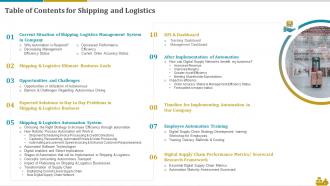
Slide 3: This slide exhibit table of content.
Slide 4: This slide exhibit table of content- Current Situation of Shipping Logistics Management System in Company.
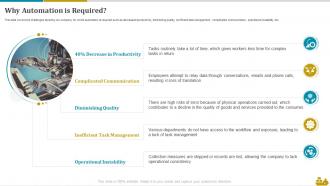
Slide 5: This slide covers the challenges faced by our company for which automation is required.
Slide 6: This slide covers the current shipping and logistics management efficiency status in the company in terms of efficient and inefficient percentages.
Slide 7: This slide covers the reasons why company wants to implement automation in business.
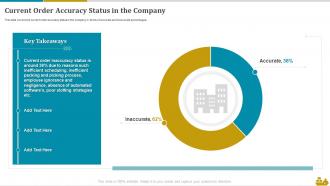
Slide 8: This slide covers the current order accuracy status in the company in terms of accurate and inaccurate percentages.
Slide 9: This slide exhibit table of content for other topics discussed in further slide.
Slide 10: This slide covers the ultimate business goals for shipping and logistic business.
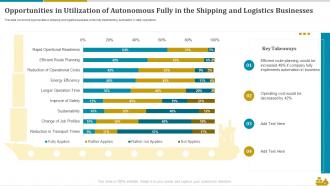
Slide 11: This slide covers the opportunities in the shipping and logistics business while fully implementing automation in daily operations.
Slide 12: This slide covers the barriers and challenges that will occur while implementing automation in logistics and shipping business.
Slide 13: This slide covers the expected solutions to daily problems of the shipping and logistics businesses.
Slide 14: This slide exhibit table of content- Shipping and Logistics Automation System.
Slide 15: This slide covers the strategies that can be used by the company in order to implement automation in business processes to increase efficiency.
Slide 16: This slide covers the working strategy of robotic process automation in shipment scheduling and tracking, invoice processing and credit collections.
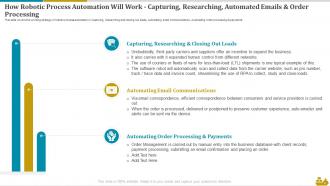
Slide 17: This slide covers the working strategy of robotic process automation in Capturing, researching and closing out loads etc.
Slide 18: This slide covers the working strategy of robotic process automation in automating procurement and inventory processes.
Slide 19: This slide exhibit table of content- Shipping and Logistics Automation System.
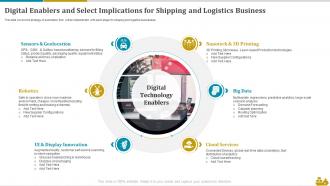
Slide 20: This slide covers various automated software technologies that can be used by the company to enhance its logistics management efficiency.
Slide 21: This slide covers the strategy of automation that will be implemented with each stage for shipping and logistics businesses.
Slide 22: This slide covers the strategy of automation that will be implemented with each stage for shipping and logistics businesses.
Slide 23: This slide covers the concepts of automation which concerns the autonomous transports for shipping and logistics industry.
Slide 24: This slide covers the effect of platooning approaches.
Slide 25: This slide exhibit table of content- Transformation of Supply Chain.
Slide 26: This slide covers the linear supply chain structure which is needed to be transformed In new digital supply network.
Slide 27: This slide covers the new and transformed supply chain network from the traditional liner supply chain.
Slide 28: This slide exhibit table of content for other topics discussed in further slide.
Slide 29: This slide covers the digital supply chain performance metrics.
Slide 30: This slide covers the assessment maturity matrix based on how company will manage supply chain risks.
Slide 31: This slide exhibit table of content for other topics discussed in further slide.
Slide 32: This slide covers the material for the training of the employees to get them understand the use of automation technology and how it will help business grow.
Slide 33: This slide covers the training delivery methods for the certificate courses of business process automation.
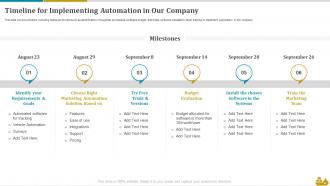
Slide 34: This slide covers a Timeline for Implementing Automation in Our Company.
Slide 35: This slide exhibit table of content- After Implementation of Automation.
Slide 36: This slide covers the digital supply chain working through different physical and digital channels.
Slide 37: This slide covers the reasons for the increase revenue in business through digital supply chain.
Slide 38: This slide covers the reasons for the improved margins in business through digital supply chain.
Slide 39: This slide covers the reasons for the improved asset efficiency in business through digital supply chain.
Slide 40: This slide covers the reasons for Meeting Shareholder Expectations through digital supply chain.
Slide 41: This slide exhibit table of content- Impact on Efficiency.
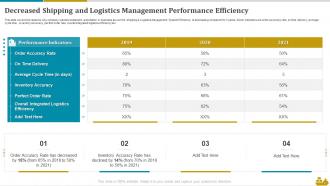
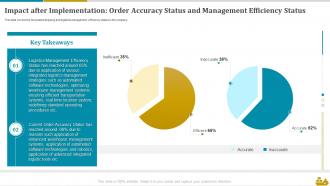
Slide 42: This slide covers the forecasted shipping and logistics management efficiency status in the company.
Slide 43: This slide covers the forecasted Logistics Management System Efficiency in terms of order accuracy rate, delivery time, inventory accuracy, order rating etc.
Slide 44: This slide exhibit table of content- KPI & Dashboard.
Slide 45: This slide covers Key performance indicators to track the automation system of the company.
Slide 46: This slide covers KPI’s to track the automation system of the company including warehouse operating costs, perfect order cost, on-time shipment etc.
Slide 47: This is the icons slide.
Slide 48: This slide presents title for additional slides.
Slide 49: This slide shows about your company, target audience and its client's values.
Slide 50: This slide displays Venn.
Slide 51: This slide depicts 30-60-90 days plan for projects.
Slide 52: This slide displays yearly stacked bar graph for different products.
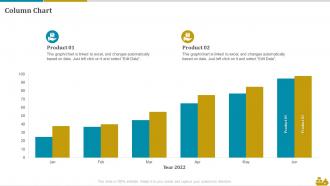
Slide 53: This slide displays column chart for different products.
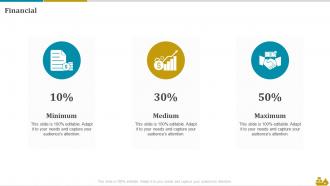
Slide 54: This slide showcases financials of company.
Slide 55: This slide showcases Comparison of male & female user.
Slide 56: This slide exhibit Timeline.
Slide 57: This is thank you slide & contains contact details of company like office address, phone no., etc.
Shipping And Logistics Powerpoint Presentation Slides with all 62 slides:
Use our Shipping And Logistics Powerpoint Presentation Slides to effectively help you save your valuable time. They are readymade to fit into any presentation structure.
























FAQs for Shipping And Logistics
Dude, automation and AI are everywhere now - warehouse bots, route optimization, all that stuff. Real-time tracking became essential after COVID showed how messed up supply chains could get. Electric vehicles and better packaging are big because everyone's obsessing over carbon footprints (which honestly, good for them). Blockchain's actually useful now too, not just crypto nonsense - helps with transparency and tracking shipments. Your customers will want this tech in 2-3 years max, so you'd better start paying attention to it now.
Dude, start by getting quotes from like 3-4 different carriers - most people just auto-renew with FedEx or whoever and never shop around. Batch your shipments when you can, use regional carriers for nearby stuff (they're usually way cheaper). Your packaging probably sucks too - those dimensional weight fees will kill you. Oh and definitely get some route planning software, saves a ton. I'd throw in some discount for customers who pick standard shipping instead of overnight. Track everything obsessively though. Seriously, just audit what you're spending now and you'll find obvious money drains.
Honestly, start with IoT sensors and GPS tracking - they're game changers. You can watch your stuff move from supplier to customer in real time, which is pretty wild when you think about it. Cloud platforms connect all your partners so everyone's looking at the same data instead of that spreadsheet nightmare we've all been through. The best part? You'll catch bottlenecks before they blow up into actual problems. I'd focus on your biggest headaches first - maybe that one supplier who's always late or whatever. You'll notice the difference right away when alerts start telling you something's going sideways.
Big data can totally transform your logistics game - route optimization, demand forecasting, spotting bottlenecks early. Track fuel usage, delivery times, all that stuff. Then algorithms find patterns you'd miss completely. Fleet predictive maintenance and dynamic pricing usually give the best returns, honestly those are where I'd put my money first. The sheer volume of data in logistics is pretty crazy when you step back and look at it. My advice? Pick one area to start with instead of going all-in everywhere. You'll actually see results that way instead of drowning in data overload.
So shipping's biggest problems are CO2 emissions, air pollution, and ocean contamination from fuel spills. Maritime shipping hits about 3% of global greenhouse gas emissions - honestly not as terrible as I expected, but still pretty significant given how much stuff gets moved around. Your best bets are consolidating shipments and picking carriers with newer, fuel-efficient ships. Slower shipping helps too since speed just guzzles fuel like crazy. Some companies are trying biofuels or even electric vessels for shorter routes, which is cool. I'd start by looking at your current shipping patterns first, then bug your carriers about what they're actually doing sustainability-wise.
Dude, international shipping regulations are such a pain but they'll totally mess up your shipments if you ignore them. Each country has its own customs rules and banned items lists - like Japan's super picky about electronics while some places don't really care. EU rules are completely different from what you'd deal with in South America too. Brazil's customs can be a nightmare honestly. I learned this the hard way once! Check the specific import rules for wherever you're sending stuff. If it gets complicated, just use a freight forwarder who actually knows what they're doing.
You've gotta stay super tight with your suppliers - like, know their lead times and demand patterns in real-time. Set automated reorder points based on what you're actually using, not some forecast that's probably wrong anyway. Keep safety stock low but smart for the stuff that really matters. Honestly? It's nerve-wracking at first since there's zero room for screwups. Have backup suppliers ready and build solid relationships with your main ones. Oh, and get decent inventory software that alerts you before things get critical - trying to track this manually is asking for trouble.
Dude, automation is honestly a game changer for warehouses. Your processing times get slashed because robots handle picking and sorting way faster than people can. Fewer mistakes too - machines don't zone out during their shift like we do lol. The 24/7 thing is pretty crazy when you think about it. Those automated vehicles that move inventory around are slick, and AI systems can actually predict what you'll need before you run out. I'd say figure out where you're getting bottlenecked first, then see which solutions would pay for themselves quickest.
Oh man, logistics are such a pain for small businesses. Shipping costs kill you because you can't get those bulk discounts the big guys have. Your warehouse space is probably tiny, delivery times are all over the place, and honestly? Managing supply chains when you're already stretched thin is just... ugh. Most small business owners don't even have logistics people - you're doing shipping between answering emails and whatever else. The worst part is paying for shipping upfront before customers pay you. Definitely shop around different carriers though, and maybe look into fulfillment services if you're doing decent volume.
Start by spreading your suppliers around - don't put everything in one country or region. Most companies have no clue where their stuff actually comes from, so map that out first. Yeah, you'll need buffer inventory for critical items (your CFO won't love the extra costs). Multiple shipping routes help too. The paranoid companies did way better during COVID, honestly. They already had backup plans ready. Get regular check-ins going with key suppliers and keep those emergency contracts handy. Oh, and partner with different logistics providers so you're not screwed if one goes down.
Dude, e-commerce totally flipped shipping on its head. Instead of sending huge bulk orders to stores, now you're dealing with thousands of tiny packages going to random houses - which is honestly way harder than it sounds. Everyone wants their stuff tomorrow (or yesterday), so companies had to build warehouses closer to cities. The whole last-mile thing to people's doorsteps? Complete headache compared to just dropping pallets at a warehouse. Plus returns went crazy since people buy three sizes online and send two back. If you're in logistics now, forget the old slow-and-cheap approach - it's all about being fast and flexible.
Dude, it's wild how Amazon basically rewired everyone's brain about shipping. Two-day delivery went from "wow, fancy!" to bare minimum expectations overnight. Now customers want live tracking, flexible delivery times, hassle-free returns - the whole nine yards. They'll bail on you in a heartbeat if you can't keep up. Companies had to totally rebuild their logistics networks and throw money at automation just to stay relevant. Here's the kicker though: you can't just compete with similar businesses anymore. Your customers are comparing you to whoever does it best, period. So benchmark against the top dogs, not just your industry neighbors.
Honestly, diversifying your delivery options is where you'll see the biggest wins. Local pickup points and parcel lockers work great - plus those flexible time slots customers actually want. Route optimization software will slash your fuel costs big time. I know Amazon set crazy expectations for everyone, but smart local partnerships can help you compete. Crowd-sourced delivery during busy periods? Game changer. Work with local couriers too. The real trick is letting customers pick when and where they get their stuff. Oh, and definitely survey your customers first about what delivery methods they'd actually use.
Dude, the money savings alone make it worth it - these companies have way better shipping deals than you'll ever get. They've already got the warehouses, tech, and relationships built up. No need to dump cash into all that infrastructure yourself. They handle the boring stuff too - inventory tracking, packing orders, dealing with returns (ugh). Peak season hits? They scale up. Slow month? They scale down. It's pretty sweet actually. Look, unless you're planning to become a logistics company, why not let someone else deal with that mess while you focus on your actual business?
Start with system integration - get your TMS, WMS, and carrier platforms talking to each other automatically. GPS tracking is obvious at this point, but predictive analytics and exception alerts are where you'll see real value. IoT sensors are way cheaper now which is awesome for temp monitoring and stuff like that. Build your customers a portal or API so they can check their own shipments instead of bugging you constantly. Honestly, clean data is everything here. Get that sorted first, then focus on dashboards that actually help people decide things, not just look impressive.
-
I never had to worry about creating a business presentation from scratch. SlideTeam offered me professional, ready-made, and editable presentations that would have taken ages to design.
-
“Slides are formally built and the color theme is also very exciting. This went perfectly with my needs and saved a good amount of time.”