


Logistics And Supply Chain Automation System For Improving Delivery Operations Powerpoint Presentation Slides




Try Before you Buy Download Free Sample Product
 Impress Your
 Audience
 100%
100% Editable
 Save Hours
 of Time


Supply chain and logistics automation use digital technologies to improve efficiencies, connect applications and streamline processes within supply chain operations. Supply chain automation allows the company to shift human time and effort away from tedious, time-consuming procedures and toward jobs that especially demand a human touch. Check out our efficiently designed Logistics and Supply Chain Automation System for Improving Delivery Operations template that provides information about the companys overall supply chain challenges. Warehouse operating cost and time management challenges, and declining performance of the companys supply chain and logistics the PPT deck highlights supply chain optimization needs and trends, automation tools, and techniques for operation such as procurement, warehouse, back office, and transportation. This presentation covers a roadmap for implementing supply chain and logistics automation and a post-automation conceptual framework on logistics and supply chain management. Furthermore, the PowerPoint slides include the impact of automation on overall organization, supply chain and logistics performance, warehousing cost, and time spent order picking. Lastly, it provides KPI dashboards for tracking the automation of processes such as procurement, warehouse, supply chain, and transportation. Download it now.
People who downloaded this PowerPoint presentation also viewed the following :
Content of this Powerpoint Presentation
Slide 1: This slide introduces Logistics and Supply Chain Automation System for Improving Delivery Operations. State your company name and begin.
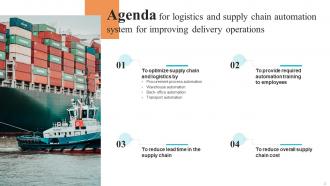
Slide 2: This slide states Agenda of the presentation.
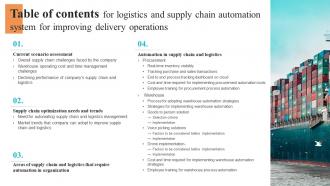
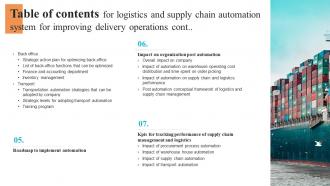
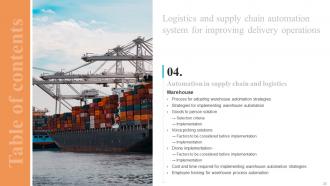
Slide 3: This slide shows Table of Content for the presentation.
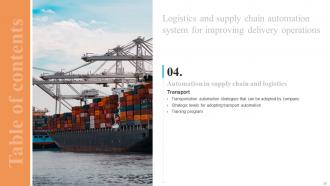
Slide 4: This is another slide continuing Table of Content for the presentation.
Slide 5: This slide depicts title for three topics that are to be covered next in the template.
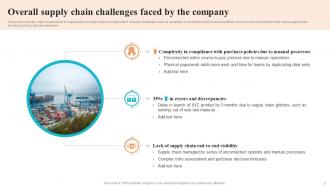
Slide 6: This slide covers the major issues faced by organization in supply chain management.
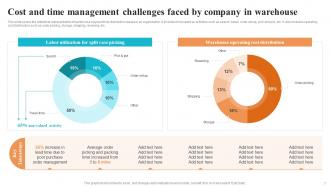
Slide 7: This slide covers the statistical representation of warehouse cost and time distribution issues in an organization.
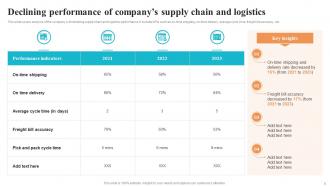
Slide 8: This slide covers analysis of the company’s diminishing supply chain and logistics performance.
Slide 9: This slide depicts title for two topics that are to be covered next in the template.
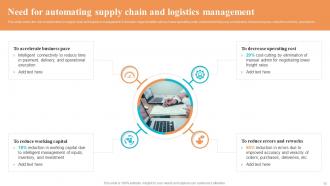
Slide 10: This slide covers the role of automation in supply chain and logistics management.
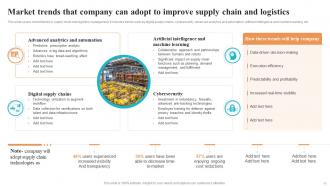
Slide 11: This slide covers recent trends in supply chain and logistics management.
Slide 12: This slide depicts title for the topic that are to be covered next in the template.
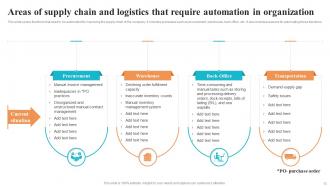
Slide 13: This slide covers functions that need to be automated for improving the supply chain of the company.
Slide 14: This slide depicts title for five topics that are to be covered next in the template.
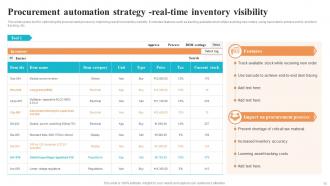
Slide 15: This slide covers tool for optimizing the procurement process by improving real-time inventory visibility.
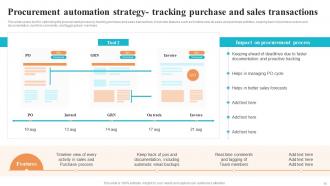
Slide 16: This slide covers tool for optimizing the procurement process by tracking purchase and sales transactions.
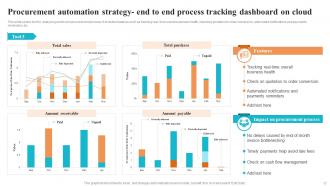
Slide 17: This slide covers tool for analysing end to end procurement process.
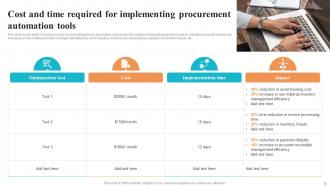
Slide 18: This slide covers table of various tools for procurement process automation.
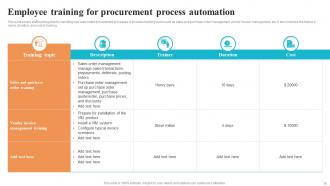
Slide 19: This slide covers staff training plan for handling new automated procurement processes.
Slide 20: This slide depicts title for twelve topics that are to be covered next in the template.
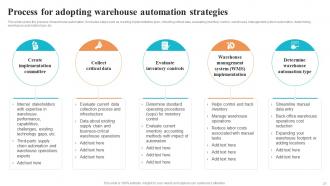
Slide 21: This slide covers the process of warehouse automation.
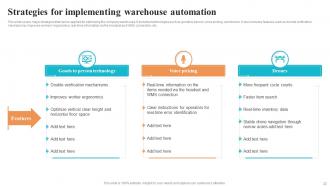
Slide 22: This slide covers major strategies that can be applied for optimizing the company warehouse.
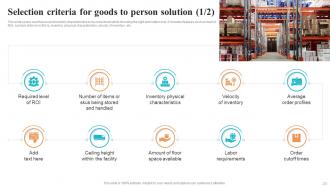
Slide 23: This slide covers warehouse and inventory characteristics to be considered while choosing the right automation tool.
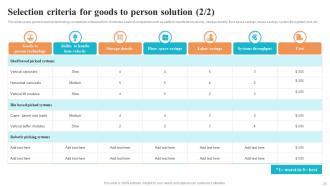
Slide 24: This slide covers goods to person technology comparison in tabular form.
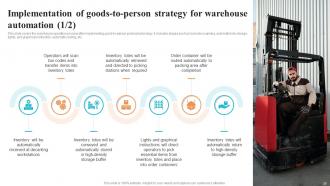
Slide 25: This slide covers the warehouse operation process after implementing good-to-person picking technology.
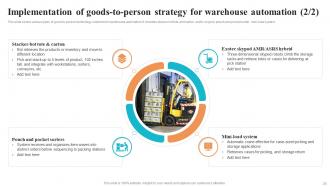
Slide 26: This slide covers various types of good-to-person technology solutions for warehouse automation.
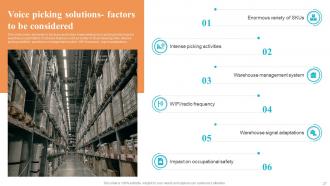
Slide 27: This slide covers elements to be assessed before implementing voice picking technology for warehouse automation.
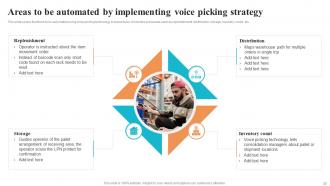
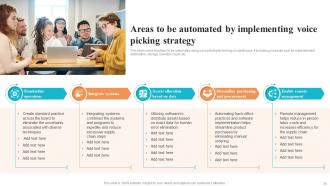
Slide 28: This slide covers functions to be automated using voice picking technology in warehouse.
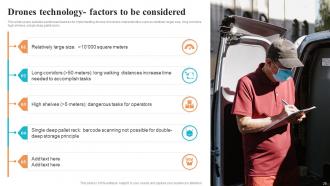
Slide 29: This slide covers suitable warehouse features for implementing drones.
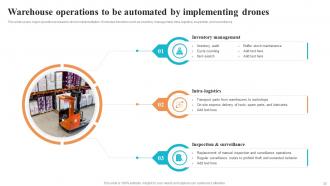
Slide 30: This slide covers major operational areas for drone implementation.
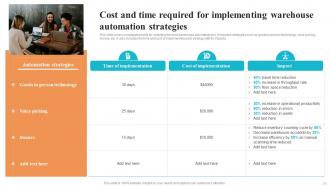
Slide 31: This slide covers comparative table for selecting the best warehouse automation tool.
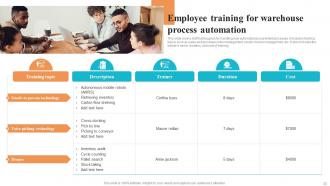
Slide 32: This slide covers staff training plan for handling new automated procurement processes.
Slide 33: This slide depicts title for five topics that are to be covered next in the template.
Slide 34: This slide covers key initiatives for implementing back-office automation.
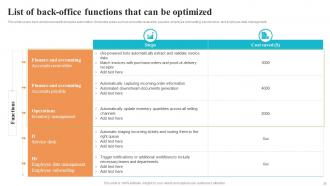
Slide 35: This slide covers back-end processes that require automation.
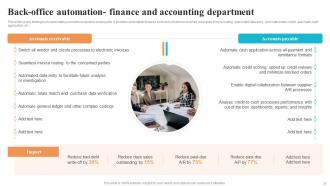
Slide 36: This slide covers strategies for automating accounts receivable and payable.
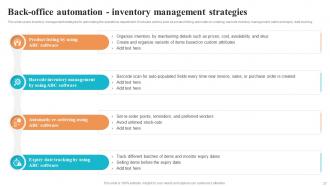
Slide 37: This slide covers inventory management strategies for automating the operations department.
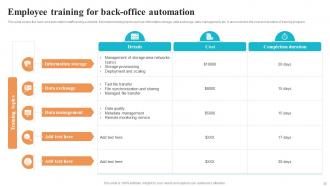
Slide 38: This slide covers the back-end automation staff training schedule.
Slide 39: This slide depicts title for three topics that are to be covered next in the template.
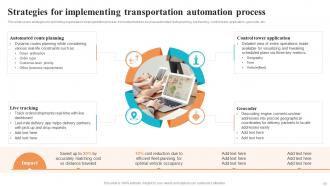
Slide 40: This slide covers strategies for optimizing organization’s transportation process.
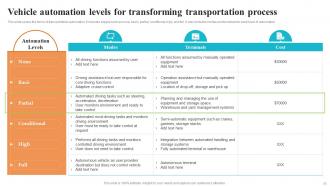
Slide 41: This slide covers the forms of transportation automation.
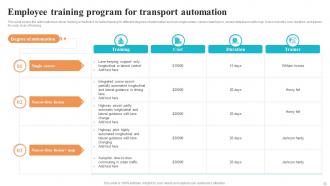
Slide 42: This slide covers the automatic truck driver training schedule.
Slide 43: This slide depicts title for topics that are to be covered next in the template.
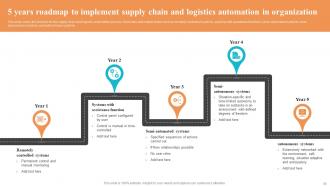
Slide 44: This slide covers the timeline for the supply chain and logistics automation process.
Slide 45: This slide depicts title for four topics that are to be covered next in the template.
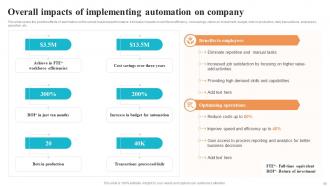
Slide 46: This slide covers the positive effects of automation on the overall business performance.
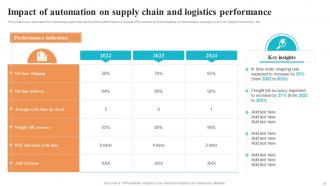
Slide 47: This slide covers estimation for improving supply chain and logistics performance.
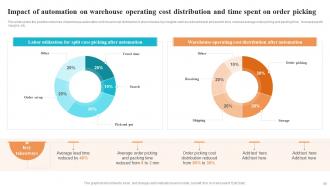
Slide 48: This slide covers the positive outcomes of warehouse automation on time and cost distribution.
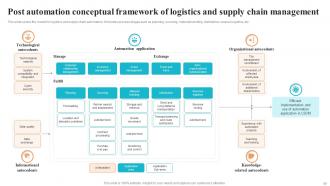
Slide 49: This slide covers the model for logistics and supply chain automation.
Slide 50: This slide depicts title for four topics that are to be covered next in the template.
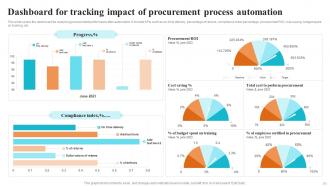
Slide 51: This slide covers the dashboard for analysing procurement performance after automation.
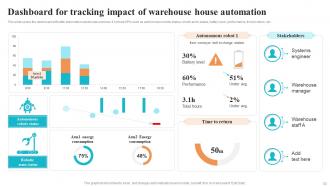
Slide 52: This slide covers the dashboard with after automation warehouse overview.
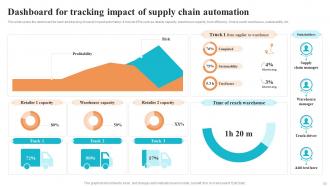
Slide 53: This slide covers the dashboard for back-end tracking of overall impact automation.
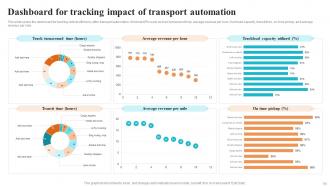
Slide 54: This slide covers the dashboard for tracking vehicle efficiency after transport automation.
Slide 55: This slide contains all the icons used in this presentation.
Slide 56: This slide is titled as Additional Slides for moving forward.
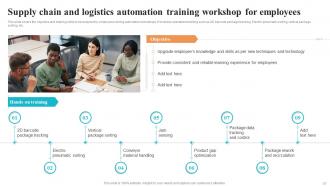
Slide 57: This slide covers the objective and training skills to be acquired by employees during automation workshops.
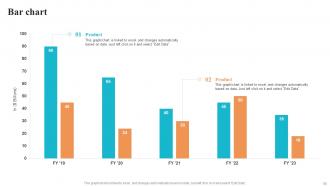
Slide 58: This slide presents Bar chart with two products comparison.
Slide 59: This is an Idea Generation slide to state a new idea or highlight information, specifications etc.
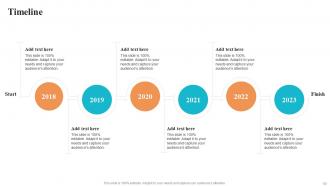
Slide 60: This is a Timeline slide. Show data related to time intervals here.
Slide 61: This slide contains Puzzle with related icons and text.
Slide 62: This slide shows Post It Notes. Post your important notes here.
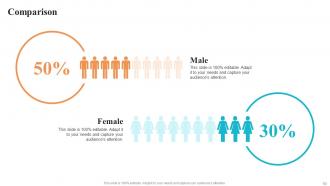
Slide 63: This is a Comparison slide to state comparison between commodities, entities etc.
Slide 64: This slide depicts Venn diagram with text boxes.
Slide 65: This is Our Goal slide. State your firm's goals here.
Slide 66: This is a Thank You slide with address, contact numbers and email address.
Logistics And Supply Chain Automation System For Improving Delivery Operations Powerpoint Presentation Slides with all 71 slides:
Use our Logistics And Supply Chain Automation System For Improving Delivery Operations Powerpoint Presentation Slides to effectively help you save your valuable time. They are readymade to fit into any presentation structure.









FAQs for Logistics And Supply Chain Automation System For Improving Delivery Operations
You're seeing AI/ML everywhere for demand forecasting and route optimization - that stuff actually works now. Robotics handles warehouse picking, IoT sensors track everything in real-time. Computer vision is pretty wild too, basically machines spotting inventory issues better than humans sometimes. Cloud platforms connect it all, which honestly should've happened years ago. The magic happens when they work together - AI decides what to grab, robots do the grabbing, IoT confirms it's done. My advice? Figure out your biggest headache first, then see what tech actually fixes that specific problem. Don't get distracted by shiny features.
Dude, automation basically eliminates all those manual headaches that slow everything down. Real-time inventory tracking, automatic order processing, predictive stuff that catches problems early - it's honestly game-changing. The warehouse robots are pretty wild too, way faster than people at picking orders. Everything connects from suppliers straight to customers without the usual hiccups. Though honestly? Don't go crazy right away. Pick something annoying like order tracking first, get that working smoothly, then expand from there. Going full warehouse robot mode immediately is just asking for trouble.
Dude, warehouse automation is pretty crazy these days. AI handles all the brain work - figuring out the best picking routes, predicting what inventory you'll need, managing workflows in real-time. Robots do the muscle work: moving pallets, sorting packages, packing orders. They work together super well now. The AI basically tells robots where to go and what's priority, then robots execute 24/7 without needing coffee breaks or calling in sick (lucky them, right?). My advice? Start by finding your most repetitive, time-sucking tasks first. That's where you'll see the biggest impact.
Yeah so the upfront costs are brutal - we're talking tens of thousands to millions depending how big you go. Software, hardware, integration, training... it all piles up quick. Most companies hit ROI in like 18-24 months though from cutting labor costs and fewer screw-ups. Oh and you'll spend about 15-20% of that initial cost each year on maintenance and updates, which honestly isn't too bad. I'd definitely test it out on one section first before dropping serious cash on the whole operation.
Yeah, automation's definitely changing things but it's not just "robots steal all jobs" like everyone thinks. Sure, basic warehouse stuff - sorting, simple picking - that's getting automated and hurting entry-level work. But honestly? New jobs are popping up too. Maintenance, programming, monitoring systems. They usually pay better than what they're replacing. The real problem is most workers don't have the right skills yet for these roles. Companies doing this right are retraining their current people instead of just hiring from outside. If I were you, I'd look into upskilling programs now rather than waiting.
Amazon's the obvious one with their warehouse tech. Honeywell and Siemens do the full automation thing. For scanning stuff, Zebra Technologies basically owns that market. Locus Robotics and 6 River Systems are killing it with those warehouse robots - honestly pretty cool to watch those things work. SAP and Manhattan Associates handle the software side for warehouse management. The whole industry moves crazy fast though. I'd figure out if you need hardware or software first, then just match it to what you're actually trying to do and how much you want to spend.
Track both the obvious stuff (labor costs, inventory, shipping) and the sneaky efficiency gains too. Things like faster processing times and fewer errors add up quick. Customer satisfaction is harder to measure but honestly pays off big time. Set your baseline numbers before you start, then check quarterly for like 18 months minimum. Dashboard showing savings vs. investment makes the boss happy - you'll need that for round two. Oh, and don't forget space utilization metrics. Sounds boring but it's actually where we saw some of our biggest wins.
Honestly, the money upfront is brutal - that's usually what hits first. Your team will probably hate the change initially, which is totally normal but still a pain to deal with. Legacy systems? They're absolute hell to work with. I watched one company battle integration issues for like 6 months straight. Training takes forever too since everything works differently. Oh, and vendors will swear their tech is perfect for you, but picking what actually fits is way harder than they admit. Start super small though - pick one area, show it works, then slowly expand from there.
Look, automation gives you real-time tracking that you just can't get doing everything by hand. Your stock levels update automatically, and the system actually predicts when you'll run low on stuff that sells fast. Set up reorder rules and it handles restocking for you. No more counting mistakes or forgetting to update those damn spreadsheets either. Barcode scanners and RFID keep everything current, so you'll catch problems way earlier. Honestly, the trend analysis alone is worth it. Start with receiving and cycle counting - that's where most people screw up anyway.
Honestly, automation is a game-changer for keeping customers happy. Real-time tracking alone makes such a difference - people just want to know where their stuff is, you know? Your order processing gets way smoother, so fewer delays and angry emails. Smart routing cuts delivery times down, and inventory management means you won't oversell things (which is always embarrassing). The coolest part? You can actually catch problems before customers even complain about them. I'd start with whatever process causes you the most headaches right now - that's where you'll see results fastest.
Honestly, just tackle the small annoying stuff first. Don't go crazy trying to automate everything - learned that lesson the hard way when we basically broke our entire workflow for two weeks lol. Map out what you're actually doing now before you change anything. Pick something super repetitive and boring to test on first. Your team needs to know what's happening or they'll hate it. Make sure your systems can actually talk to each other too, otherwise you're just moving the mess around. Roll it out slow with tons of testing. Prove one thing works, then build from there. Way less stressful.
Dude, real-time data is basically taking over logistics right now. Everyone wants instant updates on shipments and inventory because customers are so impatient these days - honestly can't blame them though. Companies are going crazy with IoT sensors and AI tracking to catch problems before they blow up. The speed everything has to update at is kinda nuts! All the new automation tools focus on processing huge data streams instantly. Split-second routing decisions are the norm now. You'll definitely want automation with real-time dashboards and instant alerts - trust me on that one.
Honestly, start with network segmentation - keep your automated stuff separate from your regular IT network. Those IoT devices? Change the default passwords right away, they're usually garbage like "admin123." Set up strong authentication and encryption for everything talking to each other. You'll need constant monitoring too because weird network traffic is usually the first sign something's wrong. Oh, and don't forget backup systems - when automation fails, it fails spectacularly and you're screwed without a fallback. I'd run a security audit first though to see what's actually vulnerable.
Pick one thing that's driving you crazy first - like tracking inventory or processing orders. Don't try to fix everything at once (trust me on this one). Cloud tools like ShipStation or Fishbowl work great for smaller companies since you're not dropping crazy money upfront. Honestly, most places I know save like 10+ hours a week just from automating shipping labels alone. Get that one process working smoothly, then you can tackle other stuff. Way less overwhelming that way.
Honestly, the AI stuff is getting crazy good at predicting demand and figuring out the best routes. Drones and self-driving delivery vehicles are actually happening now - not just those pilot programs everyone talks about. Regulations are still a pain though. What's really wild is how everything's becoming hyper-personalized. Your whole supply chain can adjust on the fly based on what individual customers want. Edge computing is making warehouse decisions happen instantly too. I'd probably start by looking at whatever manual stuff you're doing and see where predictive analytics makes sense first.
-
Love the template collection they have! I have prepared for my meetings much faster without worrying about designing a whole presentation from scratch.
-
The design is very attractive, informative, and eye-catching, with bold colors that stand out against all the basic presentation templates.