


Logistics And Supply Chain Management Powerpoint Presentation Slides




Try Before you Buy Download Free Sample Product
 Impress Your
 Audience
 100%
100% Editable
 Save Hours
 of Time


A logistics strategy is a set of principles essential for supply chain coordination. Grab our Logistics and supply chain management template. It allows you to increase efficiency in the supply chain while enhancing the supply chain management process. Our Logistics management system deck helps to analyze the implementation of a logistic strategy to improve the operational and financial performance of the company. Additionally, it exhibits the current trends in logistics management, including automation and various strategies like warehousing strategy, strategic logistics planning, etc. Further, our Inventory management PPT incorporates a workflow chart, roles, and responsibilities of the HR manager and team. The module also contains cost analysis and comparative software assessment for enhancing overall performance. Lastly, it provides KPI dashboards and impact analysis for measuring the effectiveness of social media strategies. Get access to our powerful supply chain management ppt templates now.
People who downloaded this PowerPoint presentation also viewed the following :
Content of this Powerpoint Presentation
Slide 1: This slide introduces Logistics & supply chain management. Commence by stating Your company name.
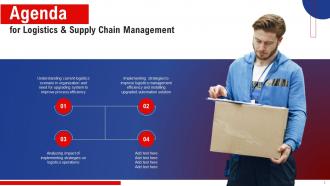
Slide 2: This slide depicts the Agenda of the presentation.
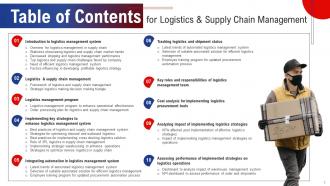
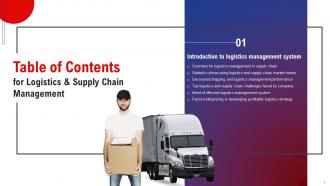
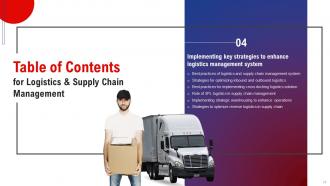
Slide 3: This slide incorporates the Table of Contents.
Slide 4: This slide highlights the Title for the Topics to be further discussed.
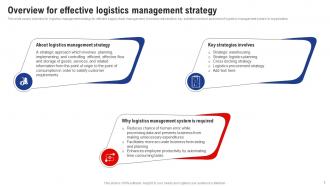
Slide 5: This slide covers the overview for logistics management strategy for efficient supply chain management.
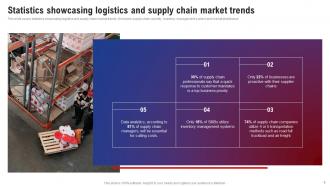
Slide 6: This slide highlights the Statistics showcasing logistics and supply chain market trends.
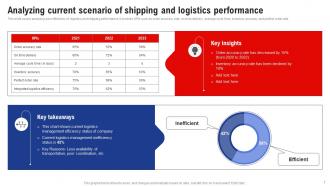
Slide 7: This slide deals with Analyzing current scenario of shipping and logistics performance.
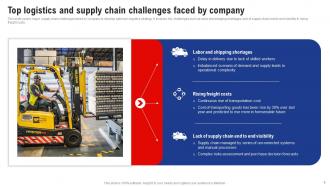
Slide 8: This slide talks about the Top logistics and supply chain challenges faced by company.
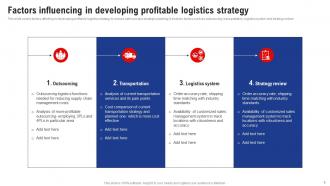
Slide 9: This slide states the Factors influencing in developing profitable logistics strategy.
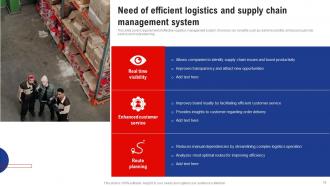
Slide 10: This slide presents the Need of efficient logistics and supply chain management system.
Slide 11: This slide portrays the Heading for the Components to be discussed next.
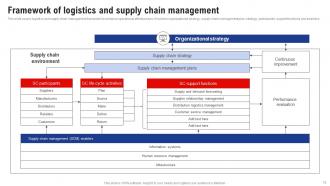
Slide 12: This slide showcases the Framework of logistics and supply chain management.
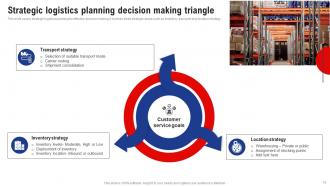
Slide 13: This slide covers strategic logistics planning for effective decision making.
Slide 14: This slide elucidates the Title for the Ideas to be further discussed.
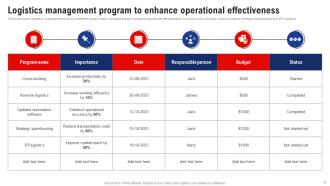
Slide 15: This slide talks about the Logistics management program to enhance operational effectiveness.
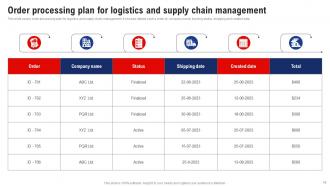
Slide 16: This slide focuses on Order processing plan for logistics and supply chain management.
Slide 17: This slide depicts the Heading for the Ideas to be covered in the forth-coming template.
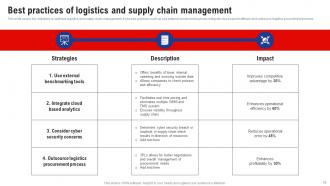
Slide 18: This slide reveals the Best practices of logistics and supply chain management.
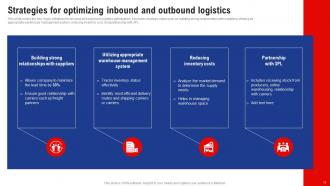
Slide 19: This slide incorporates the four major initiatives for inbound and outbound logistics optimization.
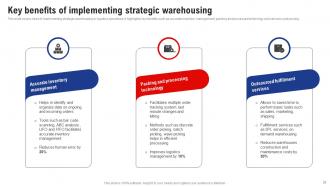
Slide 20: This slide states the Key benefits of implementing strategic warehousing.
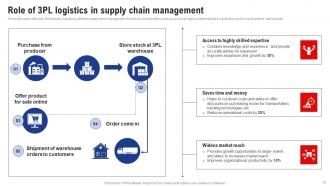
Slide 21: This slide mentions about the Role of 3PL logistics in supply chain management.
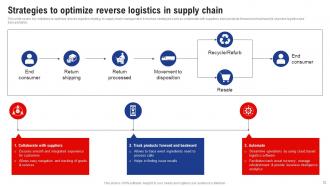
Slide 22: This slide covers key initiatives to optimize reverse logistics strategy in supply chain management.
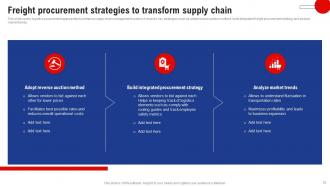
Slide 23: This slide indicates the Freight procurement strategies to transform supply chain.
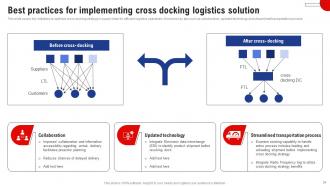
Slide 24: This slide highlights the Best practices for implementing cross docking logistics solution.
Slide 25: This slide showcases the Title for the Components to be further discussed.
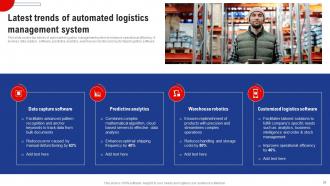
Slide 26: This slide talks about the Latest trends of automated logistics management system.
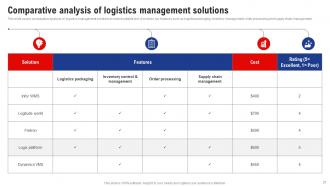
Slide 27: This slide elucidates the Comparative analysis of logistics management solutions.
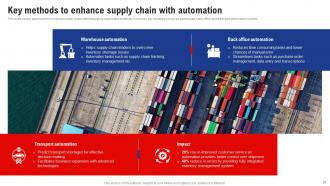
Slide 28: This slide represents the Key methods to enhance supply chain with automation.
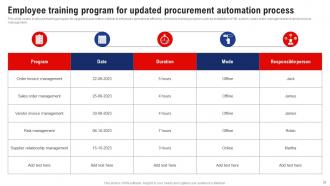
Slide 29: This slide depicts the Employee training program for updated procurement automation process.
Slide 30: This slide indicates the Heading for the Topics to be discussed in the forth-coming template.
Slide 31: This slide covers logistics and inventory sheet for supply chain management for goods and materials management.
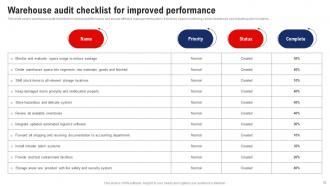
Slide 32: This slide deals with the Warehouse audit checklist for improved performance.
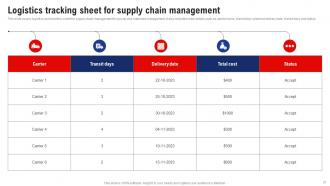
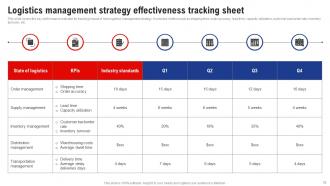
Slide 33: This slide emphasizes on the Logistics management strategy effectiveness tracking sheet.
Slide 34: This slide displays the Title for the Ideas to be discussed further.
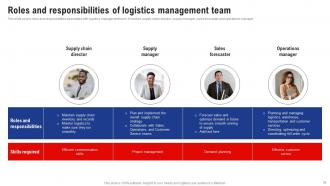
Slide 35: This slide portrays the Roles and responsibilities of logistics management team.
Slide 36: This slide shows the Heading for the Ideas to be covered in the next template.
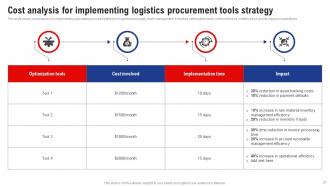
Slide 37: This slide talks about the Cost analysis for implementing logistics procurement tools strategy.
Slide 38: This slide exhibits the Title for the Contents to be discussed further.
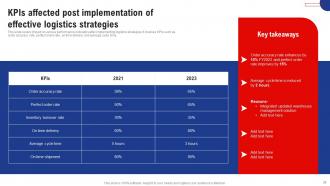
Slide 39: This slide mentions the KPIs affected post implementation of effective logistics strategies.
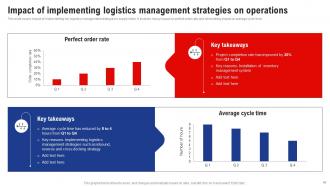
Slide 40: This slide covers impact of implementing key logistics management strategies in supply chain.
Slide 41: This slide elucidates the Heading for the Topics to be covered in the forth-coming template.
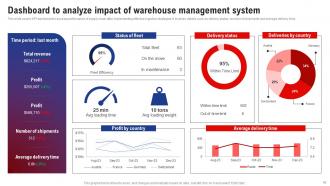
Slide 42: This slide illustrates the Dashboard to analyze impact of warehouse management system.
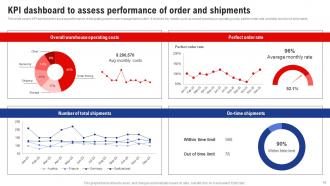
Slide 43: This slide reveals the KPI dashboard to assess performance of order and shipments.
Slide 44: This is the Icons slide containing all the Icons used in the plan.
Slide 45: This slide is used for depicting Additional information.
Slide 46: This is the 30 60 90 days plan slide for effective planning.
Slide 47: This is Our team slide for stating the team-related information.
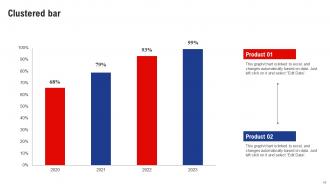
Slide 48: This slide shows he Clustered bar.
Slide 49: This is the Puzzle slide with related imagery.
Slide 50: This slide presents the Company Roadmap.
Slide 51: This is the Venn diagram slide.
Slide 52: This slide contains the Post it notes for reminders and deadlines.
Slide 53: This slide illustrates the Organization's Timeline.
Slide 54: This is Our goal slide. State your firm's goals here.
Slide 55: This is the Thank You slide for acknowledgement.
Logistics And Supply Chain Management Powerpoint Presentation Slides with all 62 slides:
Use our Logistics And Supply Chain Management Powerpoint Presentation Slides to effectively help you save your valuable time. They are readymade to fit into any presentation structure.














FAQs for Logistics And Supply Chain Management
So you need four main things: demand forecasting, inventory management, supplier relationships, and distribution networks. Most companies totally bomb the forecasting part first - like, they just guess basically. But get that right and everything else clicks into place way easier. Transportation management and warehouses that can actually grow with you matter too. Oh and the tech side is massive since you need to see what's happening everywhere in real-time. I'd start by just mapping what you're doing now and finding your worst bottlenecks. That'll tell you where to focus.
So tech basically runs everything in logistics now. Real-time tracking, warehouse robots doing their thing, AI predicting what you'll need before you do. Pretty wild stuff. IoT sensors watch temperature and location constantly, blockchain keeps records tamper-proof. Cloud systems tie it all together so your suppliers, warehouses, and customers can actually talk to each other without headaches. Honestly though? Don't just grab every new gadget that pops up - my buddy made that mistake and spent way too much. Pick what actually fits your setup first.
Honestly, sustainability in supply chains isn't optional anymore - it's just smart business. Look at reducing waste first, then tackle transportation routes to cut emissions. Ethical sourcing matters too, obviously. The crazy part? Green practices actually save money (I was skeptical at first but the data's solid). Customers are way more demanding about transparency now, so you can't really avoid it. I'd start by checking what your suppliers are already doing sustainability-wise. Quick wins like better packaging or route optimization are low-hanging fruit. Design circular processes where you can - that's where the real impact happens.
Honestly, real-time tracking tech is where you want to put your money. IoT sensors and RFID tags will show you exactly where stuff is - no more guessing games. The annoying part? Getting suppliers on board with new systems. Some of them hate change more than anything. Cloud platforms help everything talk to each other, which is huge for keeping data flowing between warehouses and stores. I'd start by figuring out where you're blind right now, then tackle the biggest problem areas first. Oh, and make sure whatever you pick actually integrates well - nothing worse than systems that don't play nice together.
Honestly, demand forecasting is the worst part - you're basically making educated guesses about what people will want. Then there's the whole cash flow nightmare of having too much inventory sitting around versus running out when customers actually need stuff. Seasonal swings mess everything up even more. Your suppliers will randomly take longer than expected, which screws up your entire plan. Oh, and don't get me started on storage limits and things going bad. My advice? Get some decent forecasting software and figure out your safety stock based on real data, not just winging it.
Honestly, globalization just makes everything messier risk-wise. You've got longer shipping routes, tons more suppliers to track, and every country has different rules. Currency swings alone can screw you over. COVID showed us what happens when we rely too heavily on one region - total nightmare. Short sentences work better here. The trade-off is you get cheaper costs and bigger markets, but man, the complexity goes through the roof. My advice? Map out where your critical suppliers are located and try to spread things around a bit. Building some backup options is worth the extra cost.
Focus on the big four: cost, speed, quality, and reliability. Track things like total supply chain costs, how fast you fulfill orders, on-time delivery rates, and inventory turnover. Customer satisfaction scores matter most though - if customers aren't happy, your other numbers are pretty useless. Also watch supplier performance and demand forecast accuracy. Oh, and cash-to-cash cycle time is clutch. Don't go crazy collecting every metric under the sun. Pick maybe 5-7 that actually tie to your business goals, nail those first, then expand later.
Honestly, data analytics is a game changer for logistics - it stops you from just guessing all the time. You'll start seeing actual patterns in your supply chain instead of flying blind. Route optimization alone can slash costs by like 15%, which is nuts when you think about it. Plus you can predict when demand's gonna spike and catch bottlenecks early before they screw you over. Just grab data from your warehouses, trucks, inventory - whatever you've got. Then use analytics tools to find the messy spots. Oh, and don't go crazy at first. Pick one thing like delivery times and build from there.
Honestly, e-commerce totally flips the whole supply chain thing. You're not shipping bulk orders to stores anymore - now it's all about getting individual packages straight to people's doorsteps. Which is kind of a mess logistically, but whatever. Customers expect fast delivery, so you'll need warehouses scattered everywhere instead of just a few big ones. The whole forecasting game changes too - people order what they want when they want it, not based on what you think they'll buy months ahead. First step? Figure out where your distribution centers need to be to actually meet delivery times people expect.
Here's what's worked for me: Set up regular check-ins with suppliers before stuff hits the fan. Don't wait for problems - just monthly calls to chat about what's coming up. Get some shared tech going too, honestly the email back-and-forth is exhausting and someone always misses something. Pick metrics you both actually care about, not just the cheapest price. Quality and on-time delivery matter way more than saving a few bucks if they're constantly screwing up your timeline. Oh, and do quarterly sit-downs where you're planning together instead of just complaining about last quarter's mess.
Honestly, get your return policies sorted from the start - I made the mistake of letting returned stuff pile up in warehouses for literally months. What a mess that was! Make it super easy for customers to send things back, then focus on quick sorting. Can you resell it? Refurbish it? Sometimes recycling's your only option. If you're doing decent volume, maybe look into those reverse logistics companies (though they're kinda pricey). But here's the thing - track everything obsessively. Return data shows you patterns you'd never expect, and that's gold for preventing returns down the line.
Oh man, yeah cultural stuff will totally trip you up if you don't see it coming. Time means different things everywhere - some places are super chill about deadlines while others are strict. Communication styles vary like crazy too. Some people are direct, others hint around everything. Then you've got relationship expectations, different ways of negotiating, quality standards that don't match up. Honestly, even basic meeting etiquette can throw you off. Religious holidays will mess with your production schedule in ways you never thought of. Best thing? Spend time learning how your partners actually operate before jumping in. Trust me, it's worth it.
Dude, automation is a game changer for supply chains. Warehouses with robots can pick stuff 3-4x faster than people, and they never need coffee breaks. Your inventory accuracy goes way up too since robots don't miscount like we do. AI forecasting helps predict what you'll need automatically. Some companies are even testing autonomous delivery vehicles - pretty wild stuff. Though honestly, I'd start small. Maybe try automated inventory tracking first before diving into full robot warehouse territory. Walking before running, you know?
Dude, supply chain issues will absolutely wreck your business if you're not careful. Production stops, inventory runs dry, customers don't get their orders - it's a nightmare domino effect. Revenue tanks immediately because you can't ship anything, then costs explode as you desperately hunt for new suppliers willing to charge you an arm and a leg. Your customers get pissed, your reputation suffers, and honestly? You'll be digging out of that hole for months. The smart move is having backup suppliers lined up right now. Build those relationships before everything goes sideways - trust me on this one.
Blockchain creates this permanent record that nobody can mess with - every time your product changes hands, it gets logged with timestamps and signatures. Pretty neat system actually. You'll get real-time tracking, spot problems faster, and customers can verify authenticity. Each handoff between suppliers, manufacturers, warehouses gets documented automatically. Honestly, the "immutable" part is what makes it powerful - like having an audit trail that can't be faked. I'd probably start with just one part of your supply chain first though, see how it works before going all in.
-
Satisfied with the way SlideTeam resolved my query regarding the right business PPTs that I was having difficulty finding. I found the perfect match with their assistance.
-
“One of the best experiences with SlideTeam for my presentation.Everything on time, communication is efficient and price is reasonable. All good in one place.”