


SIPOC Model Business Invoice Processing




Try Before you Buy Download Free Sample Product
 Impress Your
 Audience
 100%
100% Editable
 Save Hours
 of Time


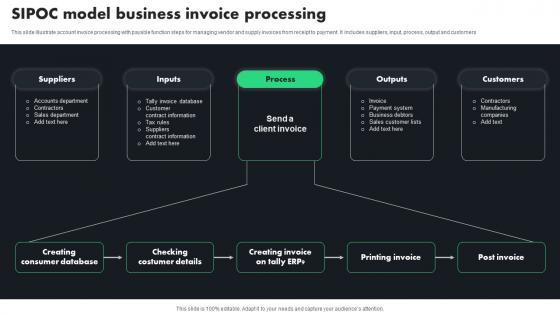
This slide illustrate account invoice processing with payable function steps for managing vendor and supply invoices from receipt to payment. It includes suppliers, input, process, output and customers.
People who downloaded this PowerPoint presentation also viewed the following :
SIPOC Model Business Invoice Processing with all 9 slides:
Use our SIPOC Model Business Invoice Processing to effectively help you save your valuable time. They are readymade to fit into any presentation structure.








FAQs for SIPOC Model
So SIPOC breaks down into five parts that connect left to right. Suppliers give you inputs, inputs feed your process, the process creates outputs, and customers get those outputs. Pretty straightforward supply chain logic. Here's the thing though - most people jump straight into mapping workflows without figuring out boundaries first, which is where SIPOC actually shines. It gets everyone on the same page about scope before you dive deep into the messy details. Quick tip: start with the middle "Process" column first, then work your way outward to suppliers and customers. Makes it way easier.
So basically SIPOC maps out your whole project before you start - Suppliers, Inputs, Process, Outputs, Customers. I swear it's saved my butt so many times with scope creep! Figure out who's giving you what first, then nail down your process steps and deliverables. Your team will actually be on the same page for once. When processes go sideways, you can pinpoint exactly where things went wrong instead of guessing. Takes maybe 30 minutes in kickoff but honestly saves you hours of headaches later. Trust me on this one.
Honestly, SIPOC works best in manufacturing, healthcare, and finance - anywhere you've got complicated processes with multiple steps. Six Sigma people are obsessed with them, which makes sense for spotting waste. Call centers use them too, plus logistics companies dealing with handoffs between teams. Look, if your process has more than 3-4 steps and different people are involved, it's probably worth trying. I'd personally start with whatever's giving you the biggest headache right now. Service industries love these things because let's face it, their processes can be a total mess sometimes.
Yeah, SIPOC mapping is really good for catching waste! I use it all the time. You map out your Suppliers, Inputs, Process, Outputs, and Customers - then suddenly you can see where things don't line up. Like inputs you don't actually need, or process steps that add zero value. Sometimes outputs that customers don't even want (which is the worst). It's kind of like getting above everything and seeing the mess clearly. Start with your SIPOC, then go through each piece asking "does this actually help the customer?" Works every time.
Honestly, just start with mapping out your actual process steps - that's the easy part. Walk through it physically if you can, or grab coffee with whoever does the work daily. For inputs, ask "what do we actually need and where's it coming from?" Then flip it for outputs - who's getting what when you're done? Don't get fancy with it at first. You'll tweak it later anyway. Oh, and definitely don't try doing this alone at your computer - you'll miss half the messy real-world stuff. Get your team in a room and just start throwing ideas around.
Dude, you absolutely need stakeholder input - can't do SIPOC in a vacuum. People actually working the process will spot stuff you'd never catch and call out your wrong assumptions. I've watched so many teams create these perfect-looking diagrams that completely miss key suppliers or outputs because nobody bothered asking frontline workers. Get reps from each area involved from the start, not just rubber-stamping at the end. They'll help identify real inputs, catch hidden customer needs, and tell you if your process boundaries actually make sense. Worth scheduling those sessions early on.
Honestly, update them whenever something big shifts - new tech, process changes, different suppliers or customers. At minimum once a year, but quarterly reviews work better if you can swing it. The teams that actually get value from these things treat them like living docs, not something that sits forgotten in a folder. My old manager used to say they're only useful if people actually look at them, which sounds obvious but... you'd be surprised. Set a calendar reminder to go through yours with your team. Make it part of your regular process talks so it doesn't feel like extra work.
Ok so biggest thing - don't get crazy detailed. Stay high level or you'll map every tiny step and hate your life. Also, people mix up inputs and suppliers all the time (suppliers give you the inputs, inputs are the actual stuff). Scoping matters too because otherwise your SIPOC becomes this monster that covers everything. Oh and stop listing internal handoffs as suppliers - they're part of YOUR process, not external. Honestly? Most people just overthink it. Get the main pieces down first, worry about perfecting it later. Way easier that way.
SIPOC plays really well with other tools, yeah. I usually throw it up first before getting into value stream mapping or flowcharts - gives everyone that bird's eye view so you're not starting from scratch. Works great with Lean Six Sigma stuff too, like fishbone diagrams. The best part? It stops those annoying meetings where someone goes "hold up, which process are we even fixing here?" Get your team aligned with SIPOC first, then pile on whatever other tools you need. Way smoother that way.
Honestly, SIPOC is a game-changer for getting teams aligned. You map out Suppliers, Inputs, Process, Outputs, and Customers together - suddenly everyone's looking at the same workflow picture. Marketing finally gets what IT actually needs, operations sees how they affect sales. It cuts through all that departmental BS, you know? Each team has to explain their role in plain English instead of their usual jargon. I'd throw it into your next project kickoff. Gets expectations sorted right from the start, which honestly saves so much headache later.
Honestly, just stick to a basic table with those five columns - Suppliers, Inputs, Process, Outputs, Customers. Bullet points work way better than paragraphs (trust me on this one). I've seen people create these massive wall-of-text SIPOCs that nobody wants to read. Your process steps need to flow left to right logically. Oh, and use the same terms throughout - don't call something "materials" in one spot and "supplies" in another. Color-coding helps but don't make it look like a rainbow threw up. Keep it to one page. Your team should get the whole process in like 30 seconds of looking at it.
Honestly, SIPOC diagrams are a total game-changer for any Lean or Six Sigma project. Think of it like sketching out a roadmap before a road trip - you need to see the whole picture first. The diagram maps your suppliers, inputs, process steps, outputs, and customers so you can spot waste and variation sources right away. Without one, your team ends up solving random problems instead of the actual issue. I learned this the hard way on a project last year. Short version: always start with a SIPOC. Your future self will thank you when you're not redoing work because someone forgot about a key stakeholder.
Honestly, digital tools make SIPOC stuff so much less painful. Miro's my go-to - you can drag things around and your whole team jumps in without the usual sticky note chaos. Lucidchart's solid too. The cool thing is how some process mapping software actually connects to your real systems and pulls live data automatically. No more outdated diagrams sitting in random folders (we've all been there). Everything just lives in the cloud where people can actually find it. Start with something basic like Miro and see what happens. You'll probably never go back to the old way.
Yeah, tons of companies swear by SIPOC! Toyota's probably the most famous example - they used it to map out their whole manufacturing chain and cut massive amounts of waste. GE rolled it out with their Six Sigma stuff to catch production defects. American Express actually applied it to their customer service workflows, which is pretty smart since most people think it's just for manufacturing. Hospitals use it for patient flow too. Honestly, the biggest mistake I see is trying to map everything at once. Just pick one process that's driving you crazy and start there - you'll get way better results.
Yeah, just make it way more flexible than the traditional approach. Break your SIPOC down by sprint or user story instead of doing one huge upfront diagram. Honestly, sticky notes on a board work great since you can move stuff around during retros. Update it constantly - agile changes so much compared to waterfall where everything was locked down forever. Keep each version super visual and simple. The whole point is staying aligned on who's giving what to whom, which gets tricky when you're moving fast. Oh, and treat it like a living doc that evolves with your project rather than some static thing gathering dust.
-
I was never satisfied with my own presentation design but SlideTeam has solved that problem for me. Thank you SlideTeam!
-
SlideTeam is a great place for PPT templates. They have many templates on a single topic. It has made my life a lot easier.