

SAP Procure To Pay Procurement Process Flowchart




Try Before you Buy Download Free Sample Product
 Impress Your
 Audience
 100%
100% Editable
 Save Hours
 of Time


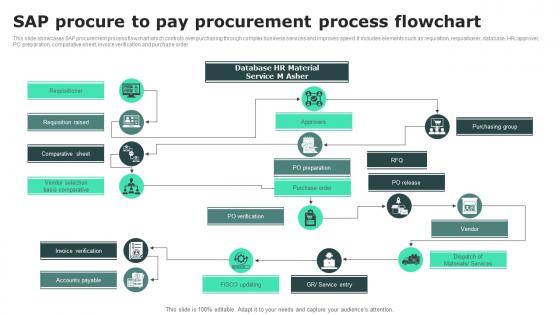
This slide showcases SAP procurement process flowchart which controls over purchasing through complex business services and improves speed. It includes elements such as requisition, requisitioner, database, HR, approver, PO preparation, comparative sheet, invoice verification and purchase order.
People who downloaded this PowerPoint presentation also viewed the following :
SAP Procure To Pay Procurement Process Flowchart with all 9 slides:
Use our SAP Procure To Pay Procurement Process Flowchart to effectively help you save your valuable time. They are readymade to fit into any presentation structure.








FAQs for SAP Procure To Pay
So SAP P2P has five main steps you'll deal with: requisition creation, purchase order processing, goods receipt, invoice verification, and payment processing. First you create a requisition for whatever your department needs. Gets converted to a PO after approval. Then you receive the goods and post a goods receipt - honestly this part's pretty tedious with all those material document numbers, but you gotta be accurate. After that, match the vendor invoice against your PO and goods receipt before payment goes through. Each step has its own SAP transactions too, so definitely save those tcodes you'll use most.
So basically, P2P talks directly to your FI/CO and MM modules since they're all on the same database. Pretty neat setup actually. When you create a PO, it hits your financial commitments right away. Then goods receipts automatically update inventory in MM - no manual stuff needed. Your AP invoices flow straight into Financial Accounting for payments too. The whole thing happens in real time, so you're not dealing with those annoying reconciliation issues later. Honestly makes reporting way cleaner. I'd start by mapping out your document flows first - you'll see how everything connects.
Ok so supplier management is honestly the backbone of your whole P2P thing. You're basically keeping track of vendor info, contracts, how well they're performing - all that stuff. When it's done right, everything flows smoothly from sourcing to actually paying people. But when it's a mess? Ugh, you'll hit problems everywhere. The whole point is making sure you're only working with vendors who actually meet your standards and won't leave you hanging. Oh and keep that supplier data clean - seriously, it's boring work but it'll save you so much drama later. Trust me on this one.
Honestly, SAP can make your procurement way less of a headache if you set it up right. First thing - map out your current mess of a process before diving in. Then you can automate all those tedious approval workflows and get rid of the manual stuff that's eating up your time. The vendor management piece is solid too, keeps everything centralized instead of scattered across spreadsheets. Real-time analytics help catch those annoying bottlenecks before they blow up. Oh, and the spend analysis feature? Actually useful for contract negotiations. Just don't expect the reporting to make sense right away - there's definitely a learning curve there.
Honestly, data migration is going to be your biggest nightmare - your vendor master data is definitely messier than you realize. User adoption will suck too because procurement teams hate change. Mapping your current workflows into SAP gets super complex, especially with custom processes. Oh, and three-way matching configuration? Good luck with that. Integration with other systems will probably break at least twice. The change management piece is brutal but you can't skip it. Start cleaning data now and throw money at training early. Trust me on the training part - I've seen too many implementations fail because they cheaped out there.
So basically SAP has these approval workflows and vendor screening built right in - catches problems before they blow up. You'll get real-time spend visibility which is honestly a game changer. Set up controls to stop people from going rogue with purchases or flag weird transactions. The audit trails are automatic too, saves you from wanting to pull your hair out during compliance season. Risk scoring for suppliers based on their track record is pretty slick. Main thing though? Get your approval levels and spending limits dialed in early. After that the system just watches everything for you.
So purchase requisitions are basically how you formally ask for stuff your department needs - they start the whole P2P thing in SAP. You're telling procurement "hey, I need this" with all the details like quantity, delivery date, cost center, whatever. Pretty simple once you figure it out. SAP uses your PR to make purchase orders and track approvals. Oh, and seriously - fill everything out right the first time. Trust me on this one. You don't want to deal with procurement going back and forth asking for missing info. That gets old fast.
So SAP analytics actually gives you decent visibility into how your procurement's performing. Instead of digging through endless spreadsheets, you get dashboards showing spend patterns, supplier metrics, contract compliance - all that good stuff. Pretty helpful for spotting negotiation opportunities and catching sketchy suppliers early. The predictive features work well for demand forecasting too, though honestly the budget planning part took me a bit to figure out. Start with automated reports for your biggest spend categories first. You'll quickly see which KPIs actually move the needle for your business.
First thing - nail down your vendor qualification criteria in the master data. Financial stability, certs, quality standards, all that stuff. SAP's got vendor evaluation tools that'll score suppliers on delivery, quality, pricing. Honestly, most teams totally blow off the regular review cycles then act shocked when everything falls apart. Track your KPIs religiously and actually DO something with the data. Quarterly business reviews with key suppliers are clutch. Set up automated alerts for when performance tanks - trust me on this one. When contract renewals hit, you'll be glad you went data-driven instead of flying blind.
So SAP P2P basically takes your whole invoice mess and automates it - matches invoices to POs and receipts, then sends everything through whatever approval rules you've got set up. Three-way matching happens automatically which is honestly kind of magical when it works. You can auto-pay approved stuff and set different thresholds for approvals. Exception handling takes care of the weird mismatched items too. Your AP people will actually thank you since they won't be buried in paperwork anymore. Just don't screw up the tolerance levels during setup - I've seen that bite people hard later.
Honestly, SAP Procure to Pay is a game changer for supply chain stuff. It automates everything from when someone requests a purchase to actually paying for it. You'll get real-time data on spending and how vendors are performing - super helpful for negotiations. The approval workflows alone cut out so much manual BS that used to bog things down. My buddy's company saw huge improvements once they could actually see their purchasing patterns and delivery metrics. I'd start by figuring out where your biggest process headaches are right now, then tackle those first.
Honestly, SAP Ariba and Fieldglass are game-changers for this stuff. Set up supplier portals so vendors can grab RFQs, submit invoices, and see payment status themselves - no more annoying "where's my money?" emails filling up your inbox. They'll love the collaborative forecasting too since it helps them plan better. The automated workflows for contracts and performance tracking are clutch. Oh, and don't try to onboard everyone at once - that's a nightmare. Start with your top 10 suppliers, get the bugs worked out, then roll it out wider. Trust me on that one.
Start with SAP's official P2P modules - they're pretty solid for learning the basics like procurement workflows and vendor stuff. Definitely get hands-on time in a sandbox though, there's really no substitute for actually creating purchase orders yourself. Make sure your company does role-specific training too since what finance people need is totally different from procurement teams. Oh and don't blow off the integration piece - knowing how P2P talks to your other systems will save you so much frustration later. I'd push for follow-up sessions about a month after launch because that's when the real questions start coming up.
So basically SAP tracks your whole PO process from start to finish. Create them in ME21N, then they hit approval workflows based on whatever authorization rules your company set up. The system watches delivery confirmations, goods receipts (MIGO), and invoice verification automatically - that three-way matching thing actually saves your butt when numbers don't add up. ME23N shows you PO status, or run ME2L for open items. Oh, and it keeps full audit trails of everything, which is clutch when you're trying to figure out where stuff got stuck in procurement. Makes tracking bottlenecks way easier.
So the big things happening in SAP P2P right now? AI automation is everywhere - smart invoice processing, spend analytics that actually predict stuff, workflows that approve themselves. Everyone's finally moving to Ariba and S/4HANA Cloud too (took long enough, right?). Real-time visibility is basically mandatory now. Companies want tight supplier collaboration and they're obsessed with ESG tracking. Mobile experiences matter way more than they used to. Oh, and marketplace integrations are huge. Honestly, I'd look at where your automation is lacking and figure out your cloud move soon - you don't want to be playing catch-up later.
-
Happy to incorporate such stunning templates in my presentation. Made my presentation look professional and engaging.
-
Templates are beautiful and easy to use. An amateur can also create a presentation using these slides. It is amazing.