


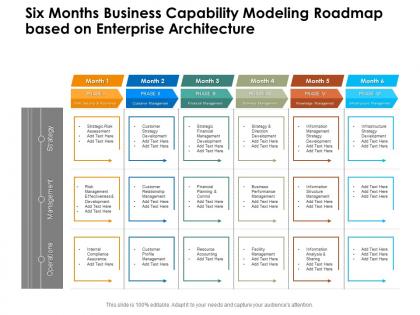
Six months business capability modeling roadmap based on enterprise architecture




Try Before you Buy Download Free Sample Product
 Impress Your
 Audience
 100%
100% Editable
 Save Hours
 of Time


A cohesive work plan is essential for achieving the desired target. Communicate your vision and lay a firm ground in front of your audience with our PowerPoint layout. Align your project milestones, budgets, deliverables, deadlines, and all the requisite information for a dynamic presentation by employing this amazingly designed Six Months Business Capability Modeling Roadmap Based On Enterprise Architecture. Maximize team efficiency and streamline a work plan efficiently by introducing our ready made roadmap PowerPoint theme. You can quickly establish coordination between different activities across the organization and present an insight to your colleagues by utilizing this useful business tool. Color code specific tasks, prioritize, and keep a close eye on the deadlines with the help of our eye catchy PowerPoint template. Download our Six Months Business Capability Modeling Roadmap Based On Enterprise Architecture for excelling at productive management.
People who downloaded this PowerPoint presentation also viewed the following :
Six months business capability modeling roadmap based on enterprise architecture with all 2 slides:
Use our Six Months Business Capability Modeling Roadmap Based On Enterprise Architecture to effectively help you save your valuable time. They are readymade to fit into any presentation structure.
FAQs for Six months business capability modeling roadmap based
Business Capability Modeling includes capability hierarchies, business functions, supporting processes, required resources, and performance metrics. These components work together by mapping organizational strengths, identifying operational gaps, and aligning strategic initiatives, with many enterprises finding that this structured approach streamlines resource allocation and enhances competitive positioning across multiple business units.
Business Capability Modeling focuses on what an organization can do rather than how it does it, examining strategic abilities like customer management or product development across the entire enterprise. Unlike traditional process mapping, which details step-by-step workflows, capability modeling provides a higher-level view that enables strategic planning, resource allocation, and transformation initiatives, ultimately delivering better organizational alignment and competitive advantage.
Business Capability Modeling serves as a strategic foundation by identifying, organizing, and prioritizing an organization's core capabilities to align with long-term objectives and market demands. This framework enables executives to assess capability gaps, optimize resource allocation, and make informed investment decisions, with many organizations finding that structured capability mapping accelerates strategic initiatives while minimizing operational risks.
Organizations leverage capability models by systematically mapping current resources against required capabilities, conducting gap analysis through stakeholder interviews and performance assessments, and prioritizing investment areas based on strategic importance. Through this structured approach, companies in sectors like manufacturing and financial services can identify skill shortages, technology deficits, and process weaknesses, ultimately enabling targeted resource allocation and competitive advantage.
Best practices for implementing capability modeling include establishing clear governance frameworks, engaging cross-functional stakeholders early, defining standardized capability definitions, and aligning initiatives with strategic business objectives. These approaches streamline organizational transformation by ensuring consistent methodology adoption, facilitating stakeholder buy-in, and creating measurable outcomes, with many enterprises finding that phased implementation ultimately delivers enhanced operational visibility and strategic decision-making capabilities.
Business Capability Models enhance IT-business alignment by creating shared language around organizational functions, establishing clear connections between technology investments and business outcomes, and enabling strategic roadmap development. Through capability mapping, IT teams prioritize systems that directly support core business functions like customer service or financial operations, while business leaders understand technology's role in achieving competitive advantage and operational efficiency.
Metrics for assessing capability model effectiveness include maturity scores, performance indicators, resource utilization rates, outcome measurements, and strategic alignment assessments. These metrics enable organizations by tracking capability development progress, identifying improvement opportunities, and measuring business value delivery, with many enterprises finding that regular assessment drives operational efficiency and enhances strategic decision-making capabilities.
External market trends significantly impact capability models by driving organizations to reassess their strategic priorities, technology investments, and operational frameworks to remain competitive. These trends, including digital transformation, changing customer expectations, and regulatory shifts, compel businesses across sectors like banking, retail, and healthcare to evolve their capability architectures, ultimately ensuring their models align with emerging market demands and deliver sustainable competitive advantage.
Leading Business Capability Modeling tools include Enterprise Architect, ARIS, BiZZdesign HoriZZon, Sparx Systems, and MEGA HOPEX. These platforms streamline capability mapping by offering drag-and-drop interfaces, automated documentation, and real-time collaboration features, with many organizations finding that integrated modeling environments ultimately deliver enhanced strategic alignment and faster transformation initiatives.
Business Capability Modeling applies across virtually all industries by providing a standardized framework for identifying core competencies, operational processes, strategic functions, and organizational strengths regardless of sector. While manufacturing organizations map production capabilities and supply chain management, financial services institutions focus on risk assessment and customer relationship functions, with healthcare systems emphasizing patient care delivery and regulatory compliance capabilities.
Organizations ensure stakeholder buy-in during capability modeling by involving key stakeholders in defining capabilities, conducting collaborative workshops, and clearly communicating business value propositions. Through transparent documentation and regular feedback sessions, companies facilitate stakeholder engagement while demonstrating how capability models drive strategic alignment, resource optimization, and operational efficiency, ultimately delivering enhanced decision-making capabilities across departments.
Organizations face challenges including unclear scope definition, inconsistent terminology across departments, difficulty mapping complex interdependencies, resistance to standardization, and maintaining model accuracy over time. These obstacles often arise from siloed thinking, competing priorities, and inadequate stakeholder alignment, with many enterprises finding that establishing clear governance frameworks and cross-functional collaboration significantly streamlines the modeling process.
Business Capability Models should be revisited quarterly for minor updates and undergo comprehensive reviews annually, with additional assessments triggered by major organizational changes, mergers, or strategic shifts. Many organizations find that regular updates enable them to maintain alignment with evolving market demands, streamline resource allocation, and enhance operational efficiency, ultimately delivering sustained competitive advantage in increasingly dynamic business environments.
Customer feedback serves as a critical input for identifying capability gaps, validating performance assumptions, and prioritizing improvement initiatives across operational, technological, and service delivery capabilities. Through systematic feedback analysis, organizations can refine their customer service processes, product development workflows, and digital engagement platforms, with many companies finding that customer-driven capability enhancements ultimately deliver improved satisfaction scores and competitive differentiation.
Capability modeling aids digital transformation by mapping current organizational abilities against future digital requirements, identifying capability gaps, and prioritizing technology investments for maximum impact. Through systematic assessment, organizations streamline resource allocation, enhance operational efficiency, and accelerate transformation initiatives, with many enterprises finding that structured capability frameworks ultimately deliver faster implementation timelines and measurable competitive advantages.
No Reviews