

Six months roadmap for research analyst career path





Try Before you Buy Download Free Sample Product
 Impress Your
Audience
 100%
Editable
 Save Hours
of Time


A cohesive work plan is essential for achieving the desired target. Communicate your vision and lay a firm ground in front of your audience with our PowerPoint layout. Align your project milestones, budgets, deliverables, deadlines, and all the requisite information for a dynamic presentation by employing this amazingly designed Six Months Roadmap For Research Analyst Career Path. Maximize team efficiency and streamline a work plan efficiently by introducing our ready made roadmap PowerPoint theme. You can quickly establish coordination between different activities across the organization and present an insight to your colleagues by utilizing this useful business tool. Color code specific tasks, prioritize, and keep a close eye on the deadlines with the help of our eye catchy PowerPoint template. Download our Six Months Roadmap For Research Analyst Career Path for excelling at productive management.
People who downloaded this PowerPoint presentation also viewed the following :
Content of this Powerpoint Presentation
Description:
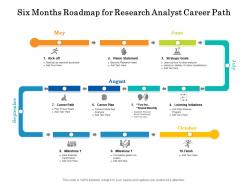
The image presented is a visual representation of a six-month roadmap specifically designed for an individual starting a career as a research analyst. The roadmap is organized in a timeline format, starting from May and ending in October, with each month having specific milestones and activities.
1. May is the "kick-off" phase, involving the start of a job as a research associate and provides space to add more text or details.
2. June focuses on crafting a vision statement to become a research head, and it also includes a provision for additional information.
3. The month of July is dedicated to setting strategic goals such as a hands-on table for data analysis and a focus on data visualization techniques, with extra space for more information if needed.
4. In August, the roadmap encouraged the individual to define a "You Inc. Brand Identity," enhancing personal brand positioning. The same month also suggests initiating learning initiatives, like joining a data science program.
5. September instructs the individual to chalk out a concrete career plan, including conducting a skills gap analysis, with extra space for additional text.
Career path planning is slated for September, focusing on planning future goals.
The roadmap ends with October aligning the final milestone to completing a global live project and attaining data scientist certification, with space to elaborate further.
Use Cases:
This structured timeline can be applied to several industries for guiding new entrants or aligning staff development plans.
1. Higher Education:
Use: Professional development for research staff
Presenter: Career services advisor
Audience: Graduate students and research associates
2. Corporate Training:
Use: Employee onboarding and career progression planning
Presenter: HR professional or personnel development manager
Audience: New hires or current employees in analyst roles
3. Professional Development Consultancies:
Use: Individual career coaching and personal branding
Presenter: Career coach or personal brand strategist
Audience: Professionals seeking career advancement
4. Non-Profit Research Organizations:
Use: Volunteer or staff development and goal setting
Presenter: Program manager or team leader
Audience: Research volunteers or non-profit staff
5. Government Agencies:
Use: Public sector employee development programs
Presenter: Department head or training coordinator
Audience: Government researchers or analysts
6. Financial Services:
Use: Career pathway planning for financial analysts
Presenter: Senior analyst or department manager
Audience: Junior analysts or associates
7. Technology Firms:
Use: Skill development and career tracking for data scientists
Presenter: Data science team lead or HR manager
Audience: Entry-level data scientists or tech associates
Six months roadmap for research analyst career path with all 2 slides:
Use our Six Months Roadmap For Research Analyst Career Path to effectively help you save your valuable time. They are readymade to fit into any presentation structure.
FAQs for Six months roadmap for research
Essential skills for research analysts include data analysis and statistical modeling, financial analysis and valuation techniques, industry research capabilities, critical thinking and problem-solving, and strong written and verbal communication skills. These competencies enable analysts to interpret complex datasets, build accurate financial models, and deliver compelling insights to stakeholders, with many professionals finding that combining technical expertise with strategic business acumen ultimately delivers significant competitive advantage in today's data-driven investment landscape.
Transitioning to research analyst roles leverages transferable skills like data interpretation, statistical analysis, analytical thinking, and report writing from data analysis or market research backgrounds. Many professionals enhance their transition by developing sector-specific knowledge, obtaining relevant certifications like CFA or FRM, and gaining exposure to financial modeling, with investment firms and consulting companies increasingly valuing this diverse analytical experience.
Research analysts are commonly employed across financial services, healthcare, technology, consulting, government agencies, and market research firms, with roles varying significantly by sector focus and analytical requirements. While financial analysts concentrate on investment decisions and market valuations, healthcare analysts examine clinical data and regulatory impacts, and technology analysts assess innovation trends and competitive positioning, ultimately delivering sector-specific insights that enable strategic decision-making and competitive advantage.
**INPUT**: Which educational qualifications are most valued for aspiring research analysts? **OUTPUT**: Most valued educational qualifications for research analysts include bachelor's degrees in finance, economics, accounting, or business, with many professionals pursuing MBAs, CFA certifications, or specialized master's programs in financial analysis. These credentials enhance analytical capabilities, industry credibility, and technical expertise, with investment firms and financial institutions increasingly seeking candidates who combine strong quantitative backgrounds with professional certifications, ultimately delivering deeper market insights and competitive advantage in research roles. **Word count: 60 words**
Statistical software proficiency is crucial for research analyst success, enabling efficient data manipulation, advanced statistical modeling, automated reporting, and visualization of complex datasets. Through tools like R, Python, SQL, and Tableau, analysts streamline workflows, enhance analytical accuracy, and deliver compelling insights faster, with many organizations finding that technical proficiency directly correlates with career advancement opportunities.
Corporate research analysts focus on market trends, competitive intelligence, financial modeling, and investment recommendations to drive business decisions and revenue growth. Academic research analysts emphasize theoretical frameworks, peer-reviewed publications, and long-term studies, with many financial services and consulting firms finding that corporate roles prioritize actionable insights while academic positions value methodological rigor and scholarly contribution.
Entry-level research analysts can build professional networks through industry conferences, LinkedIn engagement, joining professional associations like CFA Institute, participating in webinars, and connecting with colleagues across departments. These networking strategies enhance career opportunities by facilitating mentorship relationships, knowledge sharing, and industry insights, with many analysts finding that consistent engagement ultimately delivers faster career advancement and access to specialized roles.
Research analysts typically use quantitative methods like statistical analysis and regression modeling, qualitative approaches including surveys and interviews, data mining techniques, market research tools, and financial modeling software. These methodologies enable analysts to identify trends, validate hypotheses, and generate actionable insights across sectors like healthcare, finance, and technology, ultimately delivering strategic recommendations that enhance decision-making and competitive advantage.
Research analysts contribute to strategic decision-making by conducting market research, analyzing industry trends, evaluating competitive landscapes, and providing data-driven insights that inform executive choices. Through comprehensive financial modeling and risk assessment, analysts enable organizations to identify growth opportunities, optimize resource allocation, and minimize investment risks, with many companies finding that analyst recommendations directly influence merger decisions, product launches, and market expansion strategies.
Technology, particularly AI and machine learning, revolutionizes modern research analysis by automating data collection, enhancing pattern recognition, accelerating predictive modeling, and streamlining report generation. These technologies enable analysts to process vast datasets more efficiently, identify market trends faster, and deliver more accurate forecasts, with many financial institutions and consulting firms finding that AI-powered tools significantly reduce analysis time while improving decision-making accuracy.
Research analysts typically advance through senior analyst, team lead, research director, and portfolio manager roles, with specialization options including equity research, credit analysis, quantitative research, sector-specific expertise, and ESG analysis. These career paths enable professionals to deepen industry knowledge while expanding strategic influence, with many analysts finding that specialized expertise in areas like healthcare, technology, or financial services ultimately delivers enhanced career mobility and competitive advantage in increasingly data-driven markets.
Research analysts stay updated through continuous learning platforms, industry publications, professional associations, attending conferences, and networking with peers across sectors. Many analysts in financial services, healthcare, and technology find that combining formal certifications with real-time market analysis tools enables faster insights, enhanced credibility, and competitive advantage in an increasingly data-driven landscape.
Research analysts must prioritize objectivity, transparency, and accuracy while avoiding conflicts of interest, maintaining client confidentiality, and ensuring proper data sourcing and attribution. These ethical standards enable analysts to deliver unbiased insights, protect stakeholder trust, and maintain professional credibility, with many financial institutions and consulting firms finding that strong ethical frameworks ultimately enhance client relationships and competitive positioning.
Collaboration enables research analysts to leverage diverse expertise, validate findings through peer review, and integrate cross-functional insights from finance, marketing, and operations teams. In team settings, analysts enhance decision-making accuracy by combining specialized knowledge, sharing data resources, and developing comprehensive recommendations that address multiple stakeholder perspectives, ultimately delivering more robust strategic insights.
Research analysts can effectively communicate findings to non-technical stakeholders by using clear visualizations, avoiding jargon, creating executive summaries, and focusing on actionable insights rather than methodology. These approaches streamline complex data into accessible formats, with many analysts finding that storytelling techniques, real-world analogies, and outcome-focused presentations ultimately deliver better stakeholder engagement and faster decision-making across organizations.
-
Easy to edit slides with easy to understand instructions.
-
Unique and attractive product design.
-
Perfect template with attractive color combination.
-
Great designs, really helpful.