


Small Fast Food Business Plan Powerpoint Presentation Slides




Try Before you Buy Download Free Sample Product
 Impress Your
 Audience
 100%
100% Editable
 Save Hours
 of Time


Our Small Fast Food Business Plan template is a professionally curated resource that provides all the necessary tools and information to help you launch a successful and profitable fast food restaurant. This Startup Fast food business deck covers every aspect of your business, starting with a comprehensive market analysis to help you understand your target customers and competition. It also includes detailed financial projections to guide your financial planning and decision making. The operational plan section offers insights into managing staff, handling operations, and delivering excellent customer service. Additionally, the marketing strategy outlined in the presentation will assist you in attracting customers and building a loyal customer base. The financial summary section provides a clear overview of your revenue model, profit and loss statement, break even analysis, and more. With this 100 percentage editable template, you can customize the content to fit your specific business needs. Download this invaluable resource now and gain access to a highly researched and skillfully designed product that will set you on the path to success in the fast-food industry.
People who downloaded this PowerPoint presentation also viewed the following :
Content of this Powerpoint Presentation
Slide 1: This slide introduces Small Fast Food Business Plan. Commence by stating Your Company Name.
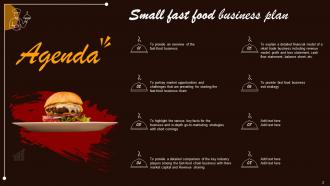
Slide 2: This slide depicts the Agenda of the presentation.
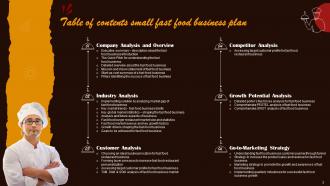
Slide 3: This slide incorporates the Table of Contents.
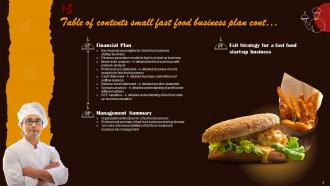
Slide 4: This slide continues the Table of Contents.
Slide 5: This slide highlights the Title for the Topics to be discussed further.
Slide 6: This slide covers a brief glimpse of what the business will be offering to the customer with market information.
Slide 7: This slide gives a glimpse of what the quick pitch of the business to the customers with market information.
Slide 8: This slide provides a Detailed overview about the fast food business.
Slide 9: This slide portrays the Mission and Vision statement of a fast food business.
Slide 10: This slide showcases the Start-up cost summary of a fast food business.
Slide 11: This slide presents the Pillars identifying the success of fast food business.
Slide 12: This slide includes the Heading for the Components to be covered in the forth-coming template.
Slide 13: This slide talks about Implementing solution by analyzing market gap of fast food business.
Slide 14: This slide continues Implementing solution by analyzing market gap of fast food business.
Slide 15: This slide highlights the thorough assessment of a market within the market trends along with the key stats.
Slide 16: This slide continues the thorough assessment of a market within the grocery or supermarket along with the key stats.
Slide 17: This slide portrays the thorough assessment of a market within the global market key stats shaping the fast food business.
Slide 18: This slide provides a brief about the fast food business, its overview.
Slide 19: This slide elucidates Fast food burger restaurant market size and statistics.
Slide 20: This slide reveals the Us Fast Food Industry Revenue Over Time.
Slide 21: This slide displays the Growth drivers shaping the fast food business.
Slide 22: This slide continues the Growth drivers shaping the fast food business.
Slide 23: This slide exhibits the Goals to be achieved for fast food business.
Slide 24: This slide elucidates the Title for the Ideas to be discused in the following template.
Slide 25: This slide highlights the thorough assessment of a business location within country.
Slide 26: This slide deals with Forming buyer personas to increase fast food restaurant personalization.
Slide 27: This slide focuses on Assessing target customer profile for fast food business.
Slide 28: This slide reveals the TAM SAM & SOM analysis of fast food business market.
Slide 29: This slide incorporates the Heading for the Ideas to be covered next.
Slide 30: This slide emphasizes on Assessing target customer profile for fast food restaurant business.
Slide 31: This slide portrays the Title for the Contents to be discussed next.
Slide 32: The slide highlights porter’s five forces model and its implications in the retail store business industry.
Slide 33: This slide showcases the Comprehensive PESTEL analysis of fast food business.
Slide 34: This slide exhibits the Comprehensive SWOT analysis of fast food business.
Slide 35: This slide mentions the Heading for the Topics to be covered in the following template.
Slide 36: This slide displays Understanding fast food business customer journey through funnel.
Slide 37: This slide talks about Strategy to increase the product sales and revenue for fast food business.
Slide 38: This slide presents the Marketing strategy to promote the growth and awareness of fast food business.
Slide 39: This slide continues the Marketing strategy to promote the growth and awareness of fast-food business.
Slide 40: This slide focuses on Implementing quarterly milestones for successful fast food business growth.
Slide 41: This slide reveals the Title for the Components to be discussed next.
Slide 42: This slide represents financial assumptions of the fast food business plan.
Slide 43: This slide elucidates the Revenue generation model for fast food start-up business.
Slide 44: This slide showcases the break-even analysis.
Slide 45: This is yet another slide continuing the Break-even Analysis.
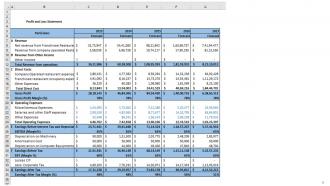
Slide 46: This slide highlights the profit and loss statement.
Slide 47: This slide continues graphs of gross profit of the business and earnings before interest tax & depreciation.
Slide 48: This is yet another slide continuing the graphs of total revenue from operations and earnings after tax.
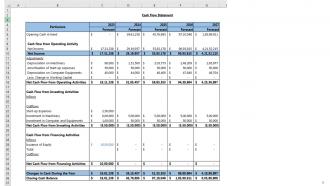
Slide 49: This slide shows the business’s historical and forecasted cash flow results.
Slide 50: This slide continues the Cash Flow Analysis.
Slide 51: This slide represents balance sheet statement.
Slide 52: This is yet another slide continuing the cash flow analysis and total assets.
Slide 53: This slide reveals the different scenarios for deriving final annual profit after tax based on best case, nominal case and worst case.
Slide 54: This slide continues the Scenario analysis.
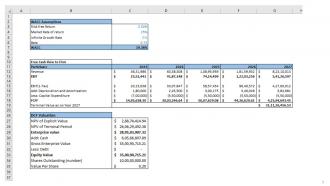
Slide 55: This slide shows the DCF valuation analysis of a business’s financials based on the free cash flow to firm.
Slide 56: THis slide displays the Heading for the Topics to be covered further.
Slide 57: This slide illustrates the organizational structure of the business.
Slide 58: This slide portrays the Professional summary of fast food business start-up founder.
Slide 59: This slide exhibits the Job roles and responsibilities of fast food restaurant business key management.
Slide 60: This slide continues the Job roles and responsibilities of fast food business key management.
Slide 61: This slide presents the Title for the Topics to be discussed in the upcoming template.
Slide 62: This slide represents exit strategy for stakeholders such as venture capitalists, private offerings and initial public offer.
Slide 63: This is the Icons Slide containing all the Icons used in the plan.
Slide 64: This slide is used for showcasing some Additional information.
Slide 65: This is the About us slide. State your company-related information here.
Slide 66: This slide displays the organization's Mission, Vision, and Goal.
Slide 67: This slide mentions about the company's Vision, Mission, and Goal.
Slide 68: This is Our team slide. State your team-related information here.
Slide 69: This slide elucidates the information related to the Financial topic.
Slide 70: This slide represents the firm's Roadmap.
Slide 71: This is the Venn diagram slide.
Slide 72: This is the Puzzle slide with related imagery.
Slide 73: This slide portrays the SWOT Analysis of the company.
Slide 74: This slide contains the Post it notes for reminders and deadlines.
Slide 75: This is the Idea generation slide for encouraging fresh ideas.
Slide 76: This is the 30 60 90 days plan slide for effective planning.
Slide 77: This is the Thank You slide for acknowledgement.
Small Fast Food Business Plan Powerpoint Presentation Slides with all 77 slides:
Use our Small Fast Food Business Plan Powerpoint Presentation Slides to effectively help you save your valuable time. They are readymade to fit into any presentation structure.





FAQs for Small Fast Food Business Plan
First thing - figure out who actually lives in your area and what they make. Check out the competition too, like their prices and menus. Honestly, I went down a total Yelp rabbit hole doing this but the reviews tell you everything. Walk around at different times and literally count cars at other fast food places - sounds weird but it works. Local permits are a pain so start that research early. You'll also want to see how easy it is for people to actually get to your spot since foot traffic can totally make or break you.
Dude, pick ONE thing that actually sets you apart. Maybe it's sourcing everything locally, or you've got some crazy fusion concept, or your service is lightning fast. "Better burgers" is so overdone - literally every place says that now. What's your area missing? Late-night spots? Actually healthy options that don't taste like cardboard? Affordable family dinners? Find that gap and own it completely. Don't try being everything to everyone because you'll just end up being forgettable. Go all-in on whatever makes you different.
Dude, first figure out your concept - lunch rush or drunk people food? Map your menu with real costs that'll actually turn profit. Location is everything since foot traffic literally decides if you survive. For operations, think staffing, suppliers, and how not to crash during busy times. Financial projections are boring but necessary - startup costs, monthly expenses, break-even timeline. Oh, and seriously budget way more working capital than you think for those first brutal months. Most people go broke waiting for customers to show up. Bottom line: you need something that makes people choose you over the McDonald's next door.
Dude, you gotta nail down who's actually gonna buy from you. Are we talking stressed office workers grabbing lunch, broke college kids, or families doing dinner? Figure out their age, income, location - the basics. Then think about what pisses them off. Speed freaks who want food in 30 seconds, or health nuts willing to wait? "Everyone eats" isn't a strategy, trust me. Check out your competitors' crowds, maybe do some quick surveys around town. I'd make like 2-3 customer profiles and see what happens when you actually open.
Dude, location is everything - seriously can't stress this enough. High foot traffic and easy parking are non-negotiable. Near offices or schools? Perfect, you'll get those lunch crowds. I've watched solid concepts totally bomb because they picked some hidden spot where customers couldn't even find them. Street visibility matters way more than you'd think too. Check out the demographics first - no point selling burgers in an area full of health nuts, right? Also scope out traffic patterns and see how many competitors are already there. Honestly, spend the extra time researching before you sign anything.
Dude, mobile ordering is where you want to start - biggest bang for your buck right there. Self-service kiosks are clutch too since people can take their time without holding up lines. Digital menu boards let you swap prices instantly (no more printing costs, thank god). The AI drive-thru stuff is pretty wild - it actually predicts what people want based on weather and time of day. Loyalty apps work great with personalized deals, plus you can set up geofencing so customers get pinged when their order's ready. Honestly though? Just nail the mobile app first. Everything else can wait.
Honestly, figure out who you're actually trying to feed first - families, office crowds, whatever. Then be real about what your kitchen can handle because there's nothing worse than putting some complicated dish on there that your cooks mess up half the time. Keep food costs under 30% or you'll hate your life. I'd stick to maybe 15-20 items max - restaurants that try to do everything usually suck at most of it. Focus on a couple signature things that make people choose you over whatever chain is nearby, then fill in the gaps around those. Oh, and test stuff first obviously.
Honestly, tackle your biggest expenses first - labor, food, and rent will destroy about 60-70% of your budget. Your lease is huge, so negotiate hard or maybe look into ghost kitchens if that works for your concept. Cross-train everyone so you're not paying extra bodies during dead hours. Food waste will absolutely kill you, so get strict with portions and track inventory daily, not monthly. Build solid relationships with your distributors too - they'll hook you up with better pricing when you need it. Actually, daily cost tracking per item sounds like a pain but it's what separates restaurants that make it from ones that don't.
Honestly, Instagram and TikTok are where it's at - those food pics will make or break you. Get on Google My Business too, and definitely partner with DoorDash/Uber Eats since that's how most people order now. I'd also do loyalty programs and maybe sponsor a local sports team or something. Limited-time offers work great too. The key is mixing strong online presence with being active in your actual neighborhood. Oh, and don't try to do everything at once - pick one platform first and get really good at it. Food photography is literally everything these days, no joke.
Dude, branding and packaging can totally make or break your fast food place. Look at McDonald's - you see those golden arches from a mile away, right? That's not an accident. Your packaging is huge because people are literally holding it, posting pics of it. Shake Shack figured this out perfectly with their whole clean vibe. Makes you think you're eating something fancier even though it's still basically a burger joint. Figure out what vibe you want first. Then just make everything match that feeling. Sounds obvious but so many places mess this up.
Start with the health department first - their kitchen requirements basically dictate your whole setup anyway. Food service license, health permits, the usual business licenses. Fire department needs to clear you too. Oh and signage permits if you're doing any exterior stuff. Workers' comp is mandatory once you hire people, which obviously you will. Honestly the health inspection process is kind of a pain but they're just making sure you don't poison anyone lol. Get the health stuff rolling first, then handle the other permits while you're building out. The whole thing takes longer than you'd think.
Honestly, start with the easy wins - swap your packaging for compostable stuff and find local suppliers. Your transport costs drop and food's fresher anyway. Energy-efficient equipment is pricey upfront but saves you money long-term. I'd also do some kind of composting program for food scraps, maybe offer half-portions too. People actually care about this environmental stuff now, which is kinda wild but works in your favor. Pick like 2-3 things max that won't destroy your budget. Then just be upfront about what you're doing - customers eat it up.
For fast food financing, banks are your obvious starting point - just need solid credit and a business plan that doesn't suck. SBA loans have better rates but man, the paperwork takes forever. Equipment financing is clutch since kitchen gear eats up most of your budget anyway. Angel investors might be interested if you've got something different (not another burger joint, please). Most owners I know mixed and matched instead of going all-in on one option. Oh, and get pre-qualified first so you're not house-hunting without knowing your budget, you know?
Honestly, half these food trends disappear faster than you think - some are total fads. Keep tabs on your social media and food blogs though, that's where you'll spot what's actually sticking. Your sales numbers tell the real story about which menu items are bombing or taking off. Limited-time offers are perfect for testing stuff without scrapping your whole menu. I'd say pick just one trend to try next quarter and see how it goes. The trick is making sure your supply chain can handle quick changes - oh, and train your team so they're not scrambling when you pivot.
Focus on your food costs first - keep them between 28-35% or you're bleeding money. Labor costs and average transaction value matter too. Speed and accuracy are huge since pissed off customers don't come back (learned that the hard way). Track your daily sales patterns, especially during rush periods, plus waste percentages. Online reviews basically control your fate now, so monitor those religiously. Repeat customers are gold. Set up some kind of weekly dashboard to catch problems early. Oh, and don't obsess over every single metric - pick the ones that actually move the needle for your spot.
-
SlideTeam’s pool of 2Million+ PPTs has really benefited my team, everyone from the IT department to HR. We are lucky to have crossed ways with them.
-
Innovative and Colorful designs.