


Small Restaurant Business Plan Powerpoint Presentation Slides




Try Before you Buy Download Free Sample Product
 Impress Your
 Audience
 100%
100% Editable
 Save Hours
 of Time


A Fast food business plan helps you launch a successful and profitable fast food restaurant. Check out our professionally curated Small Restaurant Business Plan template. It includes a comprehensive market analysis, financial projections, and a detailed operational plan. Our Startup Fast food business deck outlines your business concept, identifies your target customers, presents your marketing plan, and details your financial projections. Additionally, it includes a clear marketing strategy to help you attract customers and build a loyal customer base. Further, our Small Food Business PPT guides how to manage your staff and operations and handle customer service and complaints. Lastly, the business plan also covers a financial summary section, including a revenue model, economic impact, profit and loss statement, break even analysis, etc. Download this 100 percentage editable presentation and get access to our highly researched and skillfully designed product.
People who downloaded this PowerPoint presentation also viewed the following :
Content of this Powerpoint Presentation
Slide 1: This slide introduces Small Restaurant Business Plan. Commence by stating Your Company Name.
Slide 2: This slide depicts the Agenda of the presentation.
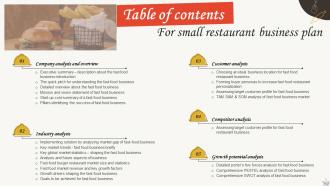
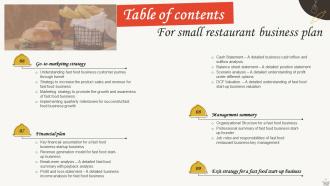
Slide 3: This slide incorporates the Table of Contents.
Slide 4: This slide continues the Table of Contents.
Slide 5: This slide highlights the Title for the Topics to be discussed further.
Slide 6: This slide covers a brief glimpse of what the business will be offering to the customer with market information.
Slide 7: This slide gives a glimpse of what the quick pitch of the business to the customers with market information.
Slide 8: This slide provides a Detailed overview about the fast food business.
Slide 9: This slide portrays the Mission and Vision statement of a fast food business.
Slide 10: This slide showcases the Start-up cost summary of a fast food business.
Slide 11: This slide presents the Pillars identifying the success of fast food business.
Slide 12: This slide includes the Heading for the Components to be covered in the forth-coming template.
Slide 13: This slide talks about Implementing solution by analyzing market gap of fast food business.
Slide 14: This slide continues Implementing solution by analyzing market gap of fast food business.
Slide 15: This slide highlights the thorough assessment of a market within the market trends along with the key stats.
Slide 16: This slide continues the thorough assessment of a market within the grocery or supermarket along with the key stats.
Slide 17: This slide portrays the thorough assessment of a market within the global market key stats shaping the fast food business.
Slide 18: This slide provides a brief about the fast food business, its overview.
Slide 19: This slide elucidates Fast food burger restaurant market size and statistics.
Slide 20: This slide reveals the Us Fast Food Industry Revenue Over Time.
Slide 21: This slide displays the Growth drivers shaping the fast food business.
Slide 22: This slide continues the Growth drivers shaping the fast food business.
Slide 23: This slide exhibits the Goals to be achieved for fast food business.
Slide 24: This slide elucidates the Title for the Ideas to be discused in the following template.
Slide 25: This slide highlights the thorough assessment of a business location within country.
Slide 26: This slide deals with Forming buyer personas to increase fast food restaurant personalization.
Slide 27: This slide focuses on Assessing target customer profile for fast food business.
Slide 28: This slide reveals the TAM SAM & SOM analysis of fast food business market.
Slide 29: This slide incorporates the Heading for the Ideas to be covered next.
Slide 30: This slide emphasizes on Assessing target customer profile for fast food restaurant business.
Slide 31: This slide portrays the Title for the Contents to be discussed next.
Slide 32: The slide highlights porter’s five forces model and its implications in the retail store business industry.
Slide 33: This slide showcases the Comprehensive PESTEL analysis of fast food business.
Slide 34: This slide exhibits the Comprehensive SWOT analysis of fast food business.
Slide 35: This slide mentions the Heading for the Topics to be covered in the following template.
Slide 36: This slide displays Understanding fast food business customer journey through funnel.
Slide 37: This slide talks about Strategy to increase the product sales and revenue for fast food business.
Slide 38: This slide presents the Marketing strategy to promote the growth and awareness of fast food business.
Slide 39: This slide continues the Marketing strategy to promote the growth and awareness of fast-food business.
Slide 40: This slide focuses on Implementing quarterly milestones for successful fast food business growth.
Slide 41: This slide reveals the Title for the Components to be discussed next.
Slide 42: This slide represents financial assumptions of the fast food business plan.
Slide 43: This slide elucidates the Revenue generation model for fast food start-up business.
Slide 44: This slide showcases the break-even analysis.
Slide 45: This is yet another slide continuing the Break-even Analysis.
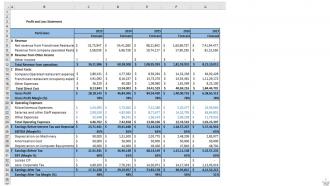
Slide 46: This slide highlights the profit and loss statement.
Slide 47: This slide continues graphs of gross profit of the business and earnings before interest tax & depreciation.
Slide 48: This is yet another slide continuing the graphs of total revenue from operations and earnings after tax.
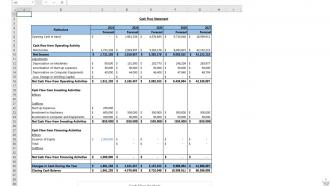
Slide 49: This slide shows the business’s historical and forecasted cash flow results.
Slide 50: This slide continues the Cash Flow Analysis.
Slide 51: This slide represents balance sheet statement.
Slide 52: This is yet another slide continuing the cash flow analysis and total assets.
Slide 53: This slide reveals the different scenarios for deriving final annual profit after tax based on best case, nominal case and worst case.
Slide 54: This slide continues the Scenario analysis.
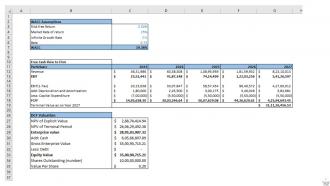
Slide 55: This slide shows the DCF valuation analysis of a business’s financials based on the free cash flow to firm.
Slide 56: THis slide displays the Heading for the Topics to be covered further.
Slide 57: This slide illustrates the organizational structure of the business.
Slide 58: This slide portrays the Professional summary of fast food business start-up founder.
Slide 59: This slide exhibits the Job roles and responsibilities of fast food restaurant business key management.
Slide 60: This slide continues the Job roles and responsibilities of fast food business key management.
Slide 61: This slide presents the Title for the Topics to be discussed in the upcoming template.
Slide 62: This slide represents exit strategy for stakeholders such as venture capitalists, private offerings and initial public offer.
Slide 63: This is the Icons Slide containing all the Icons used in the plan.
Slide 64: This slide is used for showcasing some Additional information.
Slide 65: This is the About us slide. State your company-related information here.
Slide 66: This slide displays the organization's Mission, Vision, and Goal.
Slide 67: This slide mentions about the company's Vision, Mission, and Goal.
Slide 68: This is Our team slide. State your team-related information here.
Slide 69: This slide elucidates the information related to the Financial topic.
Slide 70: This slide represents the firm's Roadmap.
Slide 71: This is the Venn diagram slide.
Slide 72: This is the Puzzle slide with related imagery.
Slide 73: This slide portrays the SWOT Analysis of the company.
Slide 74: This slide contains the Post it notes for reminders and deadlines.
Slide 75: This is the Idea generation slide for encouraging fresh ideas.
Slide 76: This is the 30 60 90 days plan slide for effective planning.
Slide 77: This is the Thank You slide for acknowledgement.
Small Restaurant Business Plan Powerpoint Presentation Slides with all 80 slides:
Use our Small Restaurant Business Plan Powerpoint Presentation Slides to effectively help you save your valuable time. They are readymade to fit into any presentation structure.






FAQs for Small Restaurant Business Plan
So you'll need the basics covered first - your concept, who you're targeting, and realistic financial projections (seriously, don't go crazy optimistic here). Map out your competition locally and figure out your operations like staffing and suppliers. Marketing strategy is huge - I see so many people think amazing food just sells itself, but it really doesn't work that way. Menu pricing takes thought too. Location analysis matters more than you'd think. Oh, and if you're seeking investors, that executive summary better grab them immediately. Management team info rounds it out. Honestly the financial piece trips up most people I know.
First figure out your restaurant concept and location - that'll point you toward your target market. Check out who lives within 3-5 miles: ages, income, family sizes, dining patterns. Honestly, just walk around the neighborhood at different times and see who's actually out there! Ask potential customers about preferences and how much they're willing to spend. Scope out your competition's crowd too. Are they families? Young professionals on dates? Create 2-3 detailed customer profiles from this info. Then - and this is crucial - actually talk to people who fit these profiles before you lock in your menu and pricing. Don't skip that last step.
Look, your USP is what stops customers from just picking the place next door. Without one, you're screwed - most restaurants fail because they blend into the background noise. Could be "authentic Korean BBQ" or "we deliver pizza in 30 seconds" or whatever, but it needs to be specific and actually defendable. People have to want what you're offering, not just think it sounds neat. Write it down in one sentence and let that drive everything else - your menu, pricing, how you market. I always tell people this is literally the foundation of your whole business plan. Get this wrong and nothing else matters.
Look, first thing - get real numbers for your area. Rent, equipment, staff wages, food costs, utilities, all of it. You'll want 6-12 months of operating cash saved up (honestly, lean toward 12 if you can swing it). Figure out how many people you can serve daily, what they'll spend on average, then calculate your staffing and food costs from there. Don't assume you'll be packed from week one - it takes time to build up. I'd go conservative on revenue estimates and bump up your expenses by 15-20% because stuff always costs more than expected. Create three scenarios: best case, realistic, and "oh crap" so you know what you're getting into.
Honestly, start with the basics - foot traffic, parking, what other businesses are around. Check out your competitors too. Their menus, prices, when they're slammed. Read their reviews (some are brutal but helpful). Demographics sound boring af but you gotta know who's actually gonna eat there - income levels, what they like to eat, work schedules. I'd also just ask people directly, like quick surveys or chat with folks on the street. Sounds like a lot but it'll save you from opening a sushi place next to three other sushi spots or whatever.
Figure out your restaurant's vibe first - what food, atmosphere, price range you're going for. Paint a clear picture of the whole experience when people walk in. The decor, music, service style, even lighting matters. Your target customer should be obvious from how you describe it. Honestly, the best restaurant concepts make you feel like you're already there just from reading about them. What makes you different from that Italian place down the street? Don't just list features - help investors actually visualize someone having dinner there. Think about restaurants you love and what sticks with you.
Dude, location analysis can totally make or break your whole thing. Walk around and count actual foot traffic, check out who lives there (income levels, age groups), and scope out your competition within like 3 miles. Parking is huge too - nobody wants to circle blocks for tacos, you know? I'd also dig into local spending habits because even if people have money doesn't mean they'll drop it on food. My cousin opened this amazing sandwich place but picked a spot where everyone brown-bagged lunch. Don't be that guy. Get real data now before you're stuck with a lease you can't afford.
Create a detailed menu broken down by category - apps, mains, desserts, drinks. Include sample dishes with descriptions and price points for each section. Explain your pricing strategy too. Going premium or targeting value? How do you stack up against nearby competition? Food costs and profit margins are crucial - investors want to see you've crunched the numbers. Highlight any signature items that'll make you stand out from the crowd (this is honestly where most people mess up). Keep it organized but detailed enough that someone could actually picture themselves ordering. Don't just throw everything at them in a giant list.
Okay so for sourcing - honestly, local suppliers are your best bet for fresh stuff. Way more reliable and you actually get to know them. Sysco and US Foods are solid for your dry goods though, saves you tons of headaches. Always have backups ready because suppliers flake sometimes. Get your payment terms sorted upfront too - everything in writing or you'll regret it later. Start with a list of what you need most, then hit up like 2-3 suppliers per category. Compare prices but don't just go with the cheapest - reliability matters more than saving five bucks.
Okay so break it into four main things: social media, local partnerships, your grand opening, and keeping customers coming back. Figure out which platforms your people actually use first. Partner up with nearby businesses and food bloggers - they're goldmines for word-of-mouth. Your grand opening is make-or-break territory, so do a full 2-week campaign with tastings and deals. Don't wing it! After that, loyalty programs work great, plus seasonal stuff and regular posts. Oh, and make a monthly calendar so you're not panicking at 2am trying to think of content ideas.
For your restaurant's org structure, start with who owns what percentage, then work down to management - GM, kitchen manager, FOH supervisor. Each role needs a brief job description plus who reports to who. Don't skip the regular staff either (servers, cooks, hosts). Honestly, investors eat this stuff up because most people just think good food will magically run itself. Throw in any advisors or consultants you're working with too. An org chart makes everything way clearer - people love visuals when they're trying to wrap their heads around how you'll actually operate day-to-day.
Honestly, don't skip the risk assessment part - that's where most food business plans fall apart. Cover the obvious stuff like labor shortages, supply chain issues, food safety problems, and economic hits. What backup suppliers do you have? Cross-train your staff so you're not screwed if someone quits. Keep cash reserves for slow months (trust me on this one). Insurance and health dept compliance too, obviously. Investors want to see you've actually thought about what happens when things go sideways, not just the perfect-world version. Too many people wing this section and it shows.
Your food costs should hit around 28-35% of revenue, and labor costs around 25-35%. Investors really want to see you'll break even within 12-18 months - that's like the golden rule. Average transaction value matters a ton, plus how many times you can turn tables daily since that's literally your money-maker. Don't overcomplicate it with weird metrics nobody understands. ROI projections are huge, and definitely show cash flow for your first two years. Honestly, keep the numbers realistic and easy to verify against what other restaurants actually do. Simple beats fancy every time.
Start with local sourcing if you can - way easier than people think. Composting and energy-efficient equipment should be next on your list. Customers actually care about this stuff now, which honestly surprised me at first, but it's become solid marketing too. Your packaging choices matter more than you'd expect. Plant-based options are huge right now. Don't go crazy trying to do everything - pick like 2-3 things and nail those first. Water usage is worth looking at too, but that can come later.
Dude, you absolutely need a timeline with real dates - permit approvals, buildout completion, staff hiring, opening day. Everything will take way longer than you expect, trust me on that one. Investors want to see you've thought this through and aren't just winging it. Plus these milestones help you spot problems before they derail everything. Banks especially love detailed planning because they know how many restaurants crash and burn from poor execution. Build in extra time for delays - like, seriously, add at least 20% buffer to whatever timeline you're thinking.
-
Great product with highly impressive and engaging designs.
-
Awesome presentation, really professional and easy to edit.