


Step By Step Plan For Restaurant Opening Powerpoint Presentation Slides





Try Before you Buy Download Free Sample Product
 Impress Your
 Audience
 100%
100% Editable
 Save Hours
 of Time


Grab our professionally designed Step-By-Step Plan for Restaurant Opening PowerPoint presentation. It serves as an exhaustive guide outlining the step-by-step process for a successful restaurant opening. From inception to inauguration, this Opening day PPT covers a detailed roadmap, encompassing essential strategies, industry best practices, and vital functional elements vital for a triumphant launch. Additionally, our Inventory management PPT highlights key insights into various aspects critical for a restaurants opening. It includes strategic planning, site selection, menu curation, staffing, marketing approaches, and operational essentials. Furthermore, the PowerPoint deck explores the comprehensive breakdown of pre-opening tasks, operational procedures, and legal requirements. It also highlights effective marketing strategies tailored to ensure a smooth inauguration. Moreover, our Restaurant inauguration module also sheds light on budgeting, timeline management, and customer engagement strategies aimed at fostering a successful launch. Get to know more by downloading our 100 percent editable and customizable template, which is also compatible with Google Slides.
People who downloaded this PowerPoint presentation also viewed the following :
Content of this Powerpoint Presentation
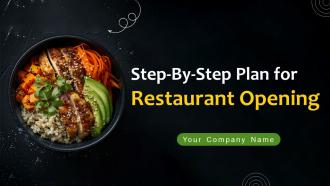
Slide 1: This slide introduces Step-By-Step Plan for Restaurant Opening. State your company name and begin.
Slide 2: This slide states Agenda of the presentation.
Slide 3: This slide shows Table of Content for the presentation.
Slide 4: This slide highlights title for topics that are to be covered next in the template.
Slide 5: This slide presents Overview associated with global restaurant industry.
Slide 6: This slide displays Comparison between restaurant industry and food service.
Slide 7: This slide represents Key statistics related to restaurant industry.
Slide 8: This slide showcases Current trends associated with restaurant industry.
Slide 9: This slide highlights title for topics that are to be covered next in the template.
Slide 10: This slide shows Timeline for restaurant business opening process.
Slide 11: This slide highlights title for topics that are to be covered next in the template.
Slide 12: This slide presents Right restaurant business concept selection.
Slide 13: This slide displays Identify potential target audience for business.
Slide 14: This slide represents Unique selling proposition for family style restaurant.
Slide 15: This slide highlights title for topics that are to be covered next in the template.
Slide 16: This slide showcases Estimate start-up expense for restaurant business.
Slide 17: This slide represents various sources for financing the restaurant business.
Slide 18: This slide shows Financial projections related to restaurant business.
Slide 19: This is another slide continuing Financial projections related to restaurant business.
Slide 20: This slide presents Cost control strategies for expense management.
Slide 21: This slide highlights title for topics that are to be covered next in the template.
Slide 22: This slide displays Location selection criteria for family style restaurant.
Slide 23: This slide represents Lease vs purchase consideration checklist for restaurant.
Slide 24: This slide showcases Restaurant business lease contract sample.
Slide 25: This slide highlights title for topics that are to be covered next in the template.
Slide 26: This slide shows Important licenses and permits required for starting restaurant.
Slide 27: This slide presents Regulatory compliance checklist for restaurant business.
Slide 28: This is another slide continuing Regulatory compliance checklist for restaurant business.
Slide 29: This slide highlights title for topics that are to be covered next in the template.
Slide 30: This slide displays Staffing requirements for operating restaurant.
Slide 31: This slide represents Recruitment and hiring process for restaurant staff.
Slide 32: This slide showcases New hire checklist for restaurant employees.
Slide 33: This slide shows Training plan to enhance employee skills.
Slide 34: This slide presents Onboarding process checklist for new hires.
Slide 35: This slide highlights title for topics that are to be covered next in the template.
Slide 36: This slide displays Menu development process for efficient serving.
Slide 37: This slide represents menu pricing strategy with the aim of increasing sales and maximizing profit for the restaurant.
Slide 38: This slide showcases Dietary accommodation in family style restaurant.
Slide 39: This slide shows Sample menu for family style restaurant.
Slide 40: This slide presents Calculation for food servings at restaurant.
Slide 41: This slide displays Identification of equipment needed for operating restaurant.
Slide 42: This slide highlights title for topics that are to be covered next in the template.
Slide 43: This slide represents Types of suppliers needed for family style restaurant.
Slide 44: This slide showcases Types of supplies needed for establishing family style restaurant.
Slide 45: This slide shows Vendor selection criteria for material supply.
Slide 46: This slide presents Sample restaurant vendor agreement format.
Slide 47: This slide highlights title for topics that are to be covered next in the template.
Slide 48: This slide displays Restaurant inventory control checklist for waste management.
Slide 49: This slide represents Restaurant inventory control checklist for waste management cont..
Slide 50: This slide highlights title for topics that are to be covered next in the template.
Slide 51: This slide showcases Restaurant technologies used to enhance business operations.
Slide 52: This slide represents key benefits associated with POS (Point On Sale) system for the restaurant.
Slide 53: This slide showcases Restaurant payment processing and management system.
Slide 54: This slide shows Restaurant reservation management system to improve customer experience.
Slide 55: This slide presents Restaurant online ordering management system.
Slide 56: This slide displays Types of kitchen automation systems to enhance operations.
Slide 57: This slide highlights title for topics that are to be covered next in the template.
Slide 58: This slide represents Online marketing strategies for restaurant promotion.
Slide 59: This slide showcases Sample restaurant online marketing campaign.
Slide 60: This slide shows Offline marketing strategies for restaurant promotion.
Slide 61: This slide presents Sample restaurant offline marketing campaign.
Slide 62: This slide displays Pre-opening restaurant marketing campaigns to attract target audience.
Slide 63: This slide highlights title for topics that are to be covered next in the template.
Slide 64: This slide represents Planning and execution checklist for restaurant soft opening.
Slide 65: This slide showcases Approaches to gather feedback after restaurant opening.
Slide 66: This slide highlights title for topics that are to be covered next in the template.
Slide 67: This slide shows Potential challenges and solutions faced by restaurant after opening.
Slide 68: This slide contains all the icons used in this presentation.
Slide 69: This slide is titled as Additional Slides for moving forward.
Slide 70: This slide provides 30 60 90 Days Plan with text boxes.
Slide 71: This is an Idea Generation slide to state a new idea or highlight information, specifications etc.
Slide 72: This is a Timeline slide. Show data related to time intervals here.
Slide 73: This slide contains Puzzle with related icons and text.
Slide 74: This slide shows SWOT describing- Strength, Weakness, Opportunity, and Threat.
Slide 75: This is a Thank You slide with address, contact numbers and email address.
Step By Step Plan For Restaurant Opening Powerpoint Presentation Slides with all 83 slides:
Use our Step By Step Plan For Restaurant Opening Powerpoint Presentation Slides to effectively help you save your valuable time. They are readymade to fit into any presentation structure.










FAQs for Step By Step Plan For Restaurant Opening
Okay so for your restaurant business plan, start with the executive summary - that's what gets people hooked or makes them bail immediately. Then you need market analysis, your menu concept, and honestly the financial stuff is where most plans live or die. Include startup costs, revenue forecasts, break-even analysis - investors will pick those numbers apart. Don't skip the operations plan and management team bios either. Oh, and location analysis is huge (I learned that the hard way with my cousin's failed taco place). Competitive research, marketing strategy, staffing plans, licensing requirements - it's a lot but worth doing right.
Dude, you gotta check if people will actually show up before you sign a lease! Look at who lives around there - ages, income, how busy the streets get. I learned this the hard way when I almost opened next to THREE coffee shops lol. Census data's helpful, but honestly? Just hang out near your potential spot during lunch and dinner. See if it's dead or packed. Check what restaurants are already killing it versus the empty ones. Don't be that person who opens another burger joint where nobody asked for one. The research saves you from expensive mistakes later.
Look for what's actually missing around you - not just what's hot in other cities. Your concept has to fix a real problem or fill a gap people care about. What's your story though? That's what I always think about first because it drives everything else. Maybe you're sharing grandma's recipes, trying some wild fusion, or creating this whole communal dining thing. Test that story with people before you blow money on anything. Get their honest feedback early - trust me, it beats learning the hard way later when you're already in deep.
Dude, budget way more than you think - seriously, most people are off by like 50% easy. Equipment and rent are obvious but there's so much random stuff. Permits, renovations, inventory to start. Plus you need cash flow for 3-6 months before making real money. Oh and all the little crap adds up insanely fast - uniforms, cleaning supplies, marketing stuff, training new people. My cousin learned this the hard way with her bakery. Make a massive list of every expense, then slap on 20% extra because something will surprise you. Start that spreadsheet now and keep updating it.
Figure out your vibe first - family spot, trendy, upscale casual, whatever. Then make everything match that energy, from your logo to how servers talk to people. Honestly, there's like a million restaurants out there, so write down what makes yours different. Who's your ideal customer? Once you know that stuff, your messaging becomes way easier - whether it's Instagram posts, your website, or even how you describe the burgers on your menu. Oh and definitely run your ideas by some friends before you go live with anything. They'll tell you if it sounds weird.
Dude, seriously don't sleep on menu design! It's like your silent salesperson working 24/7. Good design makes food sound amazing and helps people order faster without getting overwhelmed by choices. The colors and fonts you pick actually affect how customers view your prices and quality - psychology is wild like that. A messy menu creates decision fatigue and slows everything down. Professional design costs upfront but you'll make it back through higher order totals. My cousin learned this the hard way with his taco place. Trust me, it's worth the investment early on.
Okay so first thing - call your local SBA office because every city's different and they'll give you the actual checklist. But generally you're looking at business license, food service permit from health dept, and if you're doing booze then liquor license (which honestly is such a pain and takes months). Fire department needs to sign off too. Your staff will need food handler certs. Oh and don't forget the boring stuff like workers' comp insurance and getting your EIN from IRS. City probably wants signage permits too but that's usually pretty quick.
Honestly, hire for attitude first - you can teach someone to make a latte, but you can't teach them to care. I'd start recruiting like 6-8 weeks early so you're not scrambling. The buddy system is clutch - pair newbies with your best people for real hands-on training. Don't just tell them what to do, explain why you do things that way. Oh, and definitely run at least two mock services before opening. Trust me on that one. I've seen too many places crash and burn on day one because they skipped the practice rounds. Your POS system will definitely glitch when you least expect it.
Hey! So I'd say get started around 6-8 weeks out. Social media teasers work really well - just don't go overboard with the hype. Partner with local food bloggers if you can, they're usually down to help new spots. Oh and definitely do a soft opening with friends first, gets the kinks out. Google My Business is boring but necessary, same with reaching out to local press. Facebook ads aren't dead yet either, especially for targeting your neighborhood. A proper preview night for VIP people and media is smart too. Honestly, start planning your content now because last-minute scrambling sucks. The whole thing's about building buzz without promising too much.
Honestly, get a decent POS system first - that thing will save your sanity when everything's crazy those first few weeks. Handles orders, payments, inventory, the whole deal. Digital scheduling is clutch too, stops all the "wait, am I working today?" texts. Oh, and kitchen displays instead of handwritten tickets - total game changer for speed. If you're doing table service, grab some reservation software. Maybe throw in basic analytics to see what's selling and when you're slammed. But seriously, don't go overboard right away. Pick like 2-3 things max and actually learn them before adding more tech.
Start posting behind-the-scenes stuff on social media at least a month before opening - your team prepping, sneak peeks of dishes, the space coming together. People eat that insider stuff up, it's crazy how much they love it. Get some local food bloggers in for preview tastings before you officially launch. A soft opening with friends and family is clutch for working out the inevitable hiccups while getting word-of-mouth going. Don't sleep on old-school PR either - send press releases to local food writers. Oh, and partner with influencers if your budget allows. Build that anticipation slowly instead of just dropping the news last minute.
Get your staffing schedules sorted first, plus inventory and daily prep - that's your base. Peak rush plans are huge too, trust me on that one. Opening/closing checklists will save your sanity later. Yeah, cash handling and equipment maintenance sound boring but they matter. Food safety protocols obviously can't be skipped. Build backup plans for when people call out sick or deliveries run late (because they will). The more detail you hammer out now, the less you'll be scrambling when customers are lined up. You can always tweak things once you're running.
Start posting maybe 2-3 weeks out - show behind-the-scenes stuff, introduce your team, post drool-worthy pics of your signature dishes. Instagram and TikTok work best for restaurants honestly. Make a hashtag and get people using it early on. Definitely hit up local food influencers for opening week (they're usually down for free food). Run some specials just for your social media followers - makes them feel special, you know? Don't stress about making everything look perfect either. People actually prefer the authentic, slightly messy content over super polished stuff. Just stay consistent with posting and you'll be good.
Invite your friends and family first - they won't murder you if the kitchen's running 20 minutes behind. Do a few test runs to catch all the inevitable disasters with your POS system and server timing. Trust me, weird stuff always breaks on night one. Keep your menu super simple so the kitchen can actually nail what they're making instead of juggling fifty dishes badly. Write down everything that goes sideways each night, then immediately huddle with your team afterward while you're all still traumatized by whatever just happened. Those fresh war stories are gold for fixing things before real customers show up.
Definitely need those 3-5 year revenue projections and monthly cash flow for the first two years minimum. Startup costs and ongoing expenses - break that stuff down as much as possible. Food costs, labor, rent, all of it. The granular detail actually impresses them more than you'd think. Break-even analysis is huge too since they want to know when you'll be profitable. Oh, and do different scenarios - conservative, realistic, optimistic. Shows you're not just being overly hopeful. Just make sure whatever numbers you use come from actual local market research and industry data, not random guesses.
-
The design is very attractive, informative, and eye-catching, with bold colors that stand out against all the basic presentation templates.
-
It's always a delight to see new templates from you! I am extremely pleased with the fact that they are easy to modify and fit any presentation layout in seconds!