


Steps For Opening New Retail Store




Try Before you Buy Download Free Sample Product
 Impress Your
 Audience
 100%
100% Editable
 Save Hours
 of Time


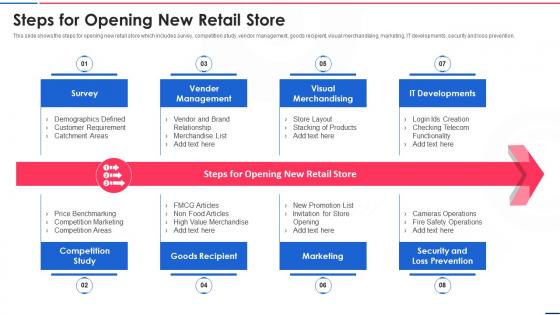
This slide shows the steps for opening new retail store which includes survey, competition study, vendor management, goods recipient, visual merchandising, marketing, IT developments, security and loss prevention.
People who downloaded this PowerPoint presentation also viewed the following :
Steps For Opening New Retail Store with all 6 slides:
Use our Steps For Opening New Retail Store to effectively help you save your valuable time. They are readymade to fit into any presentation structure.





FAQs for Steps For Opening
Key factors include foot traffic patterns, target demographic alignment, competition density, lease terms and costs, and accessibility for customers and suppliers. These location elements directly impact sales potential and operational efficiency, with many successful retail startups finding that strategic positioning in high-visibility areas with complementary businesses ultimately delivers sustained customer acquisition and competitive market advantage.
Market research helps identify target customers by analyzing demographics, purchasing behaviors, local competition, seasonal trends, and consumer preferences through surveys, focus groups, and sales data analysis. Through comprehensive market analysis, retail entrepreneurs can determine optimal product mix, pricing strategies, and store locations while understanding customer pain points, ultimately enabling more effective marketing campaigns and inventory decisions that drive higher conversion rates and customer loyalty.
Essential retail store licenses include a business license, sales tax permit, reseller's permit, zoning permits, and fire department clearances, with specific requirements varying by location and product type. These regulatory foundations enable legal operations by ensuring tax compliance, product sourcing authorization, and safety standards adherence, ultimately delivering operational legitimacy and customer trust while protecting against costly legal complications.
A retail store should define its USP by identifying specific customer pain points, analyzing competitor weaknesses, leveraging unique product offerings or service approaches, and aligning with target demographics' values and preferences. Successful retailers like Warby Parker with direct-to-consumer eyewear or Patagonia with sustainability focus demonstrate how clear differentiation drives customer loyalty, enhances brand recognition, and ultimately delivers competitive advantage in crowded markets.
Branding establishes customer recognition, trust, and differentiation in competitive markets, while communicating your store's unique value proposition, target audience appeal, and quality standards. Strong branding enables retail startups to command premium pricing, build customer loyalty, and create memorable shopping experiences, with many successful retailers finding that consistent brand messaging across packaging, signage, and digital platforms ultimately drives long-term growth and market positioning.
Startup retail stores can effectively manage inventory through demand forecasting, ABC analysis, just-in-time ordering, supplier relationship optimization, and inventory management software implementation. These approaches streamline operations by reducing carrying costs, minimizing stockouts, and improving cash flow, with many retail startups finding that strategic inventory control ultimately delivers competitive pricing and enhanced customer satisfaction.
Pre-opening marketing strategies include social media teasers, local community partnerships, influencer collaborations, email list building, and soft launch events for friends and family. These approaches generate anticipation by creating exclusive previews, offering early-bird discounts, and building relationships with local organizations, with many retailers finding that strategic pre-launch campaigns deliver higher foot traffic and stronger customer loyalty from day one.
Technology enhances retail customer experience through mobile apps for seamless shopping, AI-powered personalization engines, contactless payment systems, augmented reality try-on features, and smart inventory management. These solutions streamline operations by reducing wait times, delivering targeted product recommendations, and enabling omnichannel experiences, with many retailers finding that integrated technology platforms ultimately drive higher customer satisfaction and increased sales conversion rates.
Financing options for retail entrepreneurs include traditional bank loans, SBA loans, angel investors, venture capital, crowdfunding platforms, equipment financing, and merchant cash advances. These funding sources enable startups to secure inventory, lease prime locations, and invest in point-of-sale systems, with many retail entrepreneurs finding that combining multiple financing methods accelerates growth and reduces dependency risks.
Common mistakes include poor location selection, inadequate cash flow management, insufficient market research, overordering inventory, and neglecting customer experience strategies. New retail owners can avoid these pitfalls by conducting thorough demographic analysis, maintaining three to six months of operating expenses in reserve, implementing inventory management systems, and prioritizing staff training, ultimately delivering sustainable growth and competitive market positioning.
Customer feedback is crucial for retail stores, enabling optimization of product selection, pricing strategies, inventory management, and service delivery through direct market insights. Through systematic feedback collection, retail startups can identify trending products, adjust merchandising approaches, and enhance customer experiences, while many successful retailers find that responsive feedback integration ultimately drives customer loyalty and competitive differentiation.
Effective retail staffing strategies include hiring versatile employees who can handle multiple roles, recruiting experienced retail professionals for key positions, implementing comprehensive training programs, establishing clear job descriptions with performance metrics, and creating competitive compensation packages. These approaches streamline operations by ensuring adequate coverage, reducing training time, and maintaining consistent customer service standards, with many successful retail startups finding that strategic early hiring decisions ultimately deliver enhanced customer experiences and operational efficiency.
Retail stores can create visually appealing layouts through strategic product placement, effective lighting design, clear customer flow paths, attractive window displays, and cohesive color schemes. These design elements work together to enhance customer experience, encourage longer browsing times, and ultimately increase sales conversion rates, with many successful retailers finding that thoughtful layout planning significantly boosts foot traffic and revenue.
Sustainability practices include energy-efficient lighting, eco-friendly packaging, local sourcing partnerships, waste reduction programs, and carbon-neutral shipping options. These initiatives enhance brand reputation by demonstrating environmental responsibility, reducing operational costs, and attracting eco-conscious customers, with many retail stores finding that sustainable practices ultimately deliver competitive advantage and increased customer loyalty.
E-commerce integration revolutionizes retail startup operations by expanding market reach, streamlining inventory management, and enabling data-driven decision making. Through integrated platforms, retail startups can automate order processing, synchronize stock levels across channels, and analyze customer behavior patterns, while reducing overhead costs and operational complexity, ultimately delivering enhanced customer experiences and accelerated growth in an increasingly competitive marketplace.
-
Delighted to see unique and eye-catching PowerPoint designs that are so easy to customize.
-
The designs by SlideTeam are honestly the best I have seen so far. Will be definitely coming back for more.