


Project Planning For Successful Retail Rollout




Try Before you Buy Download Free Sample Product
 Impress Your
 Audience
 100%
100% Editable
 Save Hours
 of Time


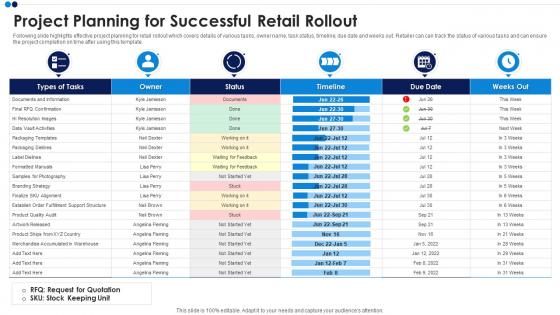
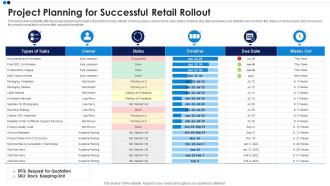
Following slide highlights effective project planning for retail rollout which covers details of various tasks, owner name, task status, timeline, due date and weeks out. Retailer can can track the status of various tasks and can ensure the project completion on time after using this template.
People who downloaded this PowerPoint presentation also viewed the following :
Project Planning For Successful Retail Rollout with all 6 slides:
Use our Project Planning For Successful Retail Rollout to effectively help you save your valuable time. They are readymade to fit into any presentation structure.





FAQs for Project Planning For
Key components of an effective project plan include clear objectives, detailed timelines, resource allocation, risk assessment, and stakeholder communication frameworks. These elements work together by establishing accountability, streamlining coordination, and enabling proactive problem-solving, with many organizations finding that comprehensive planning reduces project delays by up to 40% while enhancing team collaboration.
Project scope is defined through detailed requirements documentation, stakeholder alignment sessions, clear deliverable specifications, and established change control processes. These frameworks streamline project execution by setting firm boundaries, implementing approval workflows for modifications, and maintaining transparent communication channels, with many organizations finding that structured scope management ultimately delivers projects on time and budget while avoiding costly overruns.
Stakeholder analyses identify key individuals, groups, and organizations impacted by or influencing project outcomes, mapping their interests, power levels, communication preferences, and potential support or resistance. Through systematic stakeholder mapping, project managers can develop targeted engagement strategies, anticipate challenges, and secure necessary buy-in, ultimately delivering smoother project execution and higher success rates.
Gantt charts enhance project planning by providing visual timeline representation, task dependencies mapping, resource allocation tracking, and milestone identification in a single comprehensive view. These visual tools streamline project management by enabling teams to identify bottlenecks quickly, adjust schedules proactively, and maintain stakeholder alignment, ultimately delivering improved project completion rates and enhanced operational efficiency across organizations.
Best practices for estimating project timelines and budgets include breaking projects into detailed tasks, analyzing historical data, incorporating buffer time, conducting stakeholder consultations, and using multiple estimation techniques. These approaches enhance accuracy by accounting for scope changes, resource constraints, and unforeseen challenges, with many organizations finding that structured estimation processes ultimately deliver more predictable outcomes and improved project success rates.
Task prioritization involves evaluating activities based on critical path dependencies, resource constraints, stakeholder impact, and strategic value to the organization. Project managers increasingly use frameworks like MoSCoW method, weighted scoring models, and resource leveling techniques to optimize allocation, with many finding that combining urgency-importance matrices with capacity planning delivers enhanced project efficiency and predictable outcomes.
Technology tools for project planning include Gantt chart software, resource management platforms, collaboration tools, time tracking applications, and AI-powered scheduling systems. These technologies streamline project workflows by automating task dependencies, optimizing resource allocation, and providing real-time progress visibility, with many organizations finding that integrated platforms ultimately enhance team productivity and deliver faster project completion rates.
Risk assessment and management integrate into project planning through early identification of potential issues, development of mitigation strategies, and continuous monitoring throughout project lifecycles. Organizations systematically evaluate financial, operational, and timeline risks during planning phases, creating contingency plans and resource buffers, ultimately delivering more predictable outcomes and enhanced stakeholder confidence.
Effective communication methods include regular team meetings, collaborative project management platforms, standardized reporting templates, clear documentation protocols, and designated communication channels for different project aspects. These approaches streamline information flow by establishing consistent touchpoints, centralizing project data, and defining communication responsibilities, with many organizations finding that structured communication frameworks significantly reduce misunderstandings and enhance project delivery timelines.
Scope changes during planning are handled through formal change control processes, impact assessment, stakeholder approval, and documentation updates. Project managers evaluate how modifications affect timeline, budget, and resources, then communicate implications to stakeholders before updating project plans, with many organizations finding that structured change management prevents scope creep while maintaining project viability.
Measurable goals and objectives provide clear success criteria, enable progress tracking, facilitate resource allocation, and ensure stakeholder alignment throughout project execution. They enhance accountability by establishing specific benchmarks, streamline decision-making processes, and minimize scope creep, with many organizations finding that measurable targets ultimately deliver improved project outcomes and competitive advantage.
Effective stakeholder engagement requires regular communication touchpoints, transparent progress reporting, collaborative decision-making processes, and proactive issue resolution throughout each project phase. By implementing structured feedback sessions, milestone reviews, and real-time project dashboards, organizations can maintain stakeholder alignment and commitment, ultimately delivering projects that meet expectations while minimizing costly revisions and scope changes.
Strategies include establishing clear communication channels, defining individual roles and responsibilities, implementing regular check-ins and progress meetings, creating shared digital workspaces, and encouraging cross-functional collaboration. These approaches streamline coordination by promoting transparency, accountability, and collective problem-solving, with many organizations finding that structured collaboration frameworks ultimately deliver faster project completion and enhanced team productivity.
Agile project planning emphasizes iterative sprints, continuous stakeholder feedback, and adaptive scope changes, while traditional methodologies follow sequential phases with detailed upfront documentation and fixed timelines. Through shorter planning cycles, agile teams deliver working prototypes faster and respond to market changes more effectively, while traditional approaches provide comprehensive risk assessment and predictable deliverables, with many organizations finding hybrid models optimize both flexibility and control.
Common project planning pitfalls include unrealistic timelines, insufficient resource allocation, poor stakeholder communication, inadequate risk assessment, and scope creep management failures. These challenges can be avoided by conducting thorough feasibility studies, establishing clear communication protocols, implementing robust change management processes, and regular milestone reviews, with many organizations finding that proactive planning and stakeholder engagement ultimately delivers improved project success rates and operational efficiency.
-
The pricing page of this website is very sorted. I felt no pain while buying the PPTs.
-
SlideTeam offers so many variations of designs and topics. It’s unbelievable! Easy to create such stunning presentations now.