


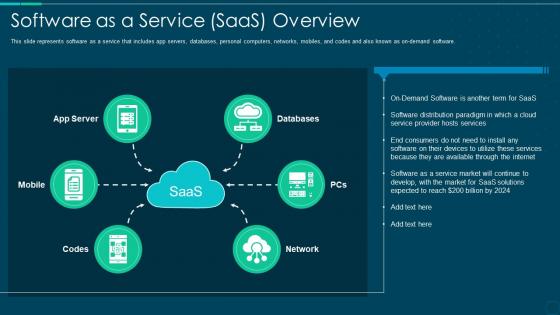
Software as a service saas overview ppt portfolio slide




Try Before you Buy Download Free Sample Product
 Impress Your
 Audience
 100%
100% Editable
 Save Hours
 of Time


Our Software As A Service Saas Overview Ppt Portfolio Slide are topically designed to provide an attractive backdrop to any subject. Use them to look like a presentation pro.
People who downloaded this PowerPoint presentation also viewed the following :
Software as a service saas overview ppt portfolio slide with all 6 slides:
Use our Software As A Service Saas Overview Ppt Portfolio Slide to effectively help you save your valuable time. They are readymade to fit into any presentation structure.





FAQs for Software as a service saas overview
SaaS is characterized by cloud-based delivery, subscription pricing models, automatic updates, multi-tenant architecture, and browser-based accessibility without local installations. These characteristics enable organizations to reduce IT overhead, scale rapidly, and access enterprise-grade software with minimal upfront investment, with many businesses finding that this model delivers enhanced flexibility and predictable operational costs.
SaaS delivers software through cloud-based subscription models, eliminating on-premise installation, maintenance, and hardware requirements that traditional deployment demands. Unlike conventional licensing approaches, SaaS enables organizations to access applications instantly, scale resources dynamically, and reduce IT overhead costs, with many enterprises finding that subscription models deliver enhanced flexibility and faster implementation timelines.
SaaS delivers significant benefits including reduced IT infrastructure costs, automatic software updates, enhanced scalability, improved accessibility from any device, and streamlined maintenance requirements. These advantages enable organizations to minimize capital expenditures, accelerate deployment timelines, and focus resources on core business activities, with many companies finding that SaaS solutions ultimately enhance operational efficiency and competitive positioning.
Organizations should consider data encryption both in transit and at rest, multi-factor authentication, regular security audits, compliance certifications, and robust access controls when using SaaS solutions. These measures work together to protect sensitive information, with many financial services and healthcare institutions finding that comprehensive security frameworks ultimately deliver regulatory compliance and customer trust while minimizing breach risks.
SaaS providers ensure data privacy and compliance through robust encryption protocols, regular security audits, multi-factor authentication systems, and adherence to frameworks like GDPR, HIPAA, and SOC 2. These comprehensive measures enable organizations to maintain regulatory compliance while streamlining operations, with many enterprises finding that trusted SaaS solutions ultimately deliver enhanced security and reduced compliance overhead.
Businesses should evaluate security protocols, scalability options, integration capabilities, pricing models, and customer support quality when choosing SaaS providers. These factors determine long-term operational efficiency, with organizations finding that robust security and seamless integration ultimately deliver cost savings, enhanced productivity, and competitive advantage in increasingly digital business environments.
SaaS applications achieve scalability through cloud infrastructure that automatically adjusts resources based on demand, while on-premises solutions require manual hardware upgrades and capacity planning. This cloud-based approach enables businesses to handle traffic spikes seamlessly, reduce infrastructure costs, and scale globally without significant upfront investments, ultimately delivering faster deployment and operational efficiency.
Common SaaS transition challenges include data migration complexities, employee resistance to change, integration difficulties with existing systems, security concerns, and vendor dependency risks. Organizations often struggle with maintaining data integrity during migration, retraining staff on new workflows, and ensuring seamless connectivity between SaaS platforms and legacy infrastructure, ultimately requiring strategic change management and technical expertise.
Subscription pricing models significantly reduce upfront costs for SaaS solutions while distributing expenses over time, enabling better cash flow management, predictable budgeting, and scalable resource allocation. Many organizations find that monthly or annual subscriptions lower barriers to adoption, facilitate easier software trials, and ultimately deliver cost transparency and operational flexibility compared to traditional licensing models.
Integration enables SaaS applications to connect seamlessly with existing business systems, databases, and third-party tools, creating unified workflows and eliminating data silos. Through APIs and cloud-based connectors, organizations streamline operations, enhance data accuracy, and deliver comprehensive user experiences, with many enterprises finding that well-integrated SaaS solutions significantly boost productivity and operational efficiency.
Businesses can measure SaaS ROI by tracking cost savings, productivity gains, revenue increases, and operational efficiency improvements against subscription costs and implementation expenses. Through metrics like reduced IT overhead, faster time-to-market, and enhanced customer satisfaction, organizations quantify benefits while monitoring user adoption rates, ultimately delivering measurable returns with many finding 200-400% ROI within two years.
SaaS optimization best practices include establishing clear governance policies, conducting regular vendor assessments, implementing robust data security protocols, training employees on platform capabilities, and monitoring usage analytics for cost efficiency. These strategies enhance operational efficiency by reducing redundant subscriptions, improving user adoption rates, and ensuring seamless integration across departments, ultimately delivering better ROI and competitive advantage.
SaaS applications deliver enhanced user experiences through cloud accessibility, automatic updates, seamless integrations, and intuitive interfaces that eliminate installation complexities. Unlike traditional software requiring manual updates and local installations, SaaS platforms enable real-time collaboration, cross-device synchronization, and continuous feature improvements, with many organizations finding that users adapt faster and achieve higher productivity levels.
Key trends shaping SaaS's future include artificial intelligence integration, industry-specific solutions, enhanced security frameworks, multi-cloud strategies, and low-code development platforms. These innovations streamline operations by delivering personalized experiences, automating complex workflows, and enabling rapid scalability, with sectors like healthcare, finance, and manufacturing increasingly finding that specialized SaaS solutions provide significant competitive advantages.
SaaS providers typically offer comprehensive help documentation, video tutorials, live chat support, email assistance, and dedicated account management for enterprise clients. These resources streamline user onboarding and ongoing operations, with many organizations finding that robust training programs and 24/7 support capabilities significantly enhance adoption rates and ultimately deliver improved productivity across teams.
-
Very well designed and informative templates.
-
I discovered this website through a google search, the services matched my needs perfectly and the pricing was very reasonable. I was thrilled with the product and the customer service. I will definitely use their slides again for my presentations and recommend them to other colleagues.