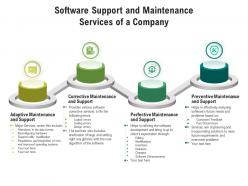
Software support and maintenance services of a company
Try Before you Buy Download Free Sample Product
Audience
Editable
of Time
Our Software Support And Maintenance Services Of A Company are topically designed to provide an attractive backdrop to any subject. Use them to look like a presentation pro.
People who downloaded this PowerPoint presentation also viewed the following :
Software support and maintenance services of a company with all 2 slides:
Use our Software Support And Maintenance Services Of A Company to effectively help you save your valuable time. They are readymade to fit into any presentation structure.
FAQs for Software support and maintenance services
Effective software support and maintenance services include proactive monitoring, regular updates and patches, performance optimization, technical troubleshooting, and comprehensive documentation management. These components work together by minimizing downtime, ensuring security compliance, and enhancing system reliability, with many organizations finding that strategic maintenance ultimately delivers improved user experiences and reduced operational costs.
Businesses can determine appropriate software support levels by assessing system criticality, user volume, operational requirements, budget constraints, and risk tolerance. Organizations with mission-critical applications, like banks or hospitals, typically require 24/7 premium support, while smaller companies find standard business-hour coverage sufficient, ultimately balancing cost with operational continuity needs.
Reactive maintenance addresses issues after they occur through bug fixes and emergency patches, while proactive maintenance prevents problems through regular updates, code optimization, and performance monitoring. Proactive strategies enable organizations to minimize downtime, reduce long-term costs, and maintain competitive advantage, with many companies finding that preventive approaches deliver superior user experiences and operational efficiency.
Software updates and patches improve system security by fixing vulnerabilities, strengthening authentication protocols, and closing security loopholes that cybercriminals exploit. Through regular patching, organizations minimize breach risks, enhance data protection, and maintain compliance standards, with financial institutions and healthcare systems finding that proactive updates deliver stronger defenses and customer trust.
User feedback serves as the primary driver for identifying bugs, performance issues, feature gaps, and usability concerns that require immediate attention or future enhancement. Through systematic feedback collection and analysis, development teams can prioritize maintenance tasks, implement targeted improvements, and ensure software evolution aligns with actual user needs, ultimately delivering enhanced user satisfaction and reduced support costs.
Companies measure software support effectiveness through response times, resolution rates, customer satisfaction scores, system uptime metrics, and cost per incident tracking. These comprehensive analytics enable organizations to identify bottlenecks, optimize resource allocation, and enhance service delivery, with many finding that regular performance assessments ultimately deliver improved user experiences and operational efficiency.
Software documentation best practices include maintaining version control systems, creating standardized templates, establishing regular review cycles, implementing collaborative editing platforms, and ensuring real-time updates during code changes. These approaches streamline maintenance workflows by reducing debugging time, enhancing team communication, and minimizing knowledge gaps, with many development organizations finding that comprehensive documentation ultimately delivers faster issue resolution and improved operational efficiency.
SLAs establish clear performance benchmarks for software support through defined response times, resolution targets, availability guarantees, and quality metrics, creating accountability between providers and clients. These agreements enable organizations to plan business operations confidently, minimize downtime costs, and ensure predictable service delivery, with many enterprises finding that well-structured SLAs significantly enhance operational efficiency and customer satisfaction.
Emerging technologies in software maintenance include AI-powered predictive analytics, automated testing frameworks, containerization platforms, cloud-native monitoring tools, and machine learning-driven code analysis systems. These technologies streamline maintenance by identifying issues before they occur, automating routine updates, and optimizing performance continuously, with many organizations finding that proactive maintenance reduces downtime and operational costs significantly.
Businesses can estimate total cost of ownership by evaluating licensing fees, implementation costs, ongoing support contracts, training expenses, and infrastructure requirements. Through comprehensive cost modeling, organizations across sectors like healthcare, finance, and retail can factor in scalability needs, integration complexity, and resource allocation, ultimately delivering predictable budgets and strategic investment planning for long-term operational efficiency.
Organizations face common challenges including legacy system complexity, resource allocation constraints, skill gaps in emerging technologies, escalating maintenance costs, and integration difficulties across multiple platforms. These issues often result in delayed updates, security vulnerabilities, and reduced operational efficiency, with many enterprises finding that outdated systems increasingly hinder their competitive advantage and customer service capabilities.
Automation enhances software support efficiency by streamlining ticket routing, enabling predictive issue detection, and accelerating resolution through automated diagnostics and self-healing systems. These technologies significantly reduce manual workload, minimize response times, and improve service quality, with many IT organizations finding that automated support processes deliver faster customer resolutions and lower operational costs.
Software maintenance significantly impacts user satisfaction by ensuring consistent performance, resolving bugs quickly, and delivering regular feature updates that meet evolving needs. Through proactive maintenance, organizations enhance user experiences, minimize downtime, and build trust, with many companies finding that well-maintained software increases customer retention rates by up to 40% while reducing support costs.
Data analytics improves software support services by identifying recurring issues, predicting potential system failures, and analyzing user behavior patterns to proactively address problems. Through predictive analytics and performance monitoring, organizations streamline incident resolution, reduce downtime, and enhance user experiences, with many IT departments finding that data-driven insights ultimately deliver faster response times and more efficient resource allocation.
Ethical considerations in software maintenance include data privacy protection, security vulnerability disclosure, equitable access to updates, transparency in service limitations, and responsible handling of user information. These principles guide organizations by ensuring fair support practices, maintaining user trust, and delivering consistent service quality, with many technology companies finding that ethical frameworks ultimately enhance customer relationships and competitive positioning.
-
Innovative and Colorful designs.
-
Commendable slides with attractive designs. Extremely pleased with the fact that they are easy to modify. Great work!
-
Unique design & color.