


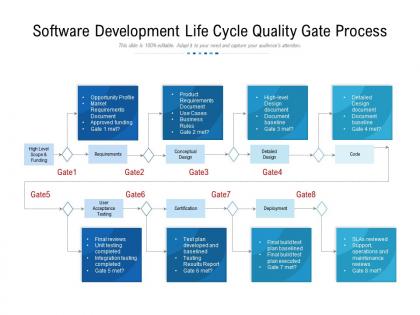
Software development life cycle quality gate process




Try Before you Buy Download Free Sample Product
 Impress Your
 Audience
 100%
100% Editable
 Save Hours
 of Time


Our Software Development Life Cycle Quality Gate Process are topically designed to provide an attractive backdrop to any subject. Use them to look like a presentation pro.
People who downloaded this PowerPoint presentation also viewed the following :
Software development life cycle quality gate process with all 2 slides:
Use our Software Development Life Cycle Quality Gate Process to effectively help you save your valuable time. They are readymade to fit into any presentation structure.
FAQs for Software development life cycle
Quality gates are basically checkpoints that stop bad code from moving forward - like automated bouncers for your repo. They'll block stuff if tests fail, coverage sucks, or there's security problems. Honestly, they save your ass by catching issues early when fixes are cheap, instead of discovering them in production at 2am on a Sunday. You want realistic thresholds though, not ones that just annoy everyone. Start simple with basic coverage and build requirements, then make them stricter over time. Way better than dealing with angry users later.
Put quality gates at the main checkpoints - commits, builds, deployments. Set up automated stuff that stops things when they fail, like broken tests or security issues. Don't bolt these on later (I've watched teams do this and it's messy). Build them right into your CI/CD from day one. Speed matters here - slow gates just make developers find workarounds. Code coverage thresholds are super useful too. Start small with maybe 2-3 critical checks, then add more once everyone's used to it. The key is making them fast enough that people won't hate them.
Start with code coverage - 80% is solid but honestly don't kill yourself chasing 100%. Track your test pass rates and build success too. Response times and error rates matter big time if you're live in production. Oh, and security vulnerability counts obviously. I'd also watch code quality metrics like complexity and tech debt ratios. Pick maybe 3-4 that actually matter to your specific team first. You can always pile on more metrics later once you've got a good rhythm going. The key is focusing on what moves the needle for your users and business goals.
Think of quality gates like checkpoints you can't skip - they catch problems before things get messy. Before moving forward, you've gotta hit specific criteria: code coverage numbers, security scans, performance tests, whatever matters for your project. Way better than crossing your fingers and hoping everything works at launch (been there, it sucks). The whole point is finding issues early when fixing them won't break your budget or timeline. Honestly, the hardest part is actually sticking to your criteria when deadlines get tight.
Honestly, getting your team on board is gonna be the hardest part. Nobody wants their builds suddenly failing because you added new rules - been there, it sucks. Setting thresholds is tricky too. Go too strict and you'll get false positives that'll make everyone want to skip the gates entirely. Too loose and you're not catching real problems. Oh, and figure out your hotfix strategy early - what happens when production's on fire but your gates are blocking the fix? I'd say start with maybe 2-3 basic metrics, let people get used to it first. Then slowly add more once they stop complaining.
So I'd start with defect escape rates - basically how many bugs slip through each gate. Then cycle time, which is just how long stuff takes to get fixed at each stage. Pass/fail rates are good too, but honestly? The real winner is comparing customer complaints to what you caught internally. That gap tells you everything. Pull this data monthly and watch for patterns. More escapes or slower fixes usually means your gates need tweaking. Don't overthink it though - just use whatever data you're already collecting and expand from there.
Dude, you really need stakeholders on board for quality gates or you're gonna have a bad time. Product owners, devs, QA, ops - they all care about different stuff and have their own ideas about what's risky. Get them involved early when you're setting the actual criteria and thresholds. Don't just ask them to approve whatever you've already decided - that's backwards. Without their input, your gates will either be way too strict and block good releases, or too loose and let garbage through. It's kinda like trying to get everyone to agree on pizza toppings, but more important for your project's success.
Yeah, quality gates are huge in those high-stakes industries. Healthcare can't mess around - one software bug in a patient monitor could be deadly. Same with aerospace, obviously nobody wants sketchy parts when you're flying. Automotive companies use them at every assembly step because recalls cost a fortune and kill people. Financial services too - I've seen one bad code push cause millions in trading losses. Actually happened to a company I know. If you're working in any of these spaces, you've got to match your quality gates to how risky your stuff actually is.
SonarQube's your best bet for this - everyone uses it and the CI/CD integration is pretty smooth. Jenkins works great for orchestrating the whole process. GitLab CI/CD and Azure DevOps both have quality gates baked right in, which is nice. Setup's honestly kind of annoying at first, but once it's running you'll wonder how you lived without it. GitHub Actions can handle simpler stuff too if you don't need anything fancy. I'd figure out what quality checks you actually want first - then just pick whatever plays nicely with your current setup. No point fighting your existing tools, you know?
Waterfall has those formal checkpoints where everything stops until you pass - super rigid. Agile's totally different though. You're constantly checking quality throughout each sprint instead of waiting for some big scary gate at the end. Quality becomes part of your daily standups and sprint reviews, which honestly feels way more natural. Short feedback loops mean you catch problems early rather than months later when it's a nightmare to fix. My old team used to dread those waterfall reviews, but with agile it's more like an ongoing conversation. Way less stressful when you can pivot quickly if something's off.
Don't just copy quality gates from other teams - biggest mistake I see everywhere. Figure out what your team actually cares about first. Coverage thresholds, security scans, performance stuff - whatever matches your risk tolerance. I'd start with looser requirements honestly, then tighten them up as you go. Too strict upfront and people will find ways around them (trust me on this one). The key is automating everything so feedback comes back fast enough to actually matter. Make the thresholds realistic but not pointless - there's a sweet spot where they'll help without driving everyone crazy.
Honestly, most teams just set up quality gates and forget about them - huge mistake. Look at your current gates and ask if they're actually catching real problems or just slowing everyone down. Mine the data on what slips through vs what gets blocked, then tweak your thresholds based on that. Your team will tell you where the annoying friction points are if you ask. Small adjustments work way better than scrapping everything. Pick one gate this sprint and dig into whether it's actually helping. Oh, and don't be afraid to kill checks that aren't pulling their weight anymore.
So quality gates are automated checkpoints that stop compliance issues before they blow up into major problems. Think HIPAA for healthcare, SOX for finance - whatever rules your industry has to follow. Honestly, they're like having that one coworker who actually reads everything and catches mistakes you'd totally miss. Each gate checks if your code or processes hit the specific standards you need. The trick is matching your gates to your actual compliance requirements. I'd start by figuring out what you absolutely can't mess up, then build gates around those critical points.
Honestly, you gotta go async with your quality gates. Set up CI/CD pipelines and automated testing that runs around the clock - saves everyone from waiting on manual approvals. Documentation is huge here (yeah, boring but necessary). Crystal clear gate criteria means people won't get stuck at 2am wondering what you actually meant. Short sentences work. But you can also spread approvers across different regions so someone's always awake to unblock things when automation isn't enough. Way better than having your Tokyo team waiting 8 hours for SF to wake up.
Dude, communication is everything with quality gates. People need to actually understand what you're measuring and why it matters - otherwise they'll just try to work around it. I learned this the hard way when our team kept bypassing gates because nobody explained the point. Get everyone involved when you're setting them up initially. Then keep the criteria super transparent and give real-time visibility into what's passing or failing. Oh, and definitely create feedback loops so people know how to fix issues. Honestly, gates without good communication are just fancy roadblocks that piss everyone off.
No Reviews