

Solar Energy For Commercial Building Powerpoint Presentation Slides





Try Before you Buy Download Free Sample Product
 Impress Your
Audience
 100%
Editable
 Save Hours
of Time


Optimize the energy consumption by using Solar Energy For Commercial Building PowerPoint Presentation Slides. The presentation contains various templates that explain energy consumption analysis and issues that the company faces. Showcase the available solutions to counter energy issues with the help of these PPT visuals. Utilize our easy-to-use renewable sources PPT infographics to provide information about energy utilization rate by monthly consumption. Information regarding the share of electricity demand, star rating of the current appliance, etc can be presented with the help of solar power for building PPT slides. Highlight the renewable technologies that companies can adopt with the help of these PPT slides. Discuss the decision-making checklist for solar projects and estimate the cost and implementation schedule using easy-to-use commercial solar panel PPT layouts. Barriers and solutions that can occur while installing a solar project can be displayed by incorporating our visually appealing commercial solar energy ppt slide deck.
People who downloaded this PowerPoint presentation also viewed the following :
Content of this Powerpoint Presentation
Slide 1: This slide introduces Solar Energy for Commercial Building. State your Company name and begin.
Slide 2: This slide displays Agenda for Solar Energy for Commercial Building.
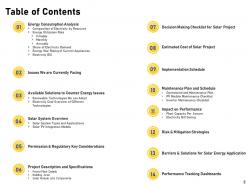
Slide 3: This slide shows Table of Contents of the presentation.
Slide 4: This slide displays Table of Content.
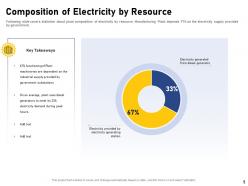
Slide 5: This slide covers statistics about plant composition of electricity by resource. Manufacturing Plant depends 77% on the electricity supply provided by government.
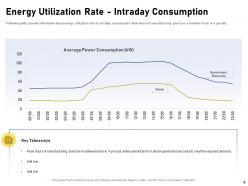
Slide 6: This slide provide information about energy utilization rate by intraday consumption. Peak hours of manufacturing plant are in between 8 am to 4 pm slot.
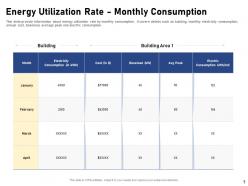
Slide 7: This slide provide information about energy utilization rate by monthly consumption. It covers details such as building, monthly electricity consumption, annual cost, baseload, average peak and electric consumption.
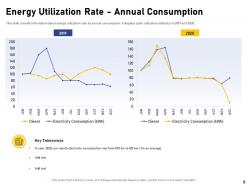
Slide 8: This slide provide information about energy utilization rate by annual consumption. It displays plant utilization statistics of 2019 and 2020.
Slide 9: This slide shows Table of Content
Slide 10: Mentioned pie chart illustrates share of electricity demand utilized by manufacturing plant in 2020. Machineries installed in the plant utilised highest share of electricity that is 57%.
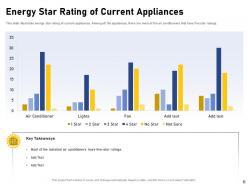
Slide 11: This slide illustrates energy star rating of current appliances. Among all the appliances, there are most of the air conditioners that have five star ratings.
Slide 12: The table in the slide shows the monthly electricity bill of the manufacturing plant. It includes machine name, wattage details, operational hours and electricity consumption.
Slide 13: This slide displays Table of Content
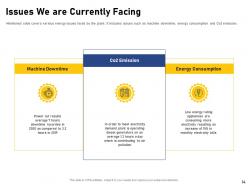
Slide 14: Mentioned slide covers various energy issues faced by the plant. It includes issues such as machine downtime, energy consumption and Co2 emission.
Slide 15: This slide shows Table of Content of the presentation.
Slide 16: This slide covers various renewable energies such as solar energy, thermal energy and biogas energy that can be installed or used at manufacturing plant.
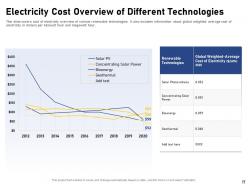
Slide 17: This slide covers cost of electricity overview of various renewable technologies. It also includes information about global weighted average cost of electricity in dollars per kilowatt hour and megawatt hour.
Slide 18: This slide displays Table of Content.
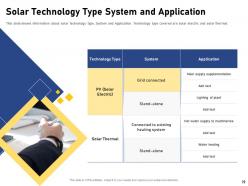
Slide 19: This slide shows information about solar technology type, System and Application. Technology type covered are solar electric and solar thermal.
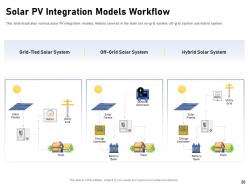
Slide 20: This slide illustrates various solar PV integration models. Models covered in the slide are on-grid system, off-grid system and hybrid system.
Slide 21: This slide Table of Content.
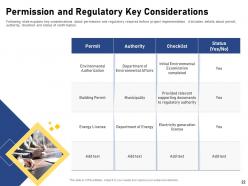
Slide 22: Following slide explains key considerations about permission and regulatory required before project implementation. It includes details about permit, authority, checklist and status of confirmation.
Slide 23: This slide showcases Table of Content of the presentation.
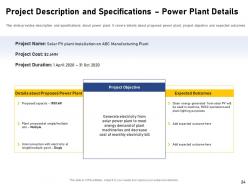
Slide 24: This slide provides description and specifications about power plant. It covers details about proposed power plant, project objective and expected outcomes
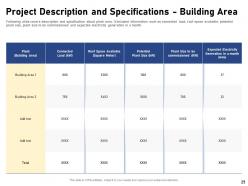
Slide 25: Following slide covers description and specification about plant area. It included information such as connected load, roof space available, potential plant size, plant size to be commissioned and expected electricity generation in a month.
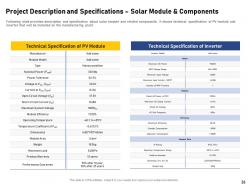
Slide 26: This slide provides description and specification about solar module and related components. It shows technical specification of PV module and inverter that will be installed on the manufacturing plant.
Slide 27: This slide displays Table of Content of the presentation.
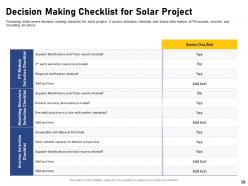
Slide 28: This slide covers decision making checklist for solar project. It covers selection checklist and status information of PV module, inverter and mounting structure.
Slide 29: This slide displays Table of Content.
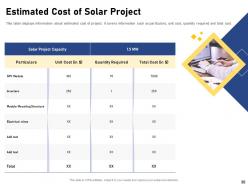
Slide 30: This table displays information about estimated cost of project. It covers information such as particulars, unit cost, quantity required and total cost.
Slide 31: This slide displays Table of Content of the presentation.
Slide 32: This slide shows solar PV project execution schedule. It includes information about work, sub-work and specific week.
Slide 33: This slide displays Table of Content of the presentation.
Slide 34: This slide provides photo voltaic operational and maintenance plan. It includes information of task, weekly, monthly and semi annually requirement.
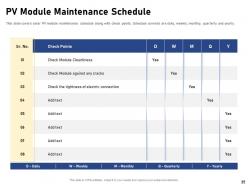
Slide 35: This slide covers solar PV module maintenance schedule along with check points. Schedule covered are daily, weekly, monthly, quarterly and yearly.
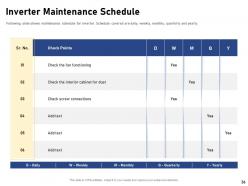
Slide 36: This slide shows maintenance schedule for inverter. Schedule covered are daily, weekly, monthly, quarterly and yearly.
Slide 37: This slide displays Table of Content of the presentation.
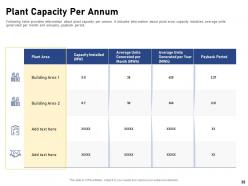
Slide 38: This table provides information about plant capacity per annum. It includes information about plant area, capacity installed, average units generated per month and annually, payback period.
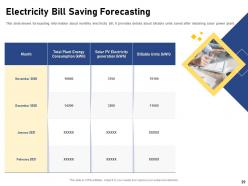
Slide 39: This slide shows forecasting information about monthly electricity bill. It provides details about billable units saved after installing solar power plant.
Slide 40: This slide showcases Table of Content.
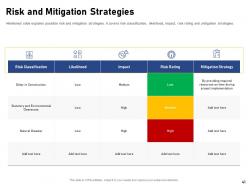
Slide 41: Mentioned slide explains possible risk and mitigation strategies. It covers risk classification, likelihood, impact, risk rating and ,mitigation strategies.
Slide 42: This slide displays Table of Content.
Slide 43: This slide shows possible barrier that may occur while installing solar project and right solutions to overcome them. Risk covered are high installation cost, government policies.
Slide 44: This slide displays Table of Content.
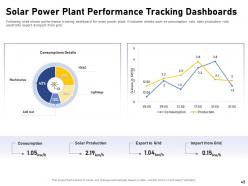
Slide 45: Following slide shows performance tracking dashboard for solar power plant. It includes details such as consumption rate, daily production rate, electricity export & import from grid.
Slide 46: This is Solar Energy For Commercial Building Icons Slide.
Slide 47: This slide is titled as Additional Slides for moving forward.
Slide 48: This is About Us slide to showcase Company specifications.
Slide 49: This slide displays Venn.
Slide 50: This slide depicts Timeline
Slide 51: This slide displays Mission, Vision and Goals.
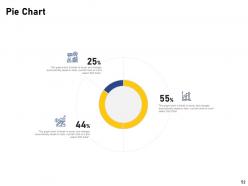
Slide 52: This slide shows Pie Chart.
Slide 53: This is Idea Generation slide to highlight important message.
Slide 54: This slide is titled as Post it Notes. Post your important notes.
Slide 55: This is 0ur Team slide with Names and Designations.
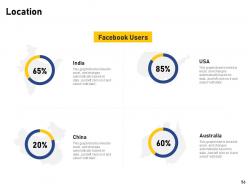
Slide 56: This slide represents Company's Location.
Slide 57: This is Thank You slide with Names and Designations.
Solar Energy For Commercial Building Powerpoint Presentation Slides with all 57 slides:
Use our Solar Energy For Commercial Building Powerpoint Presentation Slides to effectively help you save your valuable time. They are readymade to fit into any presentation structure.
















FAQs for Solar Energy For Commercial Building
Dude, solar's honestly a no-brainer these days. Free energy from the sun once you get those panels up - can't beat that. Plus you're not dumping CO2 everywhere like fossil fuels do. Costs have absolutely tanked too, like 80% cheaper than a decade ago which is wild. You'll basically be energy independent instead of getting screwed by crazy gas prices and supply chain drama. My neighbor just got his installed and he's already seeing savings. If you're seriously considering it, definitely shop around for quotes now. The payback timeline might surprise you.
So mono panels hit around 20-22% efficiency but they're pricier. Poly ones are more like 15-17% and cost maybe 10-20% less up front. The gap's gotten way smaller than it used to be though. Got a tiny roof? Go mono to squeeze out max power. But honestly, for most houses poly's probably your better bet financially - unless you're one of those people obsessed with having the absolute best efficiency numbers. I'd lean poly for the ROI.
Dude, solar's honestly a game changer for cutting emissions. No fossil fuels burned = basically zero carbon while it's running. Yeah, making the panels creates some emissions upfront, but they pay that back in like 1-4 years. After that? Pure clean energy for decades. When you swap out coal or gas power with solar, you're literally stopping CO2 from hitting the atmosphere. My neighbor just got panels and won't shut up about it - but honestly, if you want to actually dent your carbon footprint, this is probably your biggest win.
You'll need smart inverters to convert the DC solar power to AC that matches your grid's frequency and voltage - that's the basic setup. Grid operators use forecasting software to predict how much solar you'll get and adjust other power sources. Honestly battery storage isn't always required but it makes things way smoother, especially when clouds roll in. The variable output throughout the day is the tricky part. Start with a pilot program in one area first, then scale up once you see how solar actually behaves with your specific grid and demand patterns. Way less headache that way.
Honestly, it's mostly about money and infrastructure. Upfront costs for solar farms are brutal - you're talking massive investments. Then your power grid probably can't even handle all that distributed energy coming in, so more upgrades needed. Storage is still a pain too since batteries cost a fortune and you'll need backup when it's cloudy for days. Some places just don't get enough sun year-round, which is obvious but worth mentioning. Plus fossil fuel companies lobby hard against this stuff. That said, prices keep dropping fast so it's getting way more realistic.
Honestly, the battery tech is getting insane right now. Lithium-ion prices dropped like crazy and they're way more efficient. Solid-state ones are the real deal though - they charge super fast and last forever. There's also these flow batteries for big installations, plus thermal storage that literally just stores heat instead of power (which is kinda genius if you think about it). The grid-scale stuff is getting massive too. So yeah, if you're looking at solar, I'd definitely budget for batteries now since they're actually affordable for once.
Dude, location is EVERYTHING for solar panels. We're talking 30-50% difference in how much power you'll actually get. You want them facing south with zero shade - I swear, some people stick them under trees then complain about their electric bill lol. The angle should match your latitude basically. Arizona obviously crushes Seattle for sun hours, so geography matters big time. Get a proper assessment before you do anything though. Oh and check if your neighbor's planning to plant some massive oak tree next year or whatever. Short sentences, longer ones that flow naturally. That'd suck after spending all that money.
Dude, the solar market is absolutely exploding right now - we're talking 20-25% growth each year for the next decade. That could mean the whole thing triples or even quadruples by 2034, which is kinda insane if you ask me. Costs keep dropping like crazy, plus governments are throwing incentives around and companies are going all-in on sustainability. Asia-Pacific still owns most of the market, but emerging countries are catching up fast. Honestly? If you're thinking about getting into this space - whether investing or business stuff - you should probably start figuring out your move sooner rather than later.
Dude, policies totally make or break solar economics. That federal tax credit? You get 30% back on installation costs - pretty solid deal. Net metering's clutch too since you can sell extra power back to the grid. Some states pile on rebates which is nice. Honestly, without these incentives payback periods would suck and way fewer people would go solar. When policies expire though, installations just tank. Oh and definitely check what's available in your area plus expiration dates if you're thinking about it. Timing matters more than people realize.
Honestly, most people have it all wrong about solar. Yeah, it works when it's cloudy - just not as well. Costs have dropped insanely over the last decade, like 80% or something. Your roof doesn't need to face perfectly south either; east and west are totally fine. Oh, and don't believe that maintenance nightmare stuff. You literally just spray them down sometimes. The panels last forever too - mine came with a 25-year warranty but they'll probably outlive me. My neighbor was obsessing over his roof angle for months, but honestly? Just get quotes from a few different installers and see what the real numbers look like for your house.
So basically solar lets countries make their own power instead of buying oil and gas from other places. You're not getting screwed over by price jumps or supply issues anymore. Germany's actually killed it with this - they barely import energy now compared to before. It's kinda like meal prepping vs ordering takeout every night, you know? Way more predictable costs. Plus all that money you'd normally send overseas stays in your own economy instead. Honestly think more countries should've jumped on this years ago.
Yeah, solar manufacturing isn't perfect - there's definitely some nasty stuff involved like toxic chemicals and energy-heavy production. Mining for the materials creates waste too. But honestly? The panels usually offset their carbon footprint in just 1-4 years, then keep pumping out clean energy for 25+ years after that. The math is pretty compelling compared to fossil fuels. When you're shopping around, try to find manufacturers that actually use renewable energy in their facilities and have decent recycling programs. Makes a real difference.
Definitely get them on a south-facing roof if you can - shadows are solar panel killers, even tiny ones. Battery storage is pricey upfront but totally worth it for evening power. Here's what I wish someone told me: run your dishwasher and charge your car during peak sun hours when the panels are pumping out max juice. Also grab a monitoring system to track everything. Honestly, the energy habit changes make almost as much difference as the panel setup itself. Small shifts, big payoff on your investment.
So there's this crazy automated tech now that rips apart old panels way better than doing it by hand - gets the silicon, silver, all that good stuff out super clean. Companies are figuring out how to make the recovered silicon almost as good as new, which honestly changes the whole game cost-wise. Some manufacturers are even designing panels that'll be easier to recycle down the road. Oh and the EU just dropped some recycling requirements, so everyone's scrambling to get their act together. I'd definitely ask about take-back programs when you're shopping around - most decent companies have some kind of plan now.
They're surprisingly decent in most weather, honestly. Peak power on sunny days, but cloudy weather still gives you like 10-25% output. Cold actually helps efficiency since heat makes panels cranky. Rain's great - free cleaning service lol. Snow will shut things down until it melts off though. Here's the thing - installers design systems around your local climate anyway. My neighbor was worried about our winters but still hits his energy goals each year. You might see dips in winter but it balances out over time.
-
Great designs, Easily Editable.
-
Illustrative design with editable content. Exceptional value for money. Highly pleased with the product.
-
Amazing product with appealing content and design.