


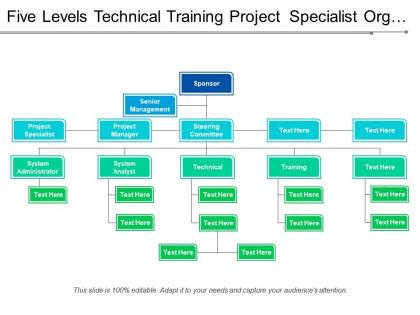
Five levels technical training project specialist org chart




Try Before you Buy Download Free Sample Product
 Impress Your
 Audience
 100%
100% Editable
 Save Hours
 of Time


Create an impact on the business value with our technical training project specialist org chart by optimizing learning organization structure presentation slide. This PPT slide of project organization chart has been created by professional team to review optimal organizational structures can improve business alignment and targeted execution on business goals. This training and development PPT slide is useful to create centralized training plan and this model provides the consistency in the management of training processes across the enterprise. With the help of this learning and development structure layout you can determine who is responsible for the overall training programs in an organization such as training manager, HR, CEO or the owner of the company. This presentation slide can be used to training model of research & development department, education, marketing and administration department. Download this power point slideshow of project training to create a sketch chart indicating the structure of your training organization. Bring an end to ambivalence with our Five Levels Technical Training Project Specialist Org Chart. Institute definite guidelines to follow.
People who downloaded this PowerPoint presentation also viewed the following :
Five levels technical training project specialist org chart with all 5 slides:
Get close and friendly with our Five Levels Technical Training Project Specialist Org Chart. Differences and distances will be erased.




FAQs for Five levels technical training project
Technical Training Specialists develop and deliver technology-focused educational programs, assess learning needs, create instructional materials, evaluate training effectiveness, and maintain technical competency standards. These professionals streamline knowledge transfer by designing hands-on curricula, facilitating software workshops, and partnering with subject matter experts, ultimately enhancing workforce capabilities and organizational productivity.
Technical Training Specialists focus specifically on complex technical systems, software, and equipment training, while general trainers cover broader topics like soft skills, leadership, and basic procedures. They possess deep technical expertise in specialized fields like IT, engineering, or manufacturing, developing hands-on curricula and troubleshooting scenarios, ultimately delivering more targeted skill development than generalist approaches.
Essential skills include instructional design expertise, technical subject matter knowledge, learning management system proficiency, multimedia content creation abilities, and adult learning principles understanding. These competencies enable specialists to develop comprehensive curricula, create engaging materials, and assess learning outcomes effectively, with many organizations finding that specialists combining technical depth with pedagogical skills deliver significantly better training ROI and employee skill development.
Organizations measure training effectiveness through performance metrics, skills assessments, knowledge retention tests, employee feedback surveys, and job performance evaluations. These measurement approaches enable companies to track competency improvements, reduced error rates, and faster project completion times, with many finding that systematic evaluation ultimately delivers enhanced productivity, better employee engagement, and stronger return on training investments.
Technical Training Specialists commonly use learning management systems (LMS), video conferencing platforms, screen recording software, simulation tools, and interactive presentation applications for training delivery. These technologies streamline content creation, enable remote instruction, and enhance learner engagement through hands-on practice, with many organizations finding that combining multiple delivery methods significantly improves knowledge retention and accelerates skill development across technical teams.
**INPUT**: How does the organizational structure impact the role of a Technical Training Specialist? **OUTPUT**: Organizational structure significantly impacts Technical Training Specialists by determining their reporting relationships, resource allocation, cross-departmental collaboration access, and strategic influence within the company. In matrix structures, specialists often collaborate across engineering, HR, and product teams simultaneously, while hierarchical organizations may limit their scope, with many tech companies finding that flatter structures enable more agile training delivery and faster skill development responses. [Word count: 60 words]
Creating an inclusive technical training environment involves establishing diverse learning modalities, implementing mentorship programs, ensuring accessible materials and tools, fostering psychological safety for questions, and providing multilingual support when needed. These practices enhance knowledge retention, reduce skill gaps, and improve team collaboration, with many organizations finding that inclusive technical training accelerates onboarding, increases employee retention, and ultimately delivers stronger technical competencies across diverse teams.
Training materials should be reviewed quarterly and updated annually at minimum, with critical technical content requiring more frequent revisions as industry standards evolve. Many technology and healthcare organizations implement continuous update cycles, reviewing materials every 3-6 months while monitoring industry developments, ensuring training remains current and employees maintain competitive skills in rapidly changing environments.
Feedback drives technical training program enhancement by identifying knowledge gaps, assessing content effectiveness, and revealing learner preferences through surveys, assessments, and performance metrics. This data enables training specialists to refine curricula, update materials, and adjust delivery methods, with many organizations finding that systematic feedback collection ultimately delivers improved learning outcomes and stronger technical competencies.
Technical Training Specialists collaborate effectively with SMEs by establishing regular communication channels, conducting structured knowledge transfer sessions, and creating collaborative content development workflows. Through strategic partnerships, specialists extract complex technical expertise while SMEs gain pedagogical support, ultimately delivering comprehensive training programs that enhance organizational knowledge retention and accelerate employee skill development across departments.
**INPUT**: What emerging trends in technology should Technical Training Specialists be aware of? **OUTPUT**: Technical Training Specialists should monitor artificial intelligence, virtual reality training platforms, microlearning technologies, adaptive learning systems, and cloud-based collaboration tools. These technologies streamline content delivery, enhance engagement through immersive experiences, and enable personalized learning paths, with many organizations finding that strategic adoption ultimately delivers faster skill development and improved training outcomes. **Word count: 54 words**
Training significantly enhances employee retention and job satisfaction in technical roles by providing clear career progression pathways, keeping skills current with evolving technologies, and demonstrating organizational investment in professional development. Through structured technical training programs, organizations reduce turnover costs, increase internal mobility, and create more engaged workforces, with many tech companies finding that comprehensive training initiatives ultimately deliver higher productivity and competitive advantage.
Technical Training Specialists face distinct challenges based on organizational size, including resource allocation, stakeholder management, content standardization, and scalability requirements. In large organizations, specialists often struggle with complex approval processes and diverse departmental needs, while smaller companies present resource constraints and role diversification challenges, with many finding that strategic program design ultimately delivers competitive advantage regardless of scale.
Data analytics informs technical training development by identifying skill gaps, tracking learning outcomes, analyzing performance metrics, and measuring engagement patterns across different modules. Through predictive analytics and learner behavior data, organizations can customize curricula, optimize delivery methods, and allocate resources more effectively, with many companies finding that data-driven training programs deliver 40% better retention rates and significantly faster skill acquisition.
**INPUT**: What strategies can be employed to foster a culture of continuous learning in technical teams? **OUTPUT**: Effective strategies include mentorship programs, cross-functional project rotations, dedicated learning time allocations, peer-led knowledge sharing sessions, and technology-specific certification pathways. These approaches streamline skill development by encouraging collaborative learning, facilitating hands-on experience, and creating structured growth opportunities, with many organizations finding that regular internal tech talks and innovation challenges ultimately deliver enhanced team capabilities and competitive advantage.
No Reviews