

Steps In Cyber Security Policy Cycle




Try Before you Buy Download Free Sample Product
 Impress Your
Audience
 100%
Editable
 Save Hours
of Time


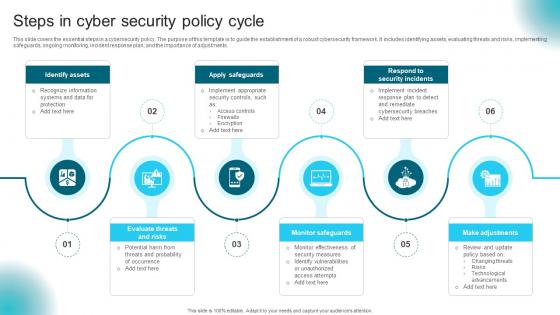
This slide covers the essential steps in a cybersecurity policy. The purpose of this template is to guide the establishment of a robust cybersecurity framework. It includes identifying assets, evaluating threats and risks, implementing safeguards, ongoing monitoring, incident response plan, and the importance of adjustments.
People who downloaded this PowerPoint presentation also viewed the following :
Steps In Cyber Security Policy Cycle with all 9 slides:
Use our Steps In Cyber Security Policy Cycle to effectively help you save your valuable time. They are readymade to fit into any presentation structure.









FAQs for Steps In Cyber
So the Cyber Security Policy Cycle has five phases - Assessment (finding your risks and weak spots), Development (writing or tweaking policies), Implementation (actually putting them into action), Monitoring (checking if people are following them), and Review (seeing what's actually working). It's a continuous loop since threats keep changing. You don't just do it once and call it good. Honestly, the trickiest part is not getting bogged down in one phase forever. Figure out where your company is right now, then just move to whatever comes next. Pretty straightforward once you get the hang of it.
Look at your security logs and past incidents first - that's your real attack surface right there. Combine that with external threat intel from CISA, industry reports, maybe some threat sharing groups if you're part of any. Phishing's still huge, honestly can't believe how many people fall for it. Map everything against your actual assets and business processes. Short version: make a simple risk matrix with likelihood vs impact, then tackle the scary high-priority stuff first when updating policies. Way more effective than trying to boil the ocean.
Dude, you absolutely need to get stakeholders involved early. Can't just lock yourself in a room and write policies - learned that the hard way at my last job. Talk to IT, HR, legal, operations, even regular users who'll actually follow these rules. They'll spot problems you totally missed and tell you what's actually doable vs. what looks nice in a document. I swear, half the failed policies I've seen died because some exec wrote them without asking how stuff really works day-to-day. Map out who's affected first, then just... actually listen to them throughout the whole process.
Look, risk assessment isn't just some box you check once - it's gotta run through your whole policy cycle. Start by figuring out what threats you're actually dealing with during planning, then build your policies around those real risks. The boring but crucial part? Reassess at least yearly or when big changes hit your environment. During rollout, test if your policies actually work against the risks you spotted earlier. Document everything so you can spot trends - honestly, this saved my butt more times than I can count. When risks shift, your policies need to shift too.
Oh man, the worst part is always getting people to actually change how they do things - everyone hates breaking their routine. Plus you'll probably run into budget issues where leadership wants results but won't give you the resources. IT and other departments never seem to communicate properly either, which creates chaos. Legacy systems are a nightmare too since nobody wants to mess with them. Half the time people don't even know whose job it is to handle what. Honestly, I'd start with small test runs first and get the department heads on your side early. Having someone champion the changes in each team makes a huge difference.
Track the obvious stuff first - incident response times, security violations, patch speeds. Those numbers matter, but they're not everything. Employee behavior is where it gets interesting though. Are people actually following policies or just finding sneaky ways around them? I'd run phishing sims and regular assessments to see what's really happening. The key is picking maybe 3-4 metrics that match your biggest risks and checking them monthly. Don't go crazy with data - you'll drown in spreadsheets and miss the real problems.
At least once a year, but stuff happens that'll make you do it sooner - like a major breach or new regulations. Pull your incident reports and see what threats popped up since last time. Loop in IT, legal, and business folks because they always spot things you miss. Test everything with tabletop exercises first (learned this the hard way). Document changes and tell everyone clearly what's different. Oh, and set quarterly calendar reminders to check if anything big went down that needs immediate attention - way better than scrambling later.
First thing - figure out which regulations actually apply to you (GDPR, HIPAA, SOX, whatever). Then build your policies around those specific requirements, not some generic template you found online. Document everything because auditors are obsessed with paper trails. The annoying part? These regs change way more than they should, so you can't just write policies once and call it done. Get someone to actually watch for updates and tweak your policies when needed. Oh, and run compliance audits regularly - it's way better to catch problems early than deal with violations later.
Focus on incident response times and how fast you're patching critical vulnerabilities - that's where the real damage happens. Phishing click rates are huge too since people still fall for everything. Track compliance scores and training completion, but honestly don't go overboard with metrics. I learned this the hard way - you'll drown in data if you try measuring everything. Pick maybe 5-7 things that actually relate to your biggest headaches. Start with whatever's keeping you up at night and work backwards from there. Way more useful than tracking random stuff that looks good on dashboards.
Honestly, don't just slap training on after you've written your policies - that's backwards. Figure out what people don't know while you're still drafting stuff, then build awareness campaigns around those gaps. Regular refresher sessions are clutch for making things actually stick (plus catching updates). Set up feedback loops so people can tell you when policies are confusing or need tweaking. Oh, and use your training data when you're reviewing policies later - it's gold for spotting problem areas. Really though, think of it as an ongoing conversation with your team, not some box you check once and forget about.
Yeah, you really need to think about AI-powered attacks and ransomware-as-a-service when writing those policies. Cloud misconfigurations are causing most breaches these days - honestly, it's kind of embarrassing how often basic settings get messed up. Don't sleep on supply chain vulnerabilities either. IoT devices are expanding your attack surface like crazy with everyone working remotely now. Oh, and insider threats jumped 44% this year, which is nuts. Deepfakes for social engineering are getting scary good too. Build everything around these newer threats instead of just focusing on traditional perimeter stuff.
Think of it like house rules - some things are set in stone, others you can bend. MFA and encryption for sensitive stuff? Non-negotiable. But how teams actually do it? That's where you give them options. Marketing might need different tools than the dev team, and that's totally fine as long as they hit the same security bar. The key is being crystal clear about what's flexible vs what's not - nobody wants to play guessing games with compliance (learned that the hard way). Start with your absolute deal-breakers, then let people figure out the details within those boundaries.
Start with SIEM - it pulls all your logs together and flags violations instantly. For endpoints, grab a solid protection platform that handles device compliance. Network intrusion detection is a must too. Identity management systems are game-changers for access control (seriously, wish I'd set mine up sooner). You'll also want data loss prevention monitoring your sensitive stuff and vulnerability scanners keeping everything up to standard. Actually, focus on SIEM and endpoint protection first. Those two will cover most of your bases right off the bat.
Set up regular checkpoints between each policy phase - that's your foundation. Track real-world performance with monitoring dashboards, then do quarterly stakeholder reviews to catch what's broken. Make feedback super easy though. People won't touch those ridiculous 20-page forms about password stuff. Simple surveys work, or even a dedicated Slack channel for quick complaints. Here's the thing - you've got to actually DO something with that feedback, not just collect it. Close the loop by telling everyone what changed based on their input. Otherwise they'll stop helping you fix things.
So basically, international standards like ISO 27001 and NIST give countries ready-made blueprints for cybersecurity policies. No need to start from scratch. Most national policies reference these because they've already figured out what works - plus everyone uses the same terminology, which honestly makes everything smoother when countries need to work together. Your country probably took one of these frameworks and tweaked it for local laws and culture rather than just copying it wholesale. Worth checking if your org's policies match both your national standards and whatever international framework they borrowed from. Makes compliance way less of a headache.
-
SlideTeam was so customer-centric and quick service-provider that I doubted the amount I was paying and literally re-checked the transaction.
-
Great templates that you can use in your next keynote or conference. They are perfect for quick and visually-engaging delivery.