


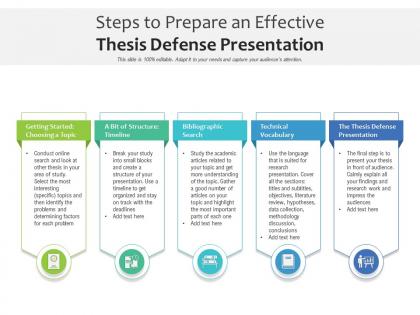
Steps to prepare an effective thesis defense presentation




Try Before you Buy Download Free Sample Product
 Impress Your
 Audience
 100%
100% Editable
 Save Hours
 of Time


Our Steps To Prepare An Effective Thesis Defense Presentation are topically designed to provide an attractive backdrop to any subject. Use them to look like a presentation pro.
People who downloaded this PowerPoint presentation also viewed the following :
Steps to prepare an effective thesis defense presentation with all 2 slides:
Use our Steps To Prepare An Effective Thesis Defense Presentation to effectively help you save your valuable time. They are readymade to fit into any presentation structure.
FAQs for Steps to prepare an effective
Okay so you need five main things: problem statement, methodology, key findings with data, limitations, and future research stuff. Intro and conclusion matter way more than people think - seriously don't breeze through those! Practice answering hard questions beforehand because committee members love to grill you on random details. Most defenses have time limits so rehearse that. Keep slides clean but not boring. Oh and definitely have a backup plan if the tech craps out on you - happened to my roommate last year and it was brutal. Run through it with friends first, they'll spot weird things you totally missed.
Hook them right away with your main finding - one sentence, boom. Tell it like a story: what problem you tackled, your approach, proof it actually works, why anyone should care. Visuals over text blocks (trust me, wall-of-text slides kill presentations). Three points max per slide or people zone out. Yeah, cover your methods but don't dive deep unless they ask. Your transitions between slides? That's where you'll trip up if you haven't practiced. End strong with clear takeaways and what's next. Oh, and rehearse out loud - it hits different than just reading in your head.
Definitely do mock sessions with your advisor first - they'll hit you with stuff you never even thought about. Also dig into recent papers that poke holes in your work, because professors love dropping those curveballs. Here's something that saved me: create a mental list for questions you can't answer on the spot. Just say "great question, let me think on that" - totally normal. They will definitely test your weak spots, so own up to what you don't know instead of trying to wing it. Trust me, they can tell when you're bullshitting and it never ends well.
Dude, practice that thing OUT LOUD like crazy - I'm talking 10+ times minimum. Record yourself so you can hear where you sound weird or rushed. Present to anyone who'll listen, even your roommate's cat lol. Time everything so you know your pacing. I used to rehearse in my car which felt super awkward but honestly worked great. Write out answers for the questions that'll definitely come up. Oh and nail those slide transitions - that's where people usually stumble. The whole point is making it so automatic that even when you're freaking out, your mouth just knows what to say. Trust me on this one.
Okay honestly? Your slides can totally make or break this thing. I've watched people with amazing research completely bomb because their PowerPoint looked like garbage. Don't be that person lol. Keep everything clean and consistent - same fonts, colors, the whole deal. White space is your friend here. Also, if your committee can't read your charts from across the room, they're too cluttered. Simplify that stuff. The visuals should help tell your story, not confuse everyone. Oh and readable fonts! Times New Roman might be boring but at least people can actually see it.
Look for patterns when you're going through everyone's feedback - if three people said the same thing, they're probably right. Practice runs with friends are seriously underrated! You can mock up Q&A sessions and figure out better ways to explain the tricky stuff. Actually use what people tell you though. Revise your slides, fix gaps in your research, whatever needs work. I keep a messy doc of all the suggestions and just chip away at it. Honestly, free advice from peers beats paying for a coach any day. Don't take it personally - they're trying to help you not suck.
Hit three main points: what gap you filled, real-world impact, and any new methods you created. Start with what nobody knew before your research - and why that actually mattered. Your findings need to show practical application too, like policy stuff or clinical uses. Honestly, committees eat up methodological innovations, so if you built new approaches, definitely highlight those. They want to see you think beyond just completing the work. You need to show why it matters in the bigger picture. Oh, and practice explaining each part in under two minutes with solid examples. That timing thing is crucial.
Honestly, timing is huge - practice it a million times because committees get annoyed when you run over. Don't get defensive when they ask tough questions either. Just listen and give thoughtful answers instead of justifying everything. I've watched people totally bomb by shoving their entire dissertation onto slides... like why? Just highlight your main contributions. Also, don't memorize some script word-for-word or you'll sound weird. Know your key points but keep it natural. The good news? They already said yes to your defense, so they're not trying to destroy you.
Okay so here's what worked for me - explain stuff in normal words first, THEN drop the fancy terms. Like "your data gets messier in some spots than others... that's heteroscedasticity." Yeah your committee already knows this jargon, but the random people sitting in will thank you. Trust me on this one lol. Spell out acronyms the first time too. Oh and try explaining your three hardest concepts to someone totally outside your field - seriously, if they can follow along, you're set. I bombed this during my practice run and had to completely redo how I explained everything.
Check with your advisor first, but most defenses are around 20-30 minutes for the actual presentation. Some programs want just 15 minutes though, others give you up to 45. Don't stress too much about hitting the exact time - I've watched people panic over being like 3 minutes over when nobody actually cared. Cover your main contributions, methods, and findings without racing through everything. One slide per minute works as a rough guide. Oh, and definitely practice with a timer a few times so you're not completely winging the pacing up there.
Practice out loud like crazy - I'm talking 10+ times until you could give it in your sleep. When you know your stuff that well, you won't panic if your mind goes blank for a sec. Do the deep breathing thing before you start (yeah, it's cheesy but whatever, it works). Your committee actually wants you to nail this - they're not sitting there plotting your downfall. And honestly? If you don't know something, just say "great question, I'd have to dig into that more." Way better than rambling through some BS answer that makes no sense.
Oh man, definitely go beyond just text slides - charts and graphs will save you. I've sat through way too many defenses where people just read bullet points and it's brutal. Mix things up with diagrams or even physical props if they make sense for your research. Videos work great too for showing processes. One thing though - make sure everything's readable from the back row because there's always that one professor who sits way back there. And seriously, test all your tech stuff beforehand. Nothing's worse than struggling with a frozen presentation while everyone watches. Live demos are cool if you've got software to show off.
Honestly, I'd start by checking out recent defenses in your department - see how long they went, what style people used, all that. Science fields usually want tons of data and methodology stuff, but humanities is more about theory and how you're engaging with the literature. Your committee members probably have their own quirks too. Some love when you get them talking, others just want you to present and wrap up. Oh, and definitely ask your advisor about any weird unwritten rules - like timing expectations or slide formatting. Each department has its own vibe. Practice with someone who knows your field's conventions because they'll catch things you might miss.
Oh man, definitely prep for those "big picture" questions - they love asking how your work connects to policy or other fields. Super annoying because you're basically supposed to predict the future! Practice explaining stuff like "what are the societal implications" in simple terms. Committee members eat that up when you show you get how your research fits the broader landscape. Also be ready to talk limitations and future studies. Honestly, these were the hardest questions for me because suddenly you need to sound like an expert on everything. But it's worth practicing those connections beforehand.
Okay so wrap up by hitting your main discoveries in 2-3 sentences - what you found and why anyone should care. Thank your committee (but like, actually mean it), admit where your work falls short while showing you get the bigger picture. Honestly, I've watched people totally bomb this part because they rush through it. Practice saying your conclusion out loud beforehand - trust me, adrenaline makes you forget everything. Toss in one final thought about where this could go next. You want to come across confident but not cocky, you know? You're adding something real to your field here.
-
Use of icon with content is very relateable, informative and appealing.
-
Topic best represented with attractive design.
-
Nice and innovative design.
-
Content of slide is easy to understand and edit.
-
Editable templates with innovative design and color combination.
-
Easy to edit slides with easy to understand instructions.
-
Out of the box and creative design.
-
Commendable slides with attractive designs. Extremely pleased with the fact that they are easy to modify. Great work!
-
Use of different colors is good. It's simple and attractive.
-
Awesome presentation, really professional and easy to edit.