


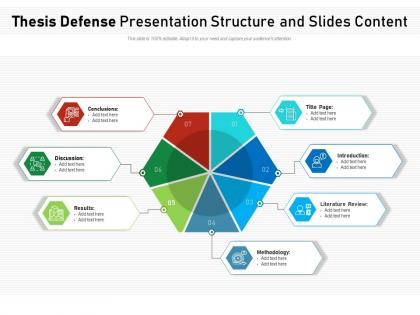
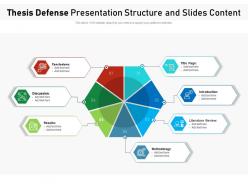
Thesis defense presentation structure and slides content




Try Before you Buy Download Free Sample Product
 Impress Your
 Audience
 100%
100% Editable
 Save Hours
 of Time


Our Thesis Defense Presentation Structure And Slides Content are topically designed to provide an attractive backdrop to any subject. Use them to look like a presentation pro.
People who downloaded this PowerPoint presentation also viewed the following :
Thesis defense presentation structure and slides content with all 2 slides:
Use our Thesis Defense Presentation Structure And Slides Content to effectively help you save your valuable time. They are readymade to fit into any presentation structure.
FAQs for Thesis defense presentation structure
A successful thesis defense presentation includes a compelling introduction, comprehensive literature review, clear methodology explanation, detailed results analysis, and strong conclusion with future implications. These components work together by establishing credibility, demonstrating research rigor, and showcasing academic contribution, with many graduate programs finding that structured presentations significantly enhance committee evaluation and student confidence.
Structure your thesis defense introduction by presenting your research problem and significance, research objectives and questions, methodology overview, and key findings preview. This approach establishes context while guiding your committee through your academic journey, with many doctoral candidates finding that a clear roadmap enhances audience engagement and demonstrates comprehensive understanding of your research's strategic contribution to the field.
Effective summarization strategies include creating hierarchical visual frameworks, highlighting key statistical outcomes, connecting findings to original hypotheses, using comparative analysis tables, and emphasizing novel contributions to your field. These approaches streamline complex data by prioritizing breakthrough discoveries, contextualizing results within existing literature, and demonstrating practical implications, with many doctoral candidates finding that structured visual storytelling ultimately delivers clearer comprehension and stronger committee engagement.
Convey research significance by clearly articulating the problem your work solves, its broader implications for your field, and practical applications across relevant sectors. Structure your presentation to highlight measurable outcomes, connect findings to real-world challenges in academia or industry, and demonstrate how your research advances knowledge while creating opportunities for future investigation and implementation.
Visual aids should include clear data visualizations like charts and graphs, conceptual diagrams illustrating your theoretical framework, methodology flowcharts, key findings summaries, and compelling infographics that distill complex information. These elements enhance comprehension by transforming dense research into digestible formats, enabling committee members to grasp intricate concepts quickly while demonstrating your ability to communicate scholarly work effectively.
Managing thesis defense time effectively requires structured preparation, clear section transitions, strategic rehearsal, and contingency planning for questions. Through targeted practice sessions, many doctoral candidates streamline their presentations by allocating specific timeframes to each chapter, preparing concise responses to anticipated questions, and building buffer time for discussions, ultimately delivering confident defenses that demonstrate mastery while respecting committee schedules.
Common structural mistakes include overloading slides with dense text, lacking clear transitions between sections, spending too much time on background instead of your contributions, and failing to allocate sufficient time for methodology and results discussion. Many successful candidates find that maintaining a logical flow from problem statement to conclusions, practicing smooth section transitions, and balancing content depth with time constraints ultimately delivers a more compelling defense and demonstrates mastery of their research narrative.
Preparing for committee questions involves anticipating critiques of your methodology, data interpretation, theoretical framework, and practical implications, while rehearsing clear, concise responses to potential challenges. Practice defending your research choices through mock sessions with advisors and peers, prepare supplementary materials for complex explanations, and develop strategies for acknowledging limitations while emphasizing your study's contributions and future research directions.
Storytelling transforms thesis defense presentations by creating narrative flow, establishing emotional connection with committee members, and making complex research relatable through real-world context. Through compelling narratives, doctoral candidates enhance audience engagement, demonstrate practical implications of their findings, and present their methodology as a logical journey, ultimately delivering memorable presentations that showcase both scholarly rigor and communication excellence.
Research each committee member's academic background, recent publications, and areas of expertise, then strategically emphasize aspects of your thesis that align with their interests. During your presentation, anticipate their likely questions by highlighting methodology choices, theoretical frameworks, and implications that resonate with their specializations, while preparing detailed responses that demonstrate how your research contributes to their respective fields and advances broader academic discourse.
The best way to present complex data involves using visual hierarchies, simplified charts, progressive disclosure, and clear narrative frameworks that guide audiences through key insights step-by-step. These approaches streamline comprehension by breaking dense information into digestible segments, emphasizing critical findings through strategic design choices, and connecting analytical results to broader implications, ultimately delivering clearer communication and stronger audience engagement across academic and professional presentations.
Integrating feedback involves restructuring arguments based on advisor comments, addressing identified weaknesses through additional evidence, and incorporating new perspectives that strengthen your methodology or conclusions. These revisions demonstrate intellectual growth and scholarly rigor, with many graduate students finding that proactive integration of critique enhances their defense performance, ultimately delivering stronger academic credibility and more confident presentation outcomes.
Effective strategies include thorough preparation through mock defenses, deep breathing exercises, positive visualization, arriving early to familiarize yourself with the space, and reframing anxiety as excitement. These techniques work by building confidence through practice, regulating physiological responses, and creating mental readiness, with many candidates finding that focusing on their expertise rather than potential criticism transforms their defense experience into a meaningful academic dialogue.
Conclude your thesis defense by synthesizing key contributions, acknowledging limitations while emphasizing broader implications, and articulating clear future research directions that demonstrate scalability. This approach transforms your defense from mere completion into strategic positioning, with many successful candidates finding that connecting their work to industry applications, policy implications, or interdisciplinary opportunities creates lasting impact and opens collaborative pathways.
**INPUT**: What resources are available for finding presentation templates tailored to thesis defense presentations? **OUTPUT**: Resources for thesis defense presentation templates include academic template libraries, university presentation repositories, professional design platforms like SlideTeam, graduate school websites, and specialized academic formatting tools. These resources streamline preparation by offering structured layouts, research-focused designs, and academic formatting standards, with many graduate students finding that professional templates enhance presentation clarity, reduce preparation time, and ultimately deliver more polished, confident defenses that effectively communicate complex research findings.
-
Innovative and attractive designs.