

Strategic overview of oil and gas industry case competition powerpoint presentation slides




Try Before you Buy Download Free Sample Product
 Impress Your
 Audience
 100%
100% Editable
 Save Hours
 of Time


Our strategic overview of oil and gas industry case competition PPT template helps you identify the key problems and challenges faced by companies in the oil and gas sector. It offers recommendations and risk management strategies to help you tackle these challenges. This operational challenges in the oil and gas industry PPT slideshow gives you the industry overview, including future growth perspective, recent and prospective trends, key factors that affect growth, and more. Our oil and gas industry trends and challenges PPT theme helps you to explore key performance indicators and key market players. It helps you devise a plan of action to meet those parameters and get on the route to growth and success. This oil and gas industry strategic recommendations PPT layout explains risk management strategies to secure your company against potential dangers that threaten to wreck your company. Download our oil and gas industry inspection PPT set today.
People who downloaded this PowerPoint presentation also viewed the following :
Content of this Powerpoint Presentation
Slide 1: This title slide introduces the Strategic Overview of the Oil and Gas Industry (Case Competition). Add the name of your company here.
Slide 2: This is the Agenda slide for the Strategic Overview of the Oil and Gas Industry (Case Competition).
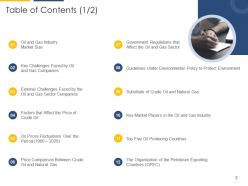
Slide 3: This slide contains the Table of Contents (1/2). It includes - Oil and Gas Industry Market Size, Key Challenges Faced by Oil and Gas Companies, External Challenges Faced by Oil and Gas Sector Companies, etc.
Slide 4: This slide contains the Table of Contents (2/2). It includes - Recent Trends that Might Transform the Oil and Gas Industry Outlook, Upcoming (for 2020 and 2021) Trends in USA Oil and Gas Industry, Key Performance Indicator to Track the Performance of Oil and Gas Company, etc.
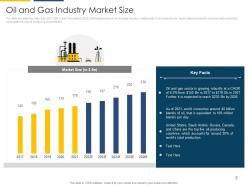
Slide 5: This slide presents the Oil and Gas Industry Market Size. It provides the historical (2017-2021) and forecasted (2022-2026) market size of the oil and gas industry.
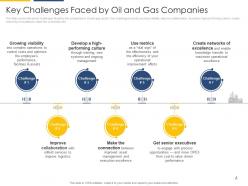
Slide 6: This slide presents the Key Challenges Faced by Oil and Gas Companies. It covers the seven challenges faced by the companies in the oil and gas sector.
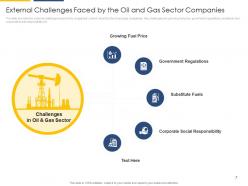
Slide 7: This slide presents the External Challenges Faced by the Oil and Gas Sector Companies. It provides the external challenges (beyond the companies’ control) faced by the oil and gas companies.
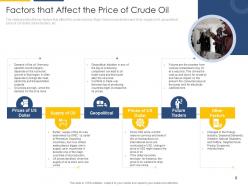
Slide 8: This slide presents the Factors that Affect the Price of Crude Oil. It provides the key factors that affect the crude oil price. Major factors include demand of oil, supply of oil, geopolitical, price of US dollar, future traders, etc.
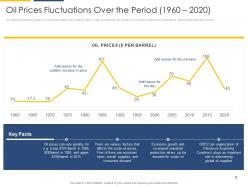
Slide 9: This slide presents the Oil Prices Fluctuations Over the Period (1960 – 2020). It provides the graph of oil price fluctuation from 1960 to 2020. It also provides the key facts such as the reason behind the fluctuations, factors that affect the price, etc.
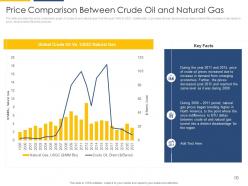
Slide 10: This slide presents the Price Comparison Between Crude Oil and Natural Gas. It provides the price comparison graph of crude oil and natural gas from the year 1995 to 2021.
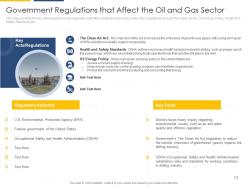
Slide 11: This slide presents the Government Regulations that Affect the Oil and Gas Sector. It provides the key acts/regulations and regulated authorities related to the oil and gas sector. Key regulations include The Clean Air Act, US Energy Policy, Health, and Safety Standards, etc.
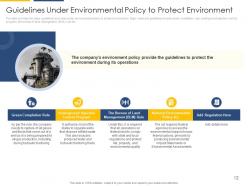
Slide 12: This slide presents the Guidelines Under Environmental Policy to Protect Environment. It provides the major guidelines and rules under the environmental policy to protect the environment.
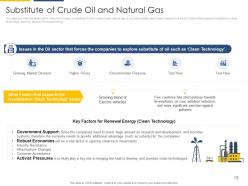
Slide 13: This slide presents the Substitute of Crude Oil and Natural Gas. It provides detail about clean technology, a substitute for crude oil and natural gas.
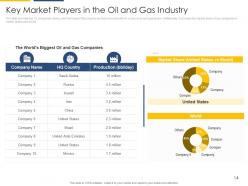
Slide 14: This slide presents the Key Market Players in the Oil and Gas Industry. It provides top 10 companies (along with their head office country and total oil production in a day) in the oil and gas sector.
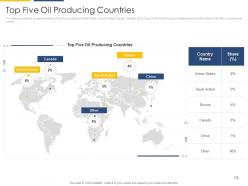
Slide 15: This slide presents the Top Five Oil Producing Countries. It provides oil production share of the top five countries (United States, Saudi Arabia, Russia, Canada, and China) in the world.
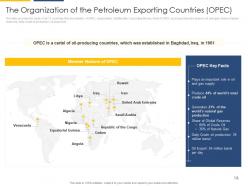
Slide 16: This slide presents The Organization of the Petroleum Exporting Countries (OPEC). It provides the name of all 13 countries that are members of the OPEC organization.
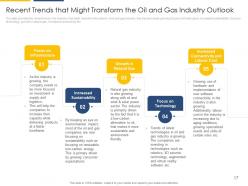
Slide 17: This slide presents the Recent Trends that Might Transform the Oil and Gas Industry Outlook. It provides the recent trend in the industry, that might transform the outlook of the oil and gas industry.
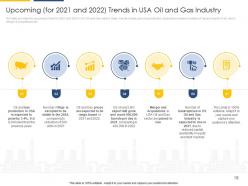
Slide 18: This slide presents the Upcoming (for 2021 and 2022) Trends in USA Oil and Gas Industry. It provides the upcoming trends for 2021 and 2022 in US Oil and Gas market.
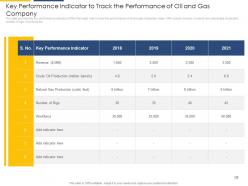
Slide 19: This slide presents the Key Performance Indicator to Track the Performance of Oil and Gas Company. It provides the key performance indicators (KPIs) that might help to track the performance of oil and gas companies.
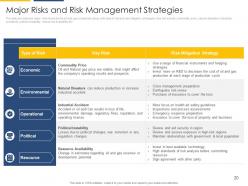
Slide 20: This slide presents the Major Risks and Risk Management Strategies. It provides the major risks faced by the oil and gas companies along with the type of risk and risk mitigation strategies.
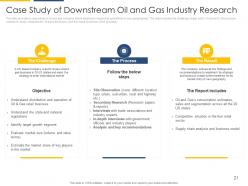
Slide 21: This slide presents the Case Study of Downstream Oil and Gas Industry Research. It provides a case study of the oil and gas company that is seeking to expand its operations in new geographies.
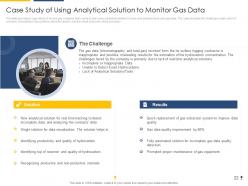
Slide 22: This slide presents the Case Study of Using Analytical solutions to Monitor Gas Data. It provides a case study of the oil and gas company that wants to use a new analytical solution to track and analyze its oil and gas data.
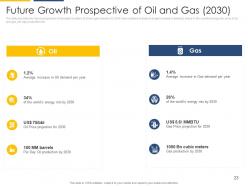
Slide 23: This slide presents the Future Growth Prospective of Oil and Gas (2030). It provides the future prospective (forecasted number) of the oil and gas industry for 2030.
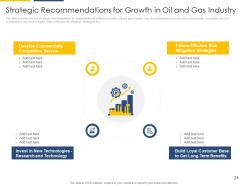
Slide 24: This slide presents the Strategic Recommendations for Growth in the Oil and Gas Industry. It provides the key strategic recommendation for sustainable and effective growth in the oil and gas industry.
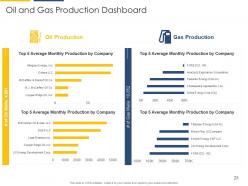
Slide 25: This slide presents the Oil and Gas Production Dashboard. It showcases - Top 5 Average Monthly Production by Company, Top 5 Average Monthly Production by Company, Top 5 Average Monthly Production by Company, etc.
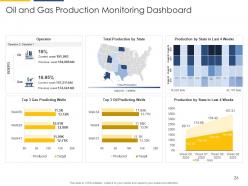
Slide 26: This slide presents the Oil and Gas Production Monitoring Dashboard. It showcases the Production by State in the Last 4 Weeks.
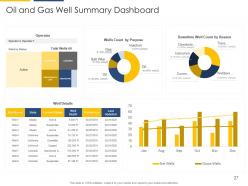
Slide 27: This slide presents the Oil and Gas Well Summary Dashboard.
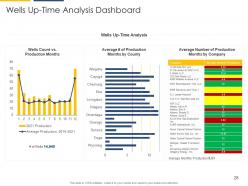
Slide 28: This slide presents the Wells Up-Time Analysis Dashboard. It shows the Average Monthly Production, Average Number of Production Months by County, Average Number of Production Months by Company, etc.
Slide 29: This is the Strategic Overview of the Oil and Gas Industry (Case Competition) Icons Slide.
Slide 30: This slide presents the Additional Slides.
Slide 31: This slide contains the information about the company aka the ‘About Us’ section. This includes Creative, Talented, and Professional.
Slide 32: This slide provides the Mission for the entire company. This includes the vision, the mission, and the goal.
Slide 33: This slide shows the members of the company team with their name, designation, and photo.
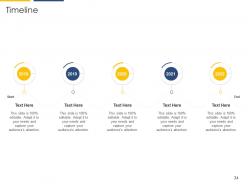
Slide 34: This slide is a Timeline template to showcase the progress of the steps of a project with time.
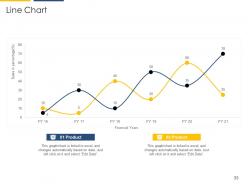
Slide 35: This slide shows a Line Chart that compares 2 products’ sales over a timeline of financial years.
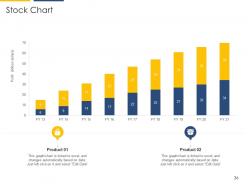
Slide 36: This slide shows a Stock Chart that compares 2 products’ profits over a timeline of financial years.
Slide 37: This slide contains Post-It Notes that can be used to express any brief thoughts or ideas.
Slide 38: This is a slide with a 30-60-90-Days Plan to set goals for these important intervals.
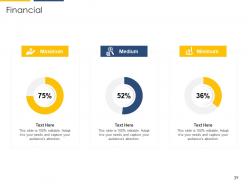
Slide 39: This slide presents the financial data with the data’s numbers at minimum, medium, and maximum percentages.
Slide 40: This is a Thank You slide where details such as the address, contact number, email address are added.
Strategic overview of oil and gas industry case competition powerpoint presentation slides with all 40 slides:
Use our Strategic Overview Of Oil And Gas Industry Case Competition Powerpoint Presentation Slides to effectively help you save your valuable time. They are readymade to fit into any presentation structure.


FAQs for Strategic overview of oil and gas industry case competition
Honestly, energy transition stuff is huge right now - companies are scrambling to figure that out. Commodity prices are all over the place, which makes planning a nightmare. ESG pressure from investors isn't going away either. COVID really messed up supply chains and they're still not back to normal. Plus there's this whole regulatory mess around carbon pricing that nobody knows how to navigate yet. Oh, and the talent thing is actually getting scary - tons of experienced people retiring and young folks just aren't jumping into oil & gas like they used to. I'd pick maybe 2-3 of these and really dig into how companies balance making money now vs. investing in sustainable stuff for later.
Focus on real carbon reduction stuff - like methane detection tech or actual renewable energy investments, not just buzzwords. Judges can smell greenwashing from a mile away, so show you're genuinely shifting the business model toward where the industry's going. Work in stakeholder engagement and how you'll handle regulations. Your financials need to include carbon pricing (that's gonna hit everyone eventually). Oh, and frame sustainability as making money, not just spending it. Companies that position green initiatives as competitive advantages instead of necessary evils tend to do way better in these competitions.
AI-powered seismic imaging is crazy good right now - it's spotting oil we'd totally miss otherwise. Digital twins let you monitor reservoirs in real-time, which is pretty cool. Automated drilling adjusts on the fly too. Carbon capture's becoming massive since everyone wants net-zero. IoT sensors are everywhere now for predictive maintenance - saves you from those expensive shutdowns nobody wants. Oh, and for your case comp? Focus on cost reduction plus safety and environmental wins. Judges eat that stuff up these days. The tech angle is solid but tie it back to those three things and you'll crush it.
Dude, competitive analysis is a game changer - shows you exactly where you stack up and what gaps you can jump on. Map out their production costs, reserves, how efficient they're running things. When you see it all laid out? Pretty wild honestly. Also helps you read the room for what's coming next. Like if ExxonMobil suddenly goes hard on renewables, that's your cue something big is shifting. Use all that intel to figure out where to throw your money and maybe spot some good acquisition targets. Oh, and partnership opportunities too - those can be clutch.
Geopolitical stuff is massive for oil/gas markets. Supply gets hit by conflicts, sanctions mess with big producers like Russia/Iran, and OPEC basically makes political decisions but calls them economic ones. Markets are so jumpy - even rumors of instability can send prices flying overnight. Pipeline disputes, trade tensions, regional conflicts all mess with supply chains directly. Oh and traders react to news headlines almost as much as actual data, which is pretty crazy if you ask me. When you're modeling your scenarios, definitely bake in whatever political drama's happening globally. It'll save you from looking naive.
Honestly, you've gotta spread out your income sources and protect yourself from those crazy price swings. Futures contracts can lock in prices - super helpful when markets go nuts. Cash reserves are your lifeline during the good months, trust me on that. Also think about operations that can shrink or expand fast when needed. Partnerships help split those massive project costs too. Oh and definitely run some "what if oil hits $30" scenarios on your business model. I've seen too many solid companies get blindsided in 2020 because they didn't plan for the worst-case stuff.
Honestly, oil companies are way behind on this stuff compared to other industries. Three main things to tackle: get real-time tracking and predictive analytics going, optimize your inventory with better demand forecasting (cuts costs big time), and build solid partnerships with suppliers - especially for the expensive drilling gear. My buddy at Shell said they saved millions just by fixing their forecasting alone. Don't try everything at once though. Pick one area, test it out, see what actually works, then roll it out everywhere else.
So the oil and gas industry is basically scrambling right now because of renewables. Companies are throwing money at carbon capture tech and diversifying into clean energy - some more successfully than others, tbh. Fossil fuel demand is supposed to peak in the next 20 years, which must make for some awkward boardroom conversations. But there's real opportunity here too. Look at how they're adapting: renewable investments, efficiency upgrades, hydrogen development. The smart money isn't on who moves fastest, but who pivots best. It's wild watching century-old companies reinvent themselves.
Yeah, regulatory stuff can totally make or break these companies' numbers. Environmental regs usually hit them hard - compliance costs go up, they need new equipment, carbon taxes eat margins. But when regulations get rolled back? That's when they can drill more and cut costs. Timing's crucial since oil companies plan investments years out. For your case comp, dig into specific examples - like what happened with the Clean Power Plan or those methane rules from a couple years back. You'll get way better cost estimates that way instead of just guessing. The historical data's actually pretty solid on this stuff.
Make CSR actually core to how you operate, not some marketing fluff. Pick real environmental stuff - carbon targets that matter, investing in communities where you work. Most oil & gas companies are honestly terrible at this, which is your opening. Authentic CSR helps you snag better talent and win government contracts. ESG investors care about this too. Don't spread yourself thin though - choose 2-3 areas where you can actually move the needle and track real results. Transparency matters way more than fancy reports nobody reads.
Yeah totally! People are way more into sustainable stuff now - EVs, solar panels, supporting companies that don't trash the planet. Gen Z especially will pay extra for cleaner options, which is wild compared to like 2015. But here's the thing - traditional energy isn't going anywhere yet. Developing countries still need it big time, plus all the heavy industry stuff. For your case, I'd look at how these companies are basically doing both now. They're keeping their old business running while also jumping on the green bandwagon to keep customers happy.
Look, you've gotta start cross-training your current people while also hunting for those hybrid candidates - like engineers who get both traditional drilling AND renewables. Most companies are making this huge mistake of only hiring for right now when everything's changing so damn fast. I'd focus on adaptability over super niche experience, honestly. Partner with universities that aren't stuck teaching outdated energy programs. Build teams that can jump between oil/gas and renewable projects. The real winners? Companies creating actual learning cultures instead of just crossing their fingers after they hire someone.
So for oil and gas, you'll definitely want DCF models but with commodity price scenarios baked in. Production decline curves are key - honestly this sector gets way more technical than most people realize with all the reserve categories and recovery factors. Monte Carlo sims help tons with the uncertainty around reserves and prices. The cash flows are weird too since you get massive upfront capex then these long production tails. NAV calculations matter a lot here. I'd start with your basic three-statement model first, then add the sector stuff like finding and development costs on top.
Look, data analytics completely changes how you approach decisions - no more guessing games. You'll catch equipment issues before they blow up, find the best drilling spots using actual geological info, and nail your market forecasts. Maintenance gets way cheaper since you're fixing things early. Plus you catch production problems that usually slip by unnoticed. My buddy's company saved tons just from spotting weird patterns in their data. The tricky part? Your team has to actually understand what the numbers mean, or you're basically staring at spreadsheets all day for nothing.
Honestly, just be real about everything first. Publish those sustainability reports and don't make promises you can't keep - that's where most companies screw up. Partner with local stuff too, like schools or small businesses where you're drilling. Social media's weird for oil companies but posting actual employee stories helps. People have a sixth sense for corporate BS in your industry, so pick one solid green project and nail it before doing anything flashy. Build that trust slowly... oh and whatever you do, don't hire some PR firm that makes you sound like a robot.
-
Appreciate the research and its presentable format.
-
Design layout is very impressive.
-
Content of slide is easy to understand and edit.
-
Excellent products for quick understanding.
-
Unique research projects to present in meeting.
-
Easily Editable.