


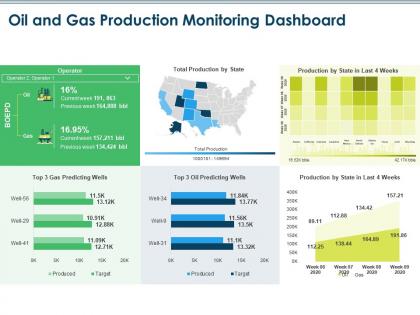
Oil and gas production monitoring dashboard oil and gas industry challenges ppt infographics




Try Before you Buy Download Free Sample Product
 Impress Your
 Audience
 100%
100% Editable
 Save Hours
 of Time


Our Oil And Gas Production Monitoring Dashboard Oil And Gas Industry Challenges Ppt Infographics are topically designed to provide an attractive backdrop to any subject. Use them to look like a presentation pro.
People who downloaded this PowerPoint presentation also viewed the following :
Oil and gas production monitoring dashboard oil and gas industry challenges ppt infographics with all 2 slides:
Use our Oil And Gas Production Monitoring Dashboard Oil And Gas Industry Challenges Ppt Infographics to effectively help you save your valuable time. They are readymade to fit into any presentation structure.
FAQs for Oil and gas production monitoring dashboard oil and gas industry
Track your barrels per day and well uptime first - that's your bread and butter. Decline curves will show you which wells are crapping out. Operating costs per barrel matter too, plus water cut and gas-to-oil ratios. Honestly, equipment efficiency can make or break you. I've seen one busted compressor tank an entire day's production, which is just brutal. Don't forget reserve replacement and finding costs for the bigger picture. Set up dashboards for daily stuff, then do monthly reviews on everything else. Start there and you'll actually know what's happening in the field.
Honestly, real-time analytics is a game changer - you catch issues while they're still fixable instead of reading about disasters in last week's reports. Equipment starts acting funky? You'll know immediately. Same with pressure drops or production changes. My buddy Jake learned this the hard way when his team missed warning signs for three days straight. Anyway, the cool part is your control systems can auto-adjust some stuff, but you still need people watching dashboards and jumping on alerts fast. Set up those key metrics and make sure everyone knows how to react quickly.
Dude, IoT sensors are everywhere now - that's probably where you should start since everything else builds on that. AI predictive analytics can spot problems before they blow up your budget, which is clutch. Digital twins are wild too, basically virtual copies of your whole operation. Drone inspections are becoming super common for checking remote stuff, and satellite monitoring is getting cheaper. Machine learning got really good at predicting when equipment's about to crap out. Oh and real-time data streaming - honestly didn't think it would catch on this fast but here we are. Start with sensors though, trust me on that one.
Ugh, environmental regs are such a pain - you're gonna be monitoring everything under the sun. Continuous emissions tracking, groundwater tests, air quality sensors, soil samples. The whole nine yards. EPA wants real-time data on methane leaks, water discharge, particulate stuff. State agencies too. And don't even get me started on record-keeping - they want everything saved for years in case they decide to audit you. Honestly though, automate whatever you can because doing this manually will kill your team's productivity. Trust me on that one.
Dude, think of IoT like having eyes everywhere without actually being there. Thousands of sensors track pressure, temp, flow rates - all that stuff feeds straight to your systems automatically. Way better than the old manual check routine, trust me. The real magic happens when you catch problems early. Like a pump starts vibrating weird or you spot pressure drops before they turn into leaks. Honestly saved my ass more times than I can count. My advice? Start with your most critical equipment first, then build from there. You'll be hooked once you see how much you were missing before.
Honestly, predictive maintenance is a game changer - you basically use sensors and data to spot problems before your equipment actually dies on you. Temperature, pressure, vibration patterns, all that stuff gets monitored. Instead of scrambling when a pump decides to quit at 2am (because they always do), you can plan maintenance during slower periods. Most places see 30-50% fewer surprise breakdowns, which is huge. I'd start with whatever equipment would screw you over the most if it failed. Get monitoring on those first, then expand from there. Your future self will thank you when you're not dealing with emergency repairs.
Ugh, the worst part is all your data lives in totally different systems that hate each other. SCADA, historians, IoT stuff, lab results - they all use different formats and timestamps. Your drilling data updates every second but production reports? Once a month. It's honestly like herding cats sometimes. Plus you're stuck with legacy systems that were built way before anyone cared about integration. I'd start by just mapping out what data you have and how often it refreshes. That'll show you which fires to put out first.
Honestly, drones are perfect for this stuff. You get eyes on everything without risking your crew - pipeline checks, thermal leak detection, those annoying flare stack inspections that nobody wants to climb. Remote sites especially benefit since you're not burning half a day just getting people out there. Real-time monitoring catches problems early, which saves you tons down the road. Regular flyovers help track how equipment's aging too. Oh, and the footage works great for compliance docs. I'd start small though - pick your most critical gear and run a pilot program first.
Real-time dashboards are your best friend here - production rates, pressure trends, equipment status, all the key stuff. Color coding helps tons (red for alerts, green for normal). Heat maps are clutch for well performance, seriously people sleep on those. Don't clutter the screens though, nobody has time to dig through random data when something's going wrong. Mobile-friendly is huge since you're always checking things remotely. Oh and customize views by role - field engineers need completely different info than management does for their weekly meetings.
So basically you train algorithms on all your historical sensor data - flow rates, pressure, equipment performance, the whole deal. Models figure out what normal operations look like, then alert you when something's off. Time series forecasting is honestly where it shines - I've seen some crazy accurate predictions. Classification helps you sort different failure types, regression predicts when stuff might break down. Main thing is your data needs to be solid and come from multiple sources. Oh, and definitely start small with like one well first before you go all-in on the whole operation.
Honestly, remote monitoring is huge for catching problems before they blow up in your face. Your sensors track pressure, temperature, gas leaks - all that stuff - so you don't have to send people into sketchy situations. Real-time alerts mean you'll know instantly when something's going wrong. And here's the cool part: you can actually shut things down from wherever you are if needed. Way better than the old days of manual checks, which were honestly pretty terrifying. Just make sure you've got good sensor coverage on your critical equipment and that everyone knows how to respond when those alerts start going off.
Calibration is huge - seriously can't emphasize this enough because drift will mess up your data bad. Most places I've seen use multiple measurement points so they can cross-check everything, plus some automated software that catches weird readings right away. Flow computers are pretty solid for handling temperature and pressure corrections too. You definitely want backup systems though - when one sensor craps out, you don't want to be scrambling. I'd say monthly calibration works well for most setups. Oh, and trust your gut when something looks off in the data. Nine times out of ten you're right about those sketchy readings.
Look, these systems basically pay for themselves by catching problems early. You'll spot equipment issues and bottlenecks before they turn into expensive disasters. Real-time optimization keeps wells running smoothly, cuts unplanned downtime, and prevents those awful equipment failures that cost a fortune. Smart maintenance scheduling becomes way easier too. The data visibility is honestly game-changing - you catch tiny issues before they snowball. I'd start by figuring out where you're bleeding money most, then see what monitoring could flag those problems ahead of time. Makes resource decisions so much clearer.
Look, you've gotta monitor environmental stuff just as hard as your production metrics. Air quality, water, soil, wildlife - track it all because the EPA doesn't mess around. Honestly, I've seen companies get hit with fines that'll make your head spin. One slip-up and they can literally shut you down while you're scrambling to fix contamination issues. It's not just about avoiding regulatory nightmares though - it's actually the right call morally too. Your monitoring systems need to be bulletproof on both sides. Trust me, catching problems early beats explaining to your board why operations are halted.
So after Stuxnet totally wrecked industrial systems, oil and gas companies got serious about security. They use network segmentation and air-gapped systems to keep critical stuff isolated. Multiple defense layers too - firewalls, intrusion detection, encrypted comms between SCADA and control centers. Zero-trust is pretty standard now where every device gets authenticated first. Honestly, regular pen testing helps, but employee training matters more since people are still the weakest link. I'd start by auditing your network setup though.
-
Informative presentations that are easily editable.
-
Colors used are bright and distinctive.
-
Attractive design and informative presentation.