


SWOT Analysis Of Spa Business Plan




Try Before you Buy Download Free Sample Product
 Impress Your
 Audience
 100%
100% Editable
 Save Hours
 of Time


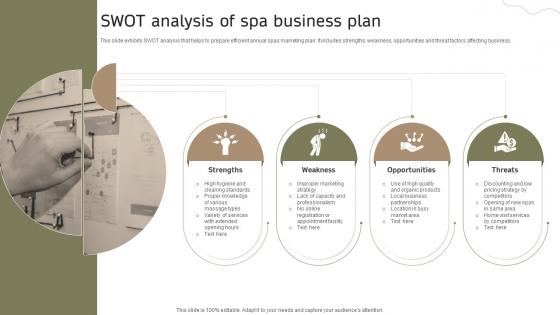
This slide exhibits SWOT analysis that helps to prepare efficient annual spas marketing plan. It includes strengths, weakness, opportunities and threat factors affecting business.
People who downloaded this PowerPoint presentation also viewed the following :
SWOT Analysis Of Spa Business Plan with all 6 slides:
Use our SWOT Analysis Of Spa Business Plan to effectively help you save your valuable time. They are readymade to fit into any presentation structure.





FAQs for SWOT Analysis Of
So SWOT stands for Strengths, Weaknesses, Opportunities, and Threats. Strengths are what you're already good at - your skills, resources, competitive advantages, whatever. Weaknesses? That's the stuff holding you back internally. Opportunities are external things you could jump on, like new markets or trends. Threats are outside risks that could mess you up. Here's the thing - you've gotta be totally honest about everything, especially the bad stuff. Don't make your weaknesses sound better than they are. Also, definitely get your whole team involved because they'll catch things you're blind to. Trust me on that one.
Honestly, start with what you're genuinely crushing at - maybe it's customer service, your pricing, or some process that just works. Get feedback from your team and customers too, since you're probably blind to half your wins. I always look at what makes competitors sweat that we handle easily. Once you've got that list, rank them by what actually drives revenue or sets you apart. Don't overthink it though - focus on like 3-5 strengths max that really matter for where you want to go. The rest is just noise.
You'll want to mix internal stuff with outside feedback - both angles matter. Financial reviews and employee surveys help catch internal issues. Customer feedback and competitor research show the external view. Honestly, the worst problems are usually the ones executives don't want to face! Look for spots where you're consistently behind goals or getting beaten by competitors. Different departments see totally different problems, so loop them all in. Oh, and set up regular check-ins - way easier than fixing massive issues later. Sometimes a fresh perspective from someone outside your bubble reveals everything.
Honestly, those annual strategy meetings are pretty much useless in fast markets. You've gotta check stuff way more often - I do monthly competitive scans and quarterly deep dives into customer feedback. Set up alerts for industry news (maybe don't obsess like I do though lol). Your sales team sees patterns first, so actually listen to them. Social listening tools catch emerging trends before they blow up. Oh, and regulatory changes can create huge openings if you're paying attention. Just track this stuff consistently with your team - doesn't need to be fancy, just regular.
For threats, look at what's happening outside your business that could screw things over. New competitors popping up? Economic changes making customers tighten their wallets? Regulations shifting in ways that hurt you? Tech disruptions are brutal - just ask Blockbuster how that went. Supply chain problems can hit out of nowhere too. Political stuff, changing customer tastes, even seasonal fluctuations matter. Honestly, this part sucks because most of it's totally out of your hands. But you've gotta face reality about what external forces could derail your plans.
Dude, trust me on this - visual SWOT analyses are a game changer. Nobody wants to stare at another wall of bullet points. Color-coded quadrants work great. Icons too. I've seen people use interactive dashboards that actually keep everyone awake during meetings (miracle, right?). Charts help you rank stuff by impact or urgency. Canva's super easy if you want something that looks professional without the hassle. Miro's good too, though I think their interface is slightly clunky. Point is, when you make it visual, people actually pay attention and you'll spot patterns way easier than scrolling through boring text.
You definitely need to get stakeholder input for your SWOT - otherwise you're just guessing. Customers will tell you about weaknesses you had no clue about. Suppliers might warn you about incoming threats. Your own employees often see operational strengths that management completely misses (which is honestly pretty common). I've watched so many companies do SWOTs that were basically just management talking to themselves in a circle. What you think is your biggest strength? Your customers might not even care about it. Survey or interview people from each group before you wrap up the analysis.
Look, SWOT analysis is basically a reality check for your startup. It forces you to be honest about what you're actually good at versus what you think you are. The threats part is huge - most founders are way too optimistic about competition. You'll figure out which opportunities make sense for your actual capabilities, not just the shiny ones that sound cool. Honestly, the weaknesses section hurts but it's probably the most valuable. Run through it every few months to make sure you're building something that actually makes business sense, not just what you're obsessed with.
Honestly, you just need to tweak SWOT to fit whatever industry you're dealing with. Tech companies should focus on innovation speed and technical debt - that disruption stuff really matters there. Healthcare? Think regulatory compliance and patient outcomes instead. Manufacturing is all about supply chains and automation capabilities. The framework's pretty flexible, which is nice. Just figure out the 3-5 things that actually make or break companies in your space, then build everything around those factors. Way more useful than doing some generic analysis that doesn't really apply to your situation.
Honestly, the worst thing you can do is be super vague - like just writing "good customer service" without any real examples. Get other people involved too, don't try to do the whole thing solo. I've seen so many teams just throw everything at the wall instead of focusing on what actually matters for their specific goal. Also? You gotta prioritize afterward or you'll end up with this massive list that nobody knows what to do with. Rank the important stuff and figure out your next moves, otherwise it's basically useless.
Honestly? Once a year isn't enough anymore. I'd go quarterly for most businesses, maybe monthly mini-checks if you're in something super competitive. Big stuff like new competitors or leadership changes should definitely trigger a fresh look too. My old boss used to say annual reviews are basically useless by month six - kinda harsh but not wrong. Really depends on your industry though. Tech moves crazy fast, retail maybe less so. Start quarterly and see how it feels. You can always dial it back if it's overkill.
Keep your group tight - maybe 5-8 people tops. Send them the SWOT framework ahead of time so they're not walking in blind. Sticky notes work great, or whatever digital board you prefer. Go through each section one by one. Oh, and here's what always happens - everyone gets obsessed with the weaknesses part and won't move on. You'll need someone decent running the show who can redirect when needed. Also make sure your quiet people actually talk (they usually have the best insights anyway). Don't just make a nice chart and walk away. Pick 2-3 things you'll actually act on.
Here's the thing - match each SWOT section to different strategy moves. Your strengths + opportunities? That's where the magic happens, honestly. Fix weaknesses before they bite you later. Use what you're good at to fight off threats, and try not to let your weak spots make threats even worse. Be super specific though - like instead of saying "better marketing," go with "start Instagram ads for millennials using our tech skills." Make a quick chart with who does what and when. Oh, and don't go crazy trying everything - pick maybe 3 solid strategies you'll actually follow through on.
So for SWOT analysis tools, I'd probably start with whatever your team's already comfortable using - makes getting buy-in way easier. Miro and Lucidchart have decent templates if you want something fancy, and they're great for remote collaboration. Canva works too, though I feel like it's more design-focused than business planning. Microsoft Visio's solid if you're stuck in that world already. But honestly? Sometimes I just throw together a simple 2x2 table in Google Docs and it does the job perfectly fine. The main thing is making sure everyone can actually contribute instead of you doing all the heavy lifting yourself.
Oh totally! SWOT is way better when you mix it with other stuff. I usually start there to get a quick overview, then dig deeper with something like Porter's Five Forces or PEST analysis. Works really well together - your SWOT findings can feed right into those other frameworks. Don't just stop at SWOT though, that's where most people mess up. Pair it with at least one other method and you'll get so much more out of it. Trust me, the combo approach is where you find the good insights hiding.
-
Qualitative and comprehensive slides.
-
The way SlideTeam professionals work is exceptional. Thanks for being so helpful!