

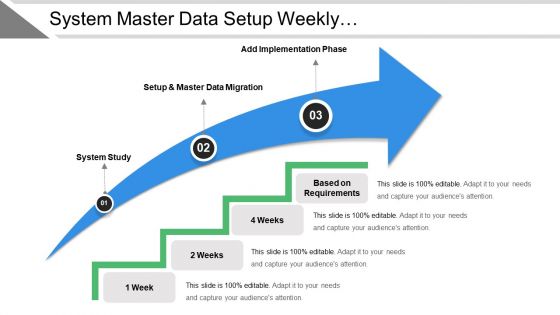
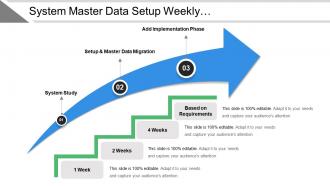
System master data setup weekly implementation roadmap with arrow





Try Before you Buy Download Free Sample Product
 Impress Your
 Audience
 100%
100% Editable
 Save Hours
 of Time


Appeal to folks to adopt a humane approach with our System Master Data Setup Weekly Implementation Roadmap With Arrow. Generate aid for the injured.
People who downloaded this PowerPoint presentation also viewed the following :
System master data setup weekly implementation roadmap with arrow with all 5 slides:
Elaborate on biased decisions with our System Master Data Setup Weekly Implementation Roadmap With Arrow. It helps fight injustice.


FAQs for System master data setup weekly implementation
Start with clean data governance and naming standards right off the bat. Someone has to own each data domain or it turns into chaos - trust me on this one. Map out how your systems talk to each other, set up validation rules, and audit regularly so things don't drift. Most teams totally ignore the governance stuff because it's not sexy, but that's what saves you later. Oh, and don't try to fix everything at once. Pick your most critical business data first and expand from there. Way less overwhelming that way.
Start by mapping your core business processes - the big ones like order-to-cash or procure-to-pay. Then trace what master data each step actually needs. Honestly, don't try to boil the ocean here - I've seen too many projects crash and burn that way. Focus on data that gets shared across multiple systems and directly hits your main business functions. Look at your current headaches too. If you're always fixing the same customer addresses or product codes, boom - that's definitely in scope. Create a priority matrix and go after the high-impact stuff first.
Set up your data quality rules first - basically define what "clean" looks like for each field. Then profile everything systematically to spot duplicates, missing stuff, and inconsistencies. Super boring work but necessary. Document what you find and build repeatable cleaning processes your team can use. Always run changes by the business users before you deploy anything - they know weird edge cases you'd never think of. Oh, and don't forget monitoring after launch. Data gets messy again fast if you're not watching it.
Start with a data audit - check what you've got for completeness, accuracy, and whether it matches across systems. Look for duplicates, missing info, old records, weird formatting. Companies find the same customer entered like 15 different ways (total nightmare). Cross-check against external sources if you can. Also track how much manual cleanup your team does daily - that's usually your best clue something's broken underneath. Focus on your biggest data first, like customers or products, then branch out. Oh and definitely measure everything so you know if you're actually improving.
Okay so you need governance to set up the rules and standards for keeping data clean. Then data stewards are the actual people enforcing those rules daily - think of them as referees. Without both? Your master data turns into chaos fast (seriously, I've watched companies crash and burn over this). Stewards handle validation, fix conflicts when systems disagree, and keep quality in check. Oh and definitely pick your stewards early - give them clear ownership of specific areas. Don't just wing it and hope someone figures it out later.
Look, you gotta map your data priorities straight to whatever business goals actually matter. Revenue growth? Focus on customer and product data first. Operational stuff? Get your supplier and asset data cleaned up. Honestly, most teams try to fix everything at once and just get overwhelmed - learned that one the hard way. Pick the data domains that'll move the needle on metrics leadership cares about. Then build your governance around those priority areas. You're solving real business problems, not just playing data janitor for no reason.
Honestly, it depends on your budget and how complex your data is. If you've got enterprise money, go with Informatica or IBM InfoSphere - they're solid but pricey. Smaller setup? A good database structure plus Talend for data quality will work fine. Hell, I've seen people do decent work with Excel if they're disciplined about it. Cloud stuff like AWS Glue sits nicely in between and won't break the bank. But here's the thing - don't get caught up in fancy tools right away. Fix your data processes first, because even the best software can't save you from garbage practices.
Honestly, you gotta get people from IT, finance, ops, and your actual end users in the room from day one. Run some workshops where everyone can hash out what they actually need - trust me, people care way more when they see how their stuff connects to everyone else's. Don't wait until the end to check in with them, that's when everything goes sideways. Let each department own their piece while you keep the overall standards consistent. Oh, and definitely make them feel like partners designing this thing, not just people who have to deal with whatever you build. Works so much better that way.
Start with data governance - I know it's boring but trust me on this one. Then do your data inventory and figure out what's actually broken (spoiler: it's more than you think). Set up cleansing rules next, followed by migration planning and testing. Most people skip the governance stuff to move faster but you'll regret it big time. Get your data ownership sorted early and build in checkpoints so you catch problems before they snowball. End with real user testing - not just IT guys clicking around. Oh, and pad your timeline. Data stuff always goes sideways somehow.
Start building compliance into your roadmap from day one - seriously don't make my mistake of treating it like an afterthought. We had to redo our entire setup once and it was brutal. Figure out which regulations apply first (SOX, GDPR, HIPAA, whatever hits your industry), then build your data governance around those. Document your data lineage, set up access controls, create audit trails for master data changes. Oh and get your compliance team reviewing each phase before moving forward. Trust me on this one - backtracking sucks way more than doing it right the first time.
Focus on three main things: technical training for your MDM tools, business training so people actually understand data standards, and ongoing support with documentation and help desk stuff. The technical part is honestly way easier than getting everyone to stick to the processes - that's where you'll pull your hair out. Do hands-on workshops instead of boring slide decks. Assign data stewards for each department as your go-to people. Monthly check-ins for the first few months will save you headaches later. Oh, and don't forget regular reviews to catch problems before they snowball into bigger messes.
Track your data quality scores first - accuracy, completeness, all that stuff. Look at operational wins too like less manual work and faster reporting. User adoption is annoying to measure but honestly crucial (people will just ignore your fancy new system otherwise). Monitor how it affects decision speed and compliance downstream. Oh, and customer complaints about bad data should drop. Set up a monthly dashboard review with stakeholders. Keeps everyone engaged and proves you didn't waste their money on this thing.
Oh man, data validation is where everything falls apart if you skip it. I've seen whole projects tank because teams thought "eh, we'll fix the messy data later." Spoiler alert - later never comes. Don't go crazy with complex hierarchies right away either. Get your end users involved from day one, not at the end when they hate everything. Also? Data migration takes forever. Like, whatever timeline you're thinking, triple it. Start small with a pilot group, check your data twice, and build in tons of time for training. Trust me on this one.
Quarterly reviews are the bare minimum, but it really depends on your industry. Fast-moving stuff like tech or retail? Go monthly. Stable industries can probably stick with quarterly. Honestly, I've watched so many teams let their data turn into complete trash because they thought "we'll get to it later." Set up alerts for the important stuff and make someone actually own it - like, put their name on it. The trick is scheduling these reviews now while you're thinking about it. Otherwise you'll be dealing with a total disaster in six months wondering where it all went wrong.
Dude, good master data is literally what separates decent reports from total garbage. Your analytics actually work when the underlying data isn't a disaster - no more spending forever trying to figure out why nothing makes sense. I've watched teams burn whole days hunting down weird inconsistencies that proper data hygiene would've prevented. Plus automated dashboards become so much easier to build. Oh, and cross-department reporting stops being a nightmare. Honestly? Just audit what you have now. You'll find some obvious fixes that'll clean up your reports immediately.
-
Much better than the original! Thanks for the quick turnaround.
-
Appreciate the research and its presentable format.