


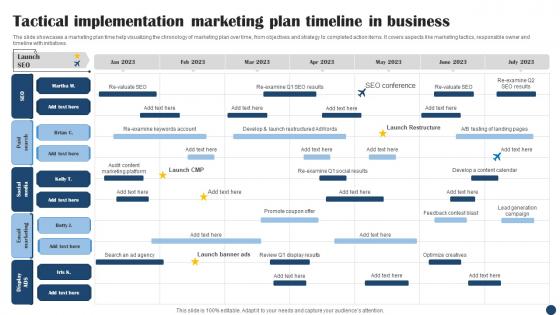
Tactical Implementation Marketing Plan Timeline In Business




Try Before you Buy Download Free Sample Product
 Impress Your
 Audience
 100%
100% Editable
 Save Hours
 of Time


The slide showcases a marketing plan time help visualizing the chronology of marketing plan over time, from objectives and strategy to completed action items. It covers aspects like marketing tactics, responsible owner and timeline with initiatives.
People who downloaded this PowerPoint presentation also viewed the following :
Tactical Implementation Marketing Plan Timeline In Business with all 6 slides:
Use our Tactical Implementation Marketing Plan Timeline In Business to effectively help you save your valuable time. They are readymade to fit into any presentation structure.





FAQs for Tactical Implementation Marketing Plan
Essential components of a marketing plan timeline include campaign phases, milestone deadlines, budget allocation periods, content creation schedules, and performance review checkpoints. These elements work together by establishing clear accountability, coordinating cross-functional teams, and ensuring resource optimization, with many organizations finding that structured timelines ultimately deliver faster campaign launches and measurable ROI improvements.
Businesses can effectively set realistic marketing deadlines by analyzing historical campaign performance, considering resource availability, factoring in market seasonality, and building buffer time for revisions. Through data-driven planning and stakeholder input, organizations can establish achievable timelines that account for content creation cycles, approval processes, and campaign optimization phases, ultimately delivering consistent results while maintaining quality standards across all marketing initiatives.
Marketing timeline tools include Asana, Trello, Monday.com, Gantt chart software like Microsoft Project, and specialized marketing platforms such as CoSchedule and HubSpot. These platforms streamline campaign coordination by automating task assignments, tracking deadlines, and enabling real-time collaboration, with many marketing teams finding that integrated dashboards ultimately deliver better resource allocation and faster campaign execution.
**INPUT**: How do you prioritize tasks within a marketing plan timeline? **OUTPUT**: Prioritizing marketing plan tasks involves assessing impact potential, resource requirements, dependencies between activities, deadlines, and strategic alignment with business objectives. Marketing teams typically tackle foundational elements like market research and brand positioning first, followed by content creation and channel setup, while campaign launches and performance optimization occur later, ultimately delivering coordinated execution that maximizes ROI and market penetration. [Word count: 58 words]
Key milestones in a marketing plan timeline include campaign launch dates, content creation deadlines, lead generation targets, conversion rate benchmarks, and budget review points. These strategic checkpoints streamline campaign management by enabling real-time adjustments, measuring ROI effectively, and maintaining stakeholder alignment, with many organizations finding that structured timelines deliver improved campaign performance and resource optimization.
Marketing plan timelines should be reviewed quarterly and updated based on performance metrics, market changes, campaign results, and seasonal business cycles. Through regular assessment, organizations can adjust strategies, reallocate resources, and pivot tactics in response to competitive pressures or emerging opportunities, with many companies finding that flexible timeline management ultimately delivers improved ROI and enhanced market responsiveness.
Consumer insights play a crucial role in determining campaign phases, content development schedules, and channel activation timing by revealing optimal engagement windows, seasonal preferences, and decision-making patterns. These data-driven revelations enable marketers to strategically sequence launches, align messaging with purchase cycles, and allocate resources more effectively, with many organizations finding that insight-informed timelines deliver significantly higher conversion rates and improved ROI.
Seasonal trends significantly impact marketing plan timelines by requiring companies to align campaigns with consumer behavior patterns, inventory cycles, and competitive landscapes throughout the year. Retail businesses often accelerate timelines before holidays, while B2B companies may extend planning phases during slower summer periods, ultimately enabling more strategic resource allocation and enhanced campaign effectiveness.
Businesses can implement milestone tracking, regular progress reviews, contingency planning, resource allocation monitoring, and cross-team communication protocols to maintain marketing timeline adherence. Through project management tools and weekly check-ins, organizations streamline campaign execution, identify potential delays early, and adjust resources accordingly, with many finding that structured accountability systems ultimately deliver more consistent campaign launches and improved ROI.
Budget allocation within a marketing plan timeline involves distributing resources across phases, channels, campaigns, and contingency reserves based on strategic priorities and expected returns. Organizations typically allocate 60-70% to proven channels while reserving 20-30% for testing new approaches, with many finding that front-loading brand awareness activities and back-loading conversion campaigns maximizes overall ROI.
Feedback loops enable continuous optimization by allowing marketers to collect performance data, analyze campaign effectiveness, and make real-time adjustments throughout the timeline. These mechanisms help organizations in retail, healthcare, and financial services refine messaging, reallocate budgets, and enhance targeting strategies, ultimately delivering improved ROI and more responsive marketing campaigns.
Different marketing channels significantly impact timeline structure by requiring varied lead times, implementation phases, and coordination points. Digital channels like social media and email enable rapid deployment within days, while traditional channels such as print advertising, radio campaigns, and event marketing require weeks or months of planning, with many organizations finding that strategic channel sequencing ultimately delivers sustained engagement and measurable competitive advantage.
Companies should avoid unrealistic deadlines, inadequate buffer time for revisions, poor cross-department coordination, and failing to account for seasonal fluctuations or market changes. These pitfalls often lead to rushed campaigns, missed opportunities, and budget overruns, with many organizations finding that building flexible timelines with regular checkpoints ultimately delivers better campaign performance and strategic alignment.
Cross-team collaboration enhances marketing plan timelines by aligning objectives, streamlining communication, and preventing resource conflicts between departments like sales, product development, and customer service. Through integrated planning platforms and regular coordination meetings, organizations achieve faster campaign launches, more cohesive messaging, and improved budget allocation, with many companies finding that collaborative timelines deliver 30% better execution rates.
Key indicators of a successful marketing plan timeline include consistent milestone achievement, measurable ROI improvements, lead generation targets being met, brand awareness growth, and campaign deliverables completed on schedule. These metrics enable organizations to track performance across quarters, optimize resource allocation, and demonstrate tangible business outcomes, with many companies finding that structured timelines ultimately deliver enhanced market positioning and competitive advantage.
-
I’m not a design person, so I couldn’t make a presentation to save my life. Thankfully, they have all kinds of templates that I regularly use for my work.
-
The designs by SlideTeam are honestly the best I have seen so far. Will be definitely coming back for more.