


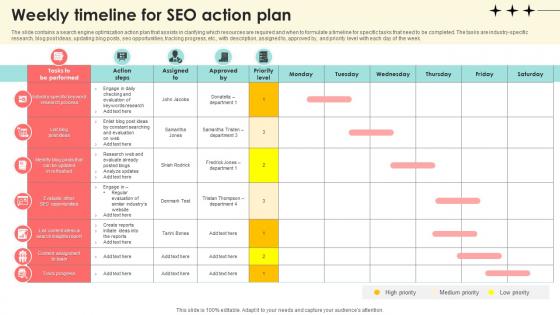
Weekly Timeline For SEO Action Plan




Try Before you Buy Download Free Sample Product
 Impress Your
 Audience
 100%
100% Editable
 Save Hours
 of Time


The slide contains a search engine optimization action plan that assists in clarifying which resources are required and when to formulate a timeline for specific tasks that need to be completed. The tasks are industry-specific research, blog post ideas, updating blog posts, seo opportunities, tracking progress, etc. with description, assigned to, approved by, and priority level with each day of the week.
People who downloaded this PowerPoint presentation also viewed the following :
Weekly Timeline For SEO Action Plan with all 6 slides:
Use our Weekly Timeline For SEO Action Plan to effectively help you save your valuable time. They are readymade to fit into any presentation structure.





FAQs for Weekly Timeline For
Start with a 30-60 day audit and keyword research - you need to know what you're dealing with first. Months 2-3 are for fixing technical stuff and optimizing what you already have. The growth phase hits around months 4-8, that's when you're cranking out content and building links. Most people quit right here because they don't see instant results (which is dumb, but whatever). After month 9 you're basically doubling down on what's actually working. Oh, and track your baseline metrics from day one - you can't measure progress without knowing where you started.
Honestly, each SEO phase usually takes 3-6 months, but it depends on where you're starting from. Technical stuff and initial setup? That's like 1-3 months. Content work can drag on for 3-6 months - and trust me, it feels longer when you're in it. Link building takes 4-6 months to show real results, though you'll be doing it constantly. Here's the catch though: you won't be doing these one at a time. Once things get rolling, you're basically spinning multiple plates. I'd plan quarterly so you can pivot when something's not working for your specific situation.
Track your keyword rankings, organic traffic, and how fast pages get indexed - those are the big ones. Technical stuff usually shows up in 2-4 weeks. New content gets indexed within a month or so. Keywords start moving around 3-6 months, then traffic follows a few weeks after rankings improve. Google's been weird lately with all their updates though, so don't panic if things look wonky. Focus on click-through rates and conversions too since those actually matter. I'd check monthly for the first six months, then maybe quarterly after that.
Fix the broken tech stuff first - that's your easiest wins right there. Focus on pages that actually bring in traffic and money next, since those matter most for your bottom line. Content's important but don't go crazy publishing every single day (learned that the hard way). Link building can wait until you've got bandwidth. Honestly, most SEO advice is just generic fluff. Track what actually works for YOUR site specifically. I'd make a quick spreadsheet ranking tasks by how much effort they take vs. the impact you'll probably see.
Yeah, keyword research is huge in those first couple months. Don't skip it like I've seen people do - you'll just end up targeting stuff nobody searches for. Super frustrating to watch. You gotta figure out what your audience actually types into Google before doing anything else. Otherwise you're just guessing and could waste months going after the wrong terms. Ahrefs or SEMrush are solid for finding keywords with decent search volume. Just make sure the competition isn't crazy high for where your site's at right now. It really does set up everything else you'll do later.
Honestly, I do monthly check-ins just to make sure nothing's completely broken - like if rankings suddenly tank or there's some weird technical issue. But the real work happens quarterly when I actually dig into keyword performance, see what content's working, check out competitors. That's where you find the good stuff. Oh, and if you're running campaigns or changing major things on your site? Yeah, definitely check weekly during those times. I set up automated reports so I don't forget - otherwise I'll go months without looking and then panic.
Oh man, algorithm updates are the worst for SEO timelines. Google will literally drop a bomb in the middle of your campaign and your rankings just disappear overnight - even when you're doing nothing wrong! Updates usually take like 2-4 weeks to settle down completely. I learned this the hard way last year. Don't freak out if you see random drops during these periods. Just build in extra time - maybe a month of cushion - because Google loves to keep us all guessing. Your rankings will probably bounce back once things stabilize.
So basically you want your content calendar to follow your SEO phases. When you're doing keyword research, that's when you plan topics and figure out which keywords each piece will target. Then schedule everything based on your SEO goals and what's happening seasonally. I always batch similar content together - honestly saves so much time. Your calendar becomes super useful for tracking what needs updates too. Start with your most important keywords first, put those on specific dates, then fill in supporting content around them. Makes the whole thing way less overwhelming.
Honestly, just start with Google Analytics and Search Console - they're free and cover most of what you need. Search Console's performance reports are seriously addictive once you get into them. Then grab a rank tracker like SEMrush or Ahrefs (SERPWatcher's cheaper if budget's tight). PageSpeed Insights is good for keeping tabs on your site's technical stuff too. Check monthly at least, but don't obsess over daily changes - trends matter more. Oh, and set up automated reports or you'll totally forget to check. Trust me on that one.
Honestly, I'd wait until month 3 or 4 before diving into link building. Get your on-page stuff dialed in first - there's no point getting links to mediocre content, ya know? Start small with internal links and local directories. Way easier wins. Then you can go after the good stuff from relevant sites. Really depends on how competitive your space is though. Most people hit their stride around month 6 when they've actually got content worth linking to. My biggest advice? Build something people genuinely want to link to first. Makes the whole outreach thing so much less painful.
Ugh, the worst part is clients expecting miracles in 30 days when SEO realistically takes 3-6 months minimum. Google keeps changing their algorithm too, which completely screws up your timeline - it's honestly like chasing a ghost sometimes. Plus you're juggling content, technical stuff, and link building all at once, which gets overwhelming fast. Oh, and resource allocation is a nightmare. My advice? Always build extra time into your projections. Set monthly check-ins so you can adjust expectations based on what's actually happening. Trust me, you'll need those reality checks.
Honestly, you've got a huge advantage over big companies - you can actually make changes without waiting for 50 people to approve them. Start with the easy stuff: get your Google Business Profile dialed in, fix any broken links or slow-loading pages. Then go after local keywords instead of trying to compete with Amazon or whatever. I mean, why fight that battle when you can own "[your service] + [your city]"? One of my clients totally crushed their local market in like 2-3 months just doing this. Build one really solid page around your main thing, see what happens, then expand from there.
Timing is everything with SEO, honestly. Launch a "holiday gifts" campaign in January and you're stuck twiddling your thumbs for 10 months waiting for traffic. Peak seasons give you higher search volume, but everyone else jumps in too. I learned this the hard way on a project once - started way too late. Best approach? Get your SEO going 3-4 months before your busy season hits. That way you can actually ride the wave when demand explodes instead of scrambling to catch up.
Honestly, it depends on what industry you're in. Finance or healthcare? You're looking at 8-12 months minimum because those sites have crazy domain authority. E-commerce is faster - maybe 3-6 months for product keywords. Local stuff is where you can actually win quickly though. Like, ranking for "best pizza downtown" could happen in 2-4 months since you're not competing with giants. My advice? Check out your competitors' domain scores first - saves you from overpromising to your boss later.
Dude, mobile stuff has to be your first move - don't even think about doing it later. Google's been judging sites based on their mobile version since 2019, so if yours is trash, you're screwed from the start. I've literally watched sites tank 30-40% of their traffic because of mobile problems. But here's the thing - once you fix the obvious stuff like slow loading and wonky layouts, you'll see changes pretty fast. Google has this Mobile-Friendly Test thing that'll show you exactly what's broken right now. Honestly wish more people would just run that first instead of guessing.
-
“There is so much choice. At first, it seems like there isn't but you have to just keep looking, there are endless amounts to explore.”
-
Use of different colors is good. It's simple and attractive.