

Task Prioritization At Workplace Training Ppt





Try Before you Buy Download Free Sample Product
 Impress Your
Audience
 100%
Editable
 Save Hours
of Time


This PPT deck covers the concept of prioritization in time management. It also includes reasons for prioritizing tasks in the workplace and the approach to follow to prioritize tasks.
People who downloaded this PowerPoint presentation also viewed the following :
Content of this Powerpoint Presentation
Slide 1
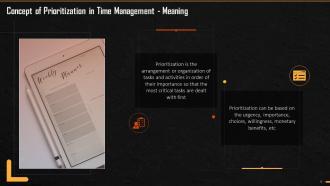
This slide explains the meaning and concept of prioritization in time management. It says that Prioritization is the arrangement or organization of tasks and activities in order of their importance so that the most important tasks can be dealt with first. Prioritization can be based on the urgency, importance, choices, willingness, and monetary benefits, etc.
Slide 2
This slide explains the reasons for prioritizing tasks in normal life and workplace. Prioritization is crucial as it improves efficiency, leads better focus, improves productivity, helps in time management, offers work-life balance, and provides clarity in goals.
Slide 3
This slide illustrates the process to be followed to prioritize tasks. It states that for accurate prioritization of tasks, the individual must focus five things before taking a decision. The five activities are - writing down the tasks to be completed, categorizing the tasks as urgent or important, assigning value to tasks, ranking the amount of effort required for each task, and then pick the one that has the highest ranking for execution.
Task Prioritization At Workplace Training Ppt with all 19 slides:
Use our Task Prioritization At Workplace Training Ppt to effectively help you save your valuable time. They are readymade to fit into any presentation structure.









FAQs for Task Prioritization At
Effective team task prioritization methods include the Eisenhower Matrix, MoSCoW prioritization, weighted scoring models, story mapping, and impact-effort analysis. These frameworks enhance team alignment by establishing clear criteria, streamlining decision-making processes, and enabling transparent resource allocation, with many organizations finding that structured prioritization ultimately delivers faster project completion and improved collaborative efficiency.
The Eisenhower Matrix enhances task prioritization by categorizing activities into four quadrants based on urgency and importance, enabling systematic decision-making about resource allocation. Through this strategic framework, professionals streamline workflow management, minimize time spent on low-value activities, and focus energy on high-impact tasks, ultimately delivering improved productivity and reduced decision fatigue across organizations.
Setting clear goals influences task prioritization by providing strategic direction, establishing urgency levels, creating measurable outcomes, and enabling resource allocation decisions. Through well-defined objectives, organizations can systematically rank activities based on impact and alignment, while teams increasingly find that goal-driven prioritization streamlines workflows, reduces decision fatigue, and ultimately delivers faster project completion and enhanced productivity.
Urgency plays a critical role in task prioritization by helping distinguish between time-sensitive activities and those that can be scheduled strategically, often working alongside importance to create comprehensive ranking systems. While urgent tasks demand immediate attention, especially in sectors like healthcare and financial services, balancing urgency with strategic importance ultimately delivers better resource allocation and prevents reactive workflows from undermining long-term objectives.
Technology tools aid task prioritization through automated scheduling, AI-powered urgency assessment, real-time deadline tracking, collaborative workflow management, and predictive analytics for resource allocation. These platforms streamline decision-making by analyzing project dependencies, team capacity, and business impact, with many organizations finding that integrated prioritization software reduces project delays while enhancing overall operational efficiency.
Common task prioritization pitfalls include confusing urgent with important, failing to estimate time accurately, neglecting to delegate appropriately, and constantly switching priorities without clear criteria. These mistakes undermine productivity by creating reactive workflows, resource misallocation, and decision fatigue, with many organizations finding that establishing clear priority frameworks and regular review processes ultimately delivers better focus and operational efficiency.
Task prioritization varies significantly across industries based on regulatory requirements, operational urgency, and customer impact factors. In healthcare, life-critical cases take precedence, while financial services prioritize compliance deadlines and risk management, and manufacturing focuses on production schedules and supply chain dependencies, ultimately enabling each sector to optimize resource allocation and deliver industry-specific outcomes efficiently.
Personal bias significantly impacts task prioritization by influencing which activities individuals perceive as urgent, important, or personally rewarding, often leading to suboptimal resource allocation and missed strategic opportunities. These cognitive tendencies can cause professionals to favor familiar tasks over challenging ones, prioritize short-term wins over long-term value, ultimately reducing organizational efficiency and competitive advantage.
Effective balance requires creating a strategic framework that allocates specific time blocks for immediate deliverables while protecting dedicated periods for strategic initiatives. By implementing structured planning cycles, many organizations find that using weekly reviews to assess urgent needs alongside monthly goal-setting sessions ultimately delivers both operational efficiency and sustainable growth momentum.
Effective deadline prioritization strategies include impact-urgency matrices, dependency mapping, time-blocking, stakeholder communication, and resource reallocation assessments. These approaches streamline workflow management by identifying critical path activities, minimizing bottlenecks, and maximizing resource efficiency, with many organizations finding that strategic task sequencing delivers faster project completion and enhanced team productivity under pressure.
Task prioritization fosters better work-life balance by helping individuals focus on high-impact activities, reduce time spent on low-value tasks, and create clear boundaries between urgent and non-urgent work. Through strategic prioritization frameworks, professionals streamline their workflows, minimize overtime requirements, and allocate dedicated time for personal activities, ultimately delivering reduced stress and enhanced productivity while maintaining quality outcomes.
**INPUT**: What metrics should be considered when evaluating task importance? **OUTPUT**: Task importance metrics include deadline urgency, strategic business impact, resource requirements, stakeholder influence, and potential revenue generation. These evaluation criteria help organizations streamline decision-making by identifying high-value activities, minimizing resource waste, and ensuring alignment with strategic objectives, with many companies finding that systematic prioritization ultimately delivers improved productivity and competitive advantage. **Word count: 54 words**
Teams can collaboratively prioritize tasks through structured frameworks like MoSCoW method, impact-effort matrices, stakeholder voting, and regular alignment meetings with clear criteria. These approaches streamline decision-making by establishing transparent evaluation processes, encouraging cross-functional input, and creating shared accountability, with many organizations finding that collaborative prioritization reduces conflicts while ultimately delivering faster project completion and enhanced team efficiency.
Regularly reassessing task priorities delivers enhanced productivity, improved resource allocation, better deadline management, reduced stress levels, and increased strategic alignment with changing objectives. This dynamic approach enables professionals to adapt to shifting business demands, capitalize on emerging opportunities, and maintain focus on high-impact activities, with many organizations finding that frequent priority reviews significantly boost overall operational efficiency and competitive responsiveness.
Emotional intelligence enhances task prioritization by enabling better self-awareness of stress triggers, improved recognition of team capacity limitations, and more effective communication about competing deadlines. Through emotional regulation and empathy, managers can assess project impacts more holistically, make decisions that account for team morale and stakeholder concerns, ultimately delivering more sustainable productivity and stronger collaborative outcomes.
-
Designs have enough space to add content.
-
I had them make a presentation for an office retirement party. They were very helpful in understanding what we wanted and delivered the perfect presentation. Highly recommended!