

The complete guide to customer lifecycle marketing powerpoint presentation slides





Try Before you Buy Download Free Sample Product
 Impress Your
Audience
 100%
Editable
 Save Hours
of Time


Lifecycle Marketing or Customer Lifecycle Marketing is increasingly becoming popular among digital marketers. Marketing any business cannot follow a one-size-fits-all approach. A customer goes through multiple stages before buying, namely awareness, interest, desire, and action. Check out our competently designed Complete Guide to Customer Lifecycle Marketing template. At each stage, the business wants to be noticed by the prospect. Customers should come to know about your solution, try it out, buy it, love it and advocate it. To capture more leads and increase conversion and brand loyalty, marketers follow customer lifecycle marketing to address customer concerns at each stage and be on top of the awareness. This PowerPoint deck has been extensively researched and compiled to guide businesses and their marketing and sales teams to plan their marketing activities accordingly. The decklists the key activities that should be carried out at each path stage to purchase to get maximum results. Capture more leads, grow more sales and win brand loyalty by following this strategy. Download it now.
People who downloaded this PowerPoint presentation also viewed the following :
Content of this Powerpoint Presentation
Slide 1: This slide introduces The complete guide to customer lifecycle marketing. State Your Company Name and begin.
Slide 2: This slide presents Table of Content for the presentation.
Slide 3: This slide shows Customer Engagement with Customer Lifecycle Stages.
Slide 4: This slide presents B2C Customer Journey with text boxes.
Slide 5: This slide displays Digital & Traditional Channels of Marketing.
Slide 6: This slide represents Customer Lifecycle Marketing for B2C Companies.
Slide 7: This slide showcases Customer Lifecycle Marketing for B2B Companies.
Slide 8: This slide shows Customer Lifecycle Marketing describing- Attract, Retain, Sell, etc.
Slide 9: This slide represents Make the customers aware about your products and services.
Slide 10: This slide showcases customer persona to understand their needs, enemy, insights, etc.
Slide 11: This slide shows Customer segmentation based on demographics, psychographics and behavior.
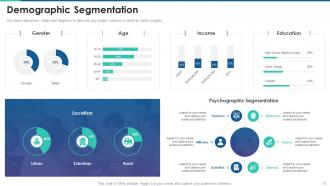
Slide 12: This slide presents Demographic Segmentation and Psychographic Segmentation with the help of bar graphs.
Slide 13: This slide displays Analyze Customer Behavior to Reach Maximum People.
Slide 14: This slide represents Content Ideas to Reach Maximum Customers.
Slide 15: This slide showcases Collect Contact Details for Follow Up.
Slide 16: This slide shows Stage 2- Sell / Convince with related imagery.
Slide 17: This slide displays Content Examples for Convincing the Target Customer.
Slide 18: This slide represents Review Customer Journey Map Template.
Slide 19: This is another slide continuing Review Customer Journey Map Template.
Slide 20: This slide showcases Use Lead Scoring to Find Potentially Most Valuable Customers.
Slide 21: This slide displays Use Lead Scoring to Find Potentially Most Valuable Customers.
Slide 22: This slide represents Create Your Content Strategy Roadmap.
Slide 23: This slide showcases Create an Editorial Calendar Template.
Slide 24: This slide displays Map Out the Sales Process with additional textboxes.
Slide 25: This slide represents Perfect Sales Strategy to Close More Deals.
Slide 26: This slide showcases Build your CRO (Conversion Rate Optimization) Plan.
Slide 27: This slide shows Stage 3- Retain with related imagery.
Slide 28: This slide presents Ideas to Win Over Your Customers.
Slide 29: This slide displays Customer satisfaction surveys to know the customer’s experience.
Slide 30: This slide represents Ways to Increase the Value of Each Customer.
Slide 31: This slide showcases Icons for the Complete Guide to Customer Lifecycle Marketing.
Slide 32: This slide is titled as Additional Slides for moving forward.
Slide 33: This slide provides Clustered bar chart with two products comparison.
Slide 34: This slide depicts Area chart with two products comparison.
Slide 35: This is About Us slide to show company specifications etc.
Slide 36: This is Our Team slide with names and designation.
Slide 37: This slide shows Post It Notes. Post your important notes here.
Slide 38: This slide depicts Venn diagram with text boxes.
Slide 39: This slide shows Linear Process with additional textboxes.
Slide 40: This is Our Target slide. State your targets here.
Slide 41: This is a Timeline slide. Show data related to time intervals here.
Slide 42: This slide presents Roadmap with additional textboxes.
Slide 43: This is a Thank You slide with address, contact numbers and email address.
The complete guide to customer lifecycle marketing powerpoint presentation slides with all 48 slides:
Use our The Complete Guide To Customer Lifecycle Marketing Powerpoint Presentation Slides to effectively help you save your valuable time. They are readymade to fit into any presentation structure.









FAQs for The complete guide to customer lifecycle marketing
So there's basically five stages customers go through: awareness, consideration, purchase, retention, and advocacy. Different tactics work at each stage - you can't just spam everyone with the same message (learned that the hard way). Awareness is all about content and SEO so people find you. During consideration, you'll want demos and case studies to nurture them. Purchase stage? Remove every possible barrier and close it. Retention comes next with solid onboarding and support - maybe some upselling too. Then advocacy turns your happy customers into your best salespeople. I'd start by figuring out where your current customers are getting stuck.
Start with whatever data you already have - website analytics, email opens, purchase history. Google Analytics plus your CRM are basically essential. Then map behaviors to stages: content downloads and site visits = awareness, demo requests = consideration, actual purchases = conversion, support tickets = retention. Social listening tools can help but honestly they're kind of a pain and super noisy. I'd add more sophisticated tracking later once you figure out what's missing. The trick is connecting specific actions to where people are in your funnel - that's where the real insights happen.
Honestly, personalization is what makes lifecycle marketing actually work. You're hitting people with the right stuff at the right time. Start by splitting your audience - new visitors vs repeat buyers vs your power customers who've ordered multiple times. Each group needs totally different messaging, you know? I'd jump into email personalization first since it's pretty straightforward and you'll see results fast. Dynamic content, product recs based on what they've bought before, landing pages that match where they are in the journey. The tricky part is keeping your data clean (ugh, I know) but once you do, acting on those insights becomes way easier.
So customer lifecycle marketing is just figuring out what content people actually want based on where they are with your brand. New folks need the basics - like what problem you solve and why they should care. Your existing customers want the good stuff: how-to guides, pro tips, that kind of thing. Then your super loyal customers? Those are goldmines for case studies and getting referrals. Way better than just throwing content at the wall and seeing what sticks (which I've definitely done before lol). I'd start by looking at what you've already got and see what's missing for each stage.
Look, start with just 2-3 metrics per stage or you'll go crazy trying to track everything. Acquisition cost and activation rates for the top of your funnel. Churn rate is huge - seriously, keeping customers is so much cheaper than finding new ones. Track engagement and retention too, plus customer lifetime value if you can swing it. Net promoter score tells you if people would actually recommend you, which is pretty telling. The key is picking stuff that actually moves the needle for YOUR business specifically. Set up some basic dashboards so you can catch trends before they bite you. Start simple, then add more as you get the hang of it.
Honestly, automation tools are a game-changer for timing your messages perfectly without going crazy tracking everything manually. Set up emails that fire when someone abandons their cart, automatically sort customers by what they've bought before, create drip campaigns that guide people through your funnel. The time savings alone are worth it - seriously, spreadsheets are the worst. I'd map your customer journey first, then figure out where automated touchpoints make sense. Welcome emails are perfect to start with since they're simple. Test that out, see how it goes, then build more workflows from there.
Oh man, the worst thing you can do is blast everyone with the same generic messages. New customers getting retention emails? Annoying. Loyal ones seeing "welcome to our brand!" for the 50th time? Boring as hell. Teams get obsessed with building these elaborate automation flows but completely ignore what customers are actually doing. Like, if everyone's dropping off at checkout, maybe fix that first? Map out where people actually are in their journey, then write for each stage. And honestly - test stuff. Your assumptions are probably wrong (mine usually are). Real data beats gut feelings every time.
You can't use the same approach for everyone - it just doesn't work. Enterprise clients want those heavy white papers and case studies, plus they'll sit through a 6-month nurture sequence. SMBs? They want pricing and quick wins immediately. Then there's the age thing too - Gen Z loves social proof and videos, while older folks still prefer detailed email comparisons (go figure). I'd map out your main segments first, then create separate flows for each group. Way better than cramming everyone into one funnel and hoping for the best.
Honestly, grab their actual words from surveys and reviews - that's gold for personalizing your emails. After someone buys something or finishes onboarding, ask what they think. Then sort people based on what they say. Most companies are terrible at this part though - they collect feedback then do absolutely nothing with it (drives me crazy). Take the good stuff for testimonials in your email campaigns. Common complaints? Address those head-on in your retention messages. Oh, and always circle back - mention their feedback in future emails so they know you listened. Start with just one stage of your funnel and test it out first.
Get them focused on the same stuff - customer lifetime value, retention rates, that kind of thing instead of just leads vs deals closed. Have regular meetings where marketing shares what they're learning about customers and sales gives feedback on lead quality. Honestly? Half the battle is just getting them talking to each other more. Set up shared CRM access so everyone sees the whole customer journey. Oh, and make sure you both agree on lead scoring criteria upfront - saves so much drama later. Create content together for different stages. Make it feel like one team, not two competing departments.
Dude, customer retention is where you actually make money. Getting new customers costs like 5-25x more than keeping the ones you already have - which honestly seems obvious but so many businesses ignore this. Your existing customers buy more over time and refer their friends (free marketing, basically). Here's the wild part: just bumping retention up 5% can increase profits by 25-95%. That's insane math right there. Stop obsessing over new leads all the time. Focus on taking care of your current customers with good experiences and maybe some loyalty perks. Way better ROI.
So basically you want different content for different types of customers. New people need educational stuff and targeted ads to get them interested. Fresh customers should get onboarding content and welcome messages. Your existing customers are the fun ones though - give them product tips, share their posts, and throw in some exclusive deals to make them feel special. At-risk customers? Hit them with re-engagement campaigns or promotions. Instagram Stories work really well for this btw. The trick is having these different content buckets ready so you're not just posting the same boring stuff to everyone.
Amazon's recommendation engine is insane - those "customers who bought this" suggestions work every single time. Spotify's year-end Wrapped thing is pure genius too, turning your listening data into something you actually want to share. Oh and Sephora's Beauty Insider program kills it by sending samples based on what you've bought before. They're not being pushy about it either, which I appreciate. The trick is using customer data to feel personal, not creepy. I'd map out your customer journey first and see where you can add those little personalized moments that actually matter.
Honestly depends where you're at business-wise. Early stage or losing lots of customers? Put more into keeping who you have - it's way cheaper than finding new ones. Like 5-7x cheaper, which is nuts when you think about it. Most mature companies do something like 60/40 or 70/30 split toward retention. Here's the thing though - you can't just look at one number. I've seen too many people get excited about new signups while their existing customers are bailing left and right. Set up some kind of dashboard where you can see your customer lifetime value, churn rate, and acquisition costs all together. Then try shifting your budget around every few months until you find what actually works for your situation.
Dude, AI is totally changing the personalization game right now. You can actually predict when customers are about to bail and send them the perfect email automatically. Product recommendations get scary accurate based on how people browse and shop. The segmentation you can do now is insane - like way more precise than the old demographic stuff we used to rely on. Honestly took me forever to wrap my head around how much you can automate without it feeling robotic. My advice? Don't try to overhaul everything at once. Just pick one part of your customer journey and test some AI personalization there first.
-
Perfect template with attractive color combination.
-
Wonderful templates design to use in business meetings.