


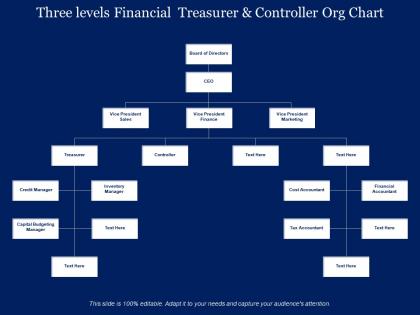
Three levels financial treasurer and controller org chart




Try Before you Buy Download Free Sample Product
 Impress Your
 Audience
 100%
100% Editable
 Save Hours
 of Time


Display the relationship of hierarchy within the organization with our three levels financial treasurer and controller org chart. This presentation slide of accounting department chart has been designed by our professional team and helpful to display to job duties perfumed by controller and treasurer as their skills sets and roles in an organization serves different purposes. Our presentation slide of role of financial controller will help you to present duties performed by managers such as monitoring internal controls to lessen financial risks and create value within the organization. With the help of our finance and accounting department organizational chart template is useful to financial reporting, analysis, and robust internal finance functions. This template of finance and treasury template can be used to illustrate the reporting relationships in your company of various finance and treasury department to represent reporting their relationships within the organization. Download this PowerPoint slide to display compliance, analysis of financial data and preparing of budgets. Compensate for any drawbacks with our Three Levels Financial Treasurer And Controller Org Chart. They help cover for any flaws.
People who downloaded this PowerPoint presentation also viewed the following :
Three levels financial treasurer and controller org chart with all 5 slides:
Your thoughts are ready to gain an opening. Create the breach with our Three Levels Financial Treasurer And Controller Org Chart.




FAQs for Three levels financial treasurer and
So basically, treasurers are all about the actual cash flow - managing money coming in and going out, handling investments, making sure you're not gonna run out of funds. Controllers are more the numbers people who do all the accounting, financial reports, and deal with compliance stuff (and yeah, they get stuck with auditors too, poor them). Different sides of the same coin really. Your treasurer watches the money move while your controller tracks where it went and makes sure everything's documented properly. Both should report to your CFO - treasurer for big financial strategy decisions, controller for the day-to-day operational stuff. Pretty standard setup.
Honestly, a good org chart just clears up who does what between your treasurer and controller. No more of that "I thought you were handling it" nonsense. It maps out decision-making authority and shows the spots where they actually need to work together - cash flow stuff, budget reviews, that kind of thing. Plus you get clear escalation paths for when they butt heads (because they will). The key is making sure it matches reality, not just what looks good on paper. I'd check it every few months since things change fast.
Usually both report to the CFO, but it depends on your industry. Manufacturing and retail? They're typically peers. Banking companies often have treasurers report straight to the CEO since risk management is huge there. Controllers handle accounting and financial reporting stuff. Treasurers deal with cash flow and funding. Tech companies love combining roles though - startups especially will have one person doing everything (probably while also fixing the coffee machine). I'd peek at some company org charts on LinkedIn to see what's normal in your field.
So treasury handles the actual cash flow stuff - they're moving money around, predicting what you'll need next month, finding funding when you're short. Controllers are more about tracking what already happened and making sure the books look right. Like treasury says "shit, we need $2M by March" and figures out how to swing it. Meanwhile your controller's recording "okay we burned through $1.8M last week" and categorizing everything properly. Treasury looks forward, controller looks back. Honestly if you need to know your real-time cash situation or need funding decisions made, treasury's your go-to.
Both jobs are super numbers-heavy, so you'll need solid analytical and financial modeling skills. Controllers focus on accounting stuff - GAAP, financial reporting, managing audits. Treasurers are more about cash flow forecasting, banking relationships, risk management. Excel skills are basically mandatory for either role, no way around it. You'll also be explaining complex financial concepts to people who aren't finance people, so communication matters way more than you'd think. Detail-oriented mindset is crucial for controller work because of compliance requirements. Strategic thinking is bigger for treasury since you're making investment and capital decisions. Figure out which technical skills you're missing first.
Honestly, automation is a game-changer for treasury and controller work. Real-time dashboards beat waiting around for reports any day. You can set up systems that handle cash forecasting and liquidity monitoring automatically - saves so much time on the boring stuff. AI reconciliation tools will crush most of your month-end closing headaches too. Cloud platforms are clutch for sharing data without those endless spreadsheet email chains (seriously, who has time for that?). Just make sure whatever you pick plays nice with your current ERP. Nobody wants to deal with data sitting in random silos making everything messier than it needs to be.
Honestly, cash flow and liquidity ratios are gonna be your best friends here. I'd watch working capital like a hawk - it catches problems before they blow up. Debt-to-equity matters too, obviously. Track your A/R aging religiously, and if you're still growing fast, burn rate is critical. Debt service coverage ratios... ugh, boring but necessary. Your controller should own P&L variance stuff while treasury handles cash positioning. Weekly cash forecasts are non-negotiable. Monthly dashboards help too, but that weekly forecast? That's where the real insights live. Those two will show you what's actually happening vs what you think is happening.
So the treasurer-controller thing is actually huge for strategic planning. Your controller tells you what already went down with the numbers, while the treasurer's looking ahead at cash flow needs. Honestly, most companies totally sleep on how powerful this combo is. When they're actually talking to each other regularly (not just sending reports up the chain separately), you catch funding problems way earlier. Plus you can make smarter calls about where to put your money based on real cash situations, not just whatever looks good on paper. Definitely worth restructuring how these two work together.
Honestly, being a treasurer gets wild when markets go crazy. You're constantly switching between different priorities depending on what's happening. Volatile times? All about risk management and making sure you have enough cash. Stable periods mean you can focus on investments and long-term financing stuff. Interest rate changes will flip your whole day upside down - I've seen it happen so many times. Leadership wants totally different info during uncertain times vs when things are growing. My biggest tip is cross-train your team now so you can move fast later. Trust me on that one.
Okay so first thing - write out exactly what each person does. Treasurer handles the money stuff like banking and funding decisions. Controller does accounting, reports, all that compliance headache. Trust me, I've watched companies where these jobs overlap and it becomes a total disaster. Document everything about who's responsible for what processes. Set up clear approval chains too. Cross-training is smart but don't let people step on each other's toes. Oh and review those boundaries every few months - prevents those annoying office politics situations.
Start with a solid 90-day plan covering tech stuff and relationships. First week: system access, process walkthroughs, meeting their team and cross-functional people. Weeks 2-4 have them shadow month-end close, cash management, reporting cycles - all that fun stuff. Honestly, the political landscape matters just as much as knowing the numbers. They need to get who makes decisions, key stakeholders, any touchy ongoing projects. Pair them with someone experienced as a buddy for the first month. Oh and definitely do 30/60/90 day check-ins so nothing falls through the cracks.
Honestly, I'd check it every 6 months - finance moves too fast for just annual reviews. Major stuff like new hires, role changes, or system rollouts are obvious triggers. But here's the thing that'll bite you: compliance requirements shift constantly on the controller side, so that org chart gets messy quick. When people leave or switch roles? Update it right away. Trust me, having an outdated chart during audit season is a nightmare you don't want. Set a calendar reminder and make someone actually own this process - otherwise it'll just sit there getting more wrong by the month.
Honestly, treasury is way more stressful than controller work. You're constantly trying to predict where markets are headed instead of just recording what already happened. Controllers have their accounting rules and deadlines - pretty straightforward stuff. But treasury? You're dealing with crazy market swings, interest rates changing, and everyone breathing down your neck about investment performance. The whole job is basically one big balancing act between making money and not losing your shirt. Oh, and you'll need to get comfortable making quick decisions with incomplete info - something I wasn't great at initially. Definitely bone up on market analysis if you're thinking about switching over.
Honestly, regulators eat this stuff up - they want to see exactly who handles what financial duties and how oversight works. You can show them segregation of duties is happening, prove your checks and balances exist, and demonstrate clear reporting lines. Super obvious stuff until an auditor comes knocking, right? The chart helps you spot control gaps before they do, which is clutch. Keep it current and easy to find. Trust me, you'll be so glad when you can just whip out clean documentation during your next review instead of scrambling around.
Honestly, having clear roles between treasurer and controller is a game-changer for risk management. You eliminate those sketchy gray areas where nobody's actually watching certain risks. Treasurer owns liquidity and market stuff, controller handles operational and compliance - boom, no confusion. They end up cross-checking each other's work naturally (though I've seen this create some office tension too, just saying). The real win? Issues get caught way faster since someone's actually responsible for each area. Document who owns what risks and check in on it quarterly. Trust me, this setup saves so much headache down the road.
No Reviews