


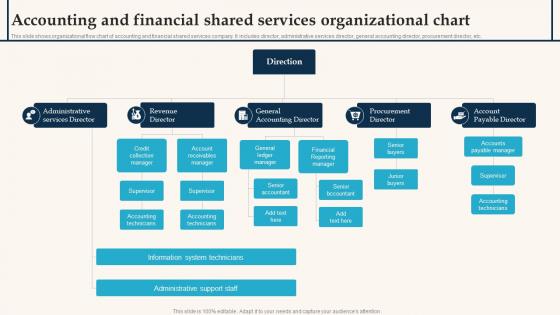
Accounting And Financial Shared Services Organizational Chart




Try Before you Buy Download Free Sample Product
 Impress Your
 Audience
 100%
100% Editable
 Save Hours
 of Time


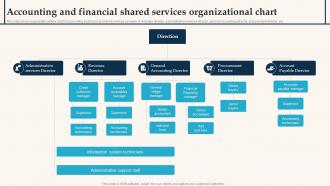
This slide shows organizational flow chart of accounting and financial shared services company. It includes director, administrative services director, general accounting director, procurement director, etc.
People who downloaded this PowerPoint presentation also viewed the following :
Accounting And Financial Shared Services Organizational Chart with all 6 slides:
Use our Accounting And Financial Shared Services Organizational Chart to effectively help you save your valuable time. They are readymade to fit into any presentation structure.





FAQs for Accounting And Financial Shared
Honestly, the cost savings alone make it worth it - most companies see 20-30% reduction just from cutting duplicate work. Your reporting finally makes sense too since everyone's using the same processes (no more "wait, why don't these numbers match?" headaches). It's way easier to roll out new systems when everything's standardized. Your finance people can actually focus on strategy instead of drowning in paperwork. Oh, and scalability becomes simple when you're not managing five different ways to do the same thing. I'd probably start with accounts payable or payroll - they're usually the easiest wins.
So basically you're consolidating all your accounting stuff instead of having separate teams everywhere. Gets rid of duplicate roles, cuts tech costs since you're only running one system, and you'll get better deals on software when buying in bulk. The centralized team gets really good at what they do too - way better than having random people handling books part-time. Most companies save like 15-30% in the first year, which is pretty solid. I'd start by figuring out how many accounting people you have now and what you're spending on different systems. That'll show you where the biggest wins are.
Honestly, people hate change so expect pushback from your team right off the bat. Different locations probably have systems that don't play nice together - tech integration is always a nightmare. Coordinating across time zones gets messy fast, and you'll have this awkward period where you're trying to keep everything running smoothly while basically tearing it all apart. Service levels might dip temporarily. I'd start small with pilot processes first - way less overwhelming that way. Also, communicate like crazy with everyone involved. Seriously, you can't overcommunicate during something like this. It makes the whole transition way less painful for everyone.
Honestly, tech can be a game-changer for shared services. Start with RPA for those soul-crushing repetitive tasks - invoice processing, journal entries, all that fun stuff. Cloud ERP systems are clutch because everyone gets real-time data access. No more "wait, which version are we using?" headaches. AI tools automatically catch weird transactions and exceptions, so you're not stuck reviewing everything manually. Oh, and digital workflows kill the paper trail nightmare. Look at whatever's eating up most of your time manually - that's where you'll get the biggest wins from automation.
Start with cost per transaction, processing time, and error rates - those are your bread and butter. Customer satisfaction from internal clients matters too, plus SLA compliance and how many transactions each person can handle. I'd honestly just pick 3-4 metrics at first because nobody wants to drown in spreadsheets, you know? You can always add more later. The key thing is comparing everything to how you did things before shared services - that's where you'll see if this whole thing actually worked. Oh, and staff productivity per FTE is pretty telling too.
Honestly, shared services actually make compliance way stronger, not weaker. Everything gets centralized so you're not dealing with different teams doing things their own way anymore. The audit trails become so much cleaner - and trust me, auditors will thank you for that. You'll have people who actually specialize in regulations instead of generalists trying to keep up with everything. Short sentences work better sometimes. The consistency alone fixes most reporting headaches since everyone's finally using the same systems and procedures. I'd map out where your compliance is currently broken so you can show exactly how this fixes it.
Honestly, cloud computing changed everything for accounting teams. Instead of waiting forever for IT to set up new servers (ugh, those were dark times), you can scale instantly and everyone accesses the same data from anywhere. Real-time collaboration is huge - no more version control nightmares. Security's actually better than what most companies handle themselves, plus automatic backups save your butt. Updates happen seamlessly too. My advice? Start small with your boring, routine stuff first. Shows quick wins without major risk, then you can expand from there.
Honestly, cross-training is gonna save your ass more than anything else. When someone calls out sick, you don't want to be scrambling. Document every single process with SOPs - I know it's boring but trust me, consistency matters huge in shared services. One person doing AR their own way screws everyone downstream. Buddy up new hires with experienced people and use actual scenarios, not textbook examples. Oh, and schedule regular refreshers because people definitely forget procedures when they're cranking through high volumes all day. Keep updating your training docs as processes change too.
Honestly, start with a security assessment to see what you're working with. Three main things matter most: solid access controls, encryption, and audits. Role-based permissions are huge - people should only access what they actually need for their jobs. Encrypt everything, both stored data and anything moving between systems. Don't skip the regular audits either, I swear that's where most companies mess up. Oh, and definitely get clear governance policies in place plus train everyone on privacy stuff. The audit thing really can't wait though.
So your ERP system is where all the transaction data sits - it's like the central hub for everything. Then your shared services center uses that same platform to handle accounting processes across different locations or business units. They're totally dependent on each other, honestly. The ERP gives you the tech foundation while shared services is more about how you organize the actual work. Oh, and definitely design them together from the start if you can. You don't want to retrofit later because that's just a headache. The whole setup works way better when they're built to complement each other.
Oh man, cultural stuff will absolutely mess with your rollout if you're not careful. Germans might eat up all that structured process work, but teams from more relationship-heavy cultures? They'll probably hate the cookie-cutter approach. Sure, language barriers are a thing, but honestly the communication styles will get you worse - like some places want everything documented while others just do handshake deals. Decision-making processes vary tons too. You'll want to bake cultural awareness right into your change plan from the start. Maybe tweak your service model by region instead of forcing everyone into the same box.
AI's definitely taking over the boring stuff - data entry, basic reports, you know the drill. Cloud everything is happening whether we like it or not. Real-time reporting is finally replacing those painful monthly cycles (thank god). Analytics are getting crazy sophisticated too. Here's the thing though - while machines handle number-crunching, there's way more demand for actual advisory work. Companies are centralizing operations globally instead of regional offices. Honestly? Your team should jump on data analysis training and strategic thinking skills now. That's where the money will be.
Honestly, you've gotta get your processes locked down first before hiring more people. Document everything so new hires aren't totally lost on day one. Automation is huge here - it'll catch mistakes way better than just eyeballing stuff. I'd start by mapping what you're doing now and finding the biggest pain points. That's where you focus first. Quality checkpoints throughout everything are clutch too. Oh and regular training sessions - people forget things or develop bad habits otherwise. I've watched teams try to grow too fast without this foundation and it's always a mess. Trust me on this one.
Honestly, you've gotta get those teams talking to each other regularly. Monthly sit-downs work great - not boring status meetings, but real problem-solving where everyone can actually speak up. Joint KPIs are a game changer because suddenly both sides care about the same outcomes. Cross-training helps tons too. When business folks see how the SSC actually works (and SSC people understand the business side), things click way better. Oh, and don't try to fix everything at once - pick one business unit first, figure out what actually works, then roll it out. Makes collaboration feel way more natural instead of some corporate mandate nobody wants to follow.
Look, these analytics tools basically give you a peek behind the curtain of what's actually happening with your shared services. You can catch bottlenecks early and see where money's being wasted. Processing times, error rates, cost per transaction - track the stuff that actually matters on a dashboard. I was skeptical at first, but the patterns jump out pretty fast once you start looking at the data. Way better than just guessing what's wrong. Your team will thank you when you can pinpoint exactly which processes are slowing everyone down and where automation makes sense.
-
Great product with effective design. Helped a lot in our corporate presentations. Easy to edit and stunning visuals.
-
I am a big fan of their newsletters because that is how I found my perfect requirement at the time of urgency. Thank God, I kept opening those.