

Training Program For Bpo Call Center Agents Action Plan For Quality Improvement In Bpo




Try Before you Buy Download Free Sample Product
 Impress Your
Audience
 100%
Editable
 Save Hours
of Time


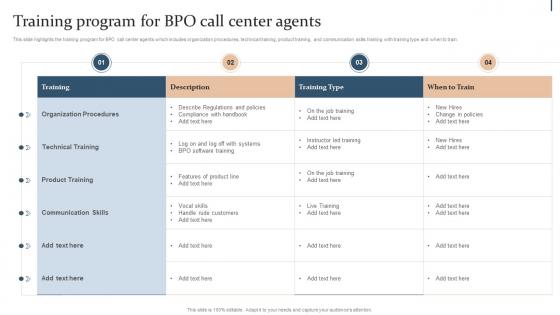
This slide highlights the training program for BPO call center agents which includes organization procedures, technical training, product training, and communication skills training with training type and when to train.
People who downloaded this PowerPoint presentation also viewed the following :
Training Program For Bpo Call Center Agents Action Plan For Quality Improvement In Bpo with all 6 slides:
Use our Training Program For Bpo Call Center Agents Action Plan For Quality Improvement In Bpo to effectively help you save your valuable time. They are readymade to fit into any presentation structure.






FAQs for Training Program For Bpo Call Center Agents Action Plan For Quality
Key call center quality metrics in BPO environments include first call resolution rates, average handle time, customer satisfaction scores, call abandonment rates, and agent adherence to scripts. These metrics enable BPO providers to streamline operations, enhance customer experiences, and deliver measurable value to clients, with many organizations finding that consistent monitoring ultimately drives competitive advantage and long-term client retention.
Customer feedback integration involves systematic collection through surveys, call monitoring, social media tracking, and real-time analytics, then channeling insights directly into agent training programs and process refinements. Financial services and healthcare call centers increasingly use this approach to identify service gaps, enhance response protocols, and personalize customer interactions, ultimately delivering improved satisfaction scores and reduced complaint escalation rates.
Call monitoring enables managers to evaluate agent performance, identify training needs, ensure compliance with protocols, and maintain service standards across customer interactions. Through real-time and recorded call analysis, BPO centers can quickly address performance gaps, recognize top performers, and implement targeted coaching programs, ultimately delivering improved customer satisfaction and operational efficiency.
AI and automation tools enhance call center service quality by enabling real-time sentiment analysis, automated call routing, intelligent scripting, and predictive analytics for agent support. These technologies streamline customer interactions through faster query resolution, personalized responses, and consistent service delivery, with many financial services and telecommunications companies finding that automation reduces average handling times while improving first-call resolution rates.
Effective call center training programs include communication skills development, product knowledge certification, customer service excellence workshops, conflict resolution training, and technology proficiency courses. These programs enhance agent performance by improving first-call resolution rates, reducing average handling times, and boosting customer satisfaction scores, with many BPO organizations finding that continuous skills development ultimately delivers higher retention rates and competitive service advantage.
Strategies include agent training optimization, call routing automation, knowledge base enhancement, performance analytics implementation, and workflow standardization. Through these approaches, BPO centers streamline operations by reducing research time, improving first-call resolution, and enabling faster issue identification, with many organizations finding that strategic technology integration ultimately delivers shorter handling times while maintaining service excellence.
Quality improvement initiatives in BPO settings align with business goals by linking performance metrics to client satisfaction, revenue targets, and operational efficiency objectives. Strategic integration involves mapping quality standards to specific business outcomes like reduced client churn, faster resolution times, and enhanced customer experiences, with many BPO organizations finding that this alignment ultimately delivers stronger client retention and competitive advantage.
Cultivating a quality culture among call center agents involves implementing comprehensive training programs, establishing clear performance metrics, providing regular feedback and coaching, recognizing achievements, and fostering open communication channels. These practices enhance agent engagement, improve customer satisfaction scores, and reduce turnover rates, with many BPO organizations finding that consistent quality reinforcement ultimately delivers stronger client relationships and competitive advantage.
Regular performance reviews contribute to sustained quality improvement by identifying skill gaps, recognizing top performers, setting clear improvement targets, and creating accountability frameworks for agents. Through structured feedback sessions and data-driven evaluations, call centers can address training needs, enhance customer interaction quality, and maintain service standards consistently, with many organizations finding that systematic reviews ultimately deliver improved first-call resolution rates and higher customer satisfaction scores.
Employee engagement significantly impacts call center performance through improved first-call resolution rates, reduced turnover, enhanced problem-solving abilities, and increased productivity metrics. Engaged representatives deliver more personalized customer interactions, demonstrate greater patience during complex inquiries, and proactively seek solutions, with many BPO organizations finding that highly engaged teams achieve 20-30% better customer satisfaction scores while reducing operational costs.
Different communication channels significantly impact BPO quality management through varying response time requirements, skill sets needed, and monitoring approaches, with phone requiring real-time emotional intelligence while chat and email allow for more measured responses. Many BPOs find that integrating omnichannel quality frameworks enables consistent service standards across platforms, ultimately delivering enhanced customer experiences and operational efficiency through specialized agent training and channel-specific performance metrics.
AI-powered speech analytics, real-time sentiment analysis, automated call scoring, predictive quality monitoring, and cloud-based QA platforms are revolutionizing call center quality assurance. These technologies streamline quality processes by providing instant feedback, identifying training opportunities, and predicting customer satisfaction issues, with many organizations finding that automated monitoring delivers more consistent evaluations and faster agent development.
Data analytics enables call centers to identify quality trends by analyzing call recordings, customer satisfaction scores, agent performance metrics, and resolution times across multiple touchpoints. Through predictive analytics and pattern recognition, BPO operations can pinpoint specific training needs, optimize workflows, and proactively address service gaps, ultimately delivering improved customer experiences and operational efficiency.
BPOs face implementation challenges including agent resistance to new processes, inconsistent quality metrics across teams, inadequate training resources, and difficulty measuring ROI on improvement initiatives. These obstacles can be overcome through comprehensive change management programs, standardized evaluation frameworks, and phased rollouts that allow gradual adaptation, with many successful BPOs finding that combining technology-driven monitoring with regular coaching delivers sustainable quality improvements and enhanced client satisfaction.
Leadership plays a pivotal role in call center quality improvement by establishing clear quality standards, allocating resources for training and technology upgrades, and creating accountability frameworks that drive consistent performance. Strong leadership enables organizations to implement comprehensive quality strategies, foster employee engagement through recognition programs, and maintain customer-focused cultures, ultimately delivering enhanced service experiences, improved first-call resolution rates, and sustainable competitive advantage in increasingly demanding markets.
-
I have just started downloading templates for my presentations and I must say this is a great design. It helped accelerate my presentation design process and made it more visually appealing.
-
Easily Understandable slides.