

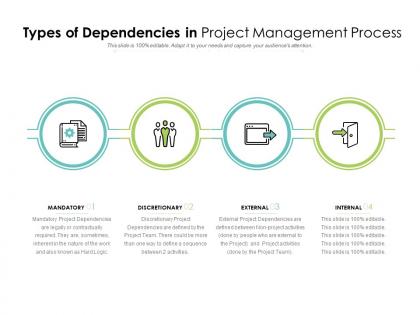
Types of dependencies in project management process




Try Before you Buy Download Free Sample Product
 Impress Your
 Audience
 100%
100% Editable
 Save Hours
 of Time


Gesture confidently with our Types Of Dependencies In Project Management Process. They generate complete belief.
People who downloaded this PowerPoint presentation also viewed the following :
Types of dependencies in project management process with all 5 slides:
Back up your gesture with our Types Of Dependencies In Project Management Process. They will confirm your commitment to deliver.


FAQs for Types of dependencies in
Project management dependencies include finish-to-start, start-to-start, finish-to-finish, and start-to-finish relationships, along with external, internal, and resource dependencies. These dependencies significantly impact timelines by creating sequential workflows, potential bottlenecks, and critical path constraints, with many project managers finding that effective dependency mapping streamlines scheduling, minimizes delays, and ultimately delivers more predictable project outcomes and improved resource allocation.
Dependency mapping improves team communication by creating visual clarity around task relationships, identifying bottlenecks before they occur, and establishing clear handoff points between team members. This transparency enables project managers to facilitate better coordination, reduces miscommunication about deliverable timelines, and helps teams proactively address potential conflicts, ultimately delivering smoother project execution.
Dependencies serve as critical coordination points that determine resource sequencing, timing, and availability across project phases, directly influencing budget allocation, team assignments, and timeline management. In large-scale infrastructure or software development projects, organizations use dependency mapping to optimize resource utilization, prevent bottlenecks, and ensure strategic allocation, ultimately delivering improved project efficiency and reduced costs.
Effectively identifying and managing external dependencies requires mapping stakeholder relationships, establishing clear communication protocols, implementing dependency tracking systems, and conducting regular risk assessments. Cross-functional teams in sectors like software development, manufacturing, and financial services streamline coordination through dependency matrices and automated alerts, ultimately reducing project delays and enhancing operational efficiency across organizational boundaries.
Effective dependency visualization tools include Gantt charts, network diagrams, PERT charts, dependency matrices, and critical path analysis software like Microsoft Project or Smartsheet. These techniques streamline project planning by identifying bottlenecks, optimizing resource allocation, and highlighting critical pathways, with many project managers finding that visual dependency mapping ultimately delivers faster project completion and enhanced team coordination.
Dependencies significantly influence risk management by creating interconnected vulnerabilities where delays, failures, or changes in one component cascade throughout the project timeline. Strategic risk management addresses these through dependency mapping, contingency planning, and buffer allocation, with many project managers finding that early identification and proactive mitigation of critical path dependencies ultimately delivers more predictable outcomes and enhanced project resilience.
Common dependency pitfalls include inadequate identification during planning, poor communication between dependent teams, unrealistic scheduling that ignores dependency chains, and lack of contingency planning for delays. These oversights frequently lead to cascading project delays, resource conflicts, and budget overruns, with many organizations finding that proactive dependency mapping and regular stakeholder alignment significantly minimize these risks while enhancing overall project predictability.
Agile methodologies address dependencies through cross-functional teams, continuous communication, daily standups, sprint planning, and dependency mapping tools. These approaches streamline coordination by identifying blockers early, facilitating real-time collaboration, and enabling rapid adjustments, with many organizations finding that this proactive dependency management ultimately delivers faster project completion and enhanced team productivity.
Dependencies significantly impact change management by creating cascading effects, requiring sequential approvals, and demanding coordinated communication across multiple project components and stakeholders. These interdependencies mean that changes in one area trigger assessments in related areas, with many project managers finding that effective dependency mapping streamlines change evaluation, reduces implementation delays, and ultimately delivers more predictable outcomes while maintaining project integrity.
Dependencies can significantly impact stakeholder engagement by creating uncertainty, shifting timelines, and requiring increased communication and coordination across teams. When external dependencies delay deliverables or internal dependencies create bottlenecks, stakeholders may experience reduced confidence and momentum, while successful dependency management enhances transparency, builds trust, and maintains project buy-in through proactive communication and realistic expectation setting.
Visualization tools enhance dependency management by transforming complex relationships into intuitive graphs, flowcharts, and interactive diagrams that reveal hidden connections and bottlenecks. Through real-time mapping and visual analytics, organizations in manufacturing, software development, and supply chain management can identify critical paths, anticipate cascading impacts, and optimize resource allocation, ultimately delivering faster decision-making and reduced operational risks.
Dependencies directly inform task prioritization by revealing critical path sequences, resource constraints, bottlenecks, and parallel work opportunities within project timelines. Through dependency mapping, project managers can identify high-impact tasks that unlock subsequent work streams, allocate resources strategically, and minimize delays, with many organizations finding that dependency-driven prioritization reduces project completion times by 20-30% while enhancing overall operational efficiency.
Dependencies in software development typically involve code libraries, APIs, data flows, and system integrations that can be updated rapidly, while construction relies on sequential physical processes, material deliveries, weather conditions, and regulatory approvals with fixed timelines. Software projects enable faster iteration and parallel development through modular architectures, whereas construction maintains linear workflows, with many organizations finding that digital project management tools help bridge these fundamental differences.
Effective dependency management strategies include early identification and mapping, creating buffer time in schedules, establishing clear communication protocols, implementing parallel work streams where possible, and developing contingency plans for critical dependencies. These approaches enable project managers to proactively address bottlenecks, maintain timeline flexibility, and ensure seamless coordination across teams, ultimately delivering improved project outcomes and reduced delay risks.
Organizations can foster proactive dependency management by implementing regular cross-team communication protocols, establishing clear escalation pathways, and integrating dependency mapping into standard project planning processes. Through dedicated dependency reviews and collaborative planning sessions, teams across finance, manufacturing, and healthcare sectors enhance project visibility, minimize bottlenecks, and accelerate delivery timelines, ultimately delivering improved operational efficiency.
No Reviews