

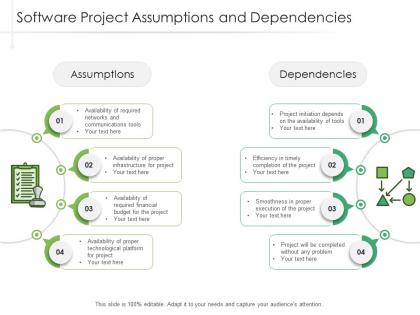
Software project assumptions and dependencies




Try Before you Buy Download Free Sample Product
 Impress Your
 Audience
 100%
100% Editable
 Save Hours
 of Time


Our Software Project Assumptions And Dependencies are topically designed to provide an attractive backdrop to any subject. Use them to look like a presentation pro.
People who downloaded this PowerPoint presentation also viewed the following :
Software project assumptions and dependencies with all 2 slides:
Use our Software Project Assumptions And Dependencies to effectively help you save your valuable time. They are readymade to fit into any presentation structure.
FAQs for Software project
Honestly, start with the big stuff - scope, timeline, budget, and whether you'll actually have the people you need. Tech assumptions are huge too, like expecting integrations to work smoothly (spoiler: they won't). I got burned once when what should've been a simple API connection took three weeks to fix. Stakeholder availability is another one - people love to promise they'll be around until they're suddenly not. Write everything down, especially the sketchy assumptions. Oh, and if you're in finance or healthcare, don't forget compliance stuff. Assumptions turn into disasters at the worst possible moments.
So dependency mapping is basically drawing out how your tasks connect to each other. Super helpful for catching bottlenecks early - trust me on this one. You'll see which tasks absolutely have to happen first and find your critical path (the stuff that'll mess up your whole timeline if it gets delayed). When your boss asks why everything's behind schedule, you can actually show them how one delayed thing screwed up three other things. I usually start with the big deliverables first, then figure out what each one needs to happen before it. Way less stressful than winging it.
Look, your assumptions basically become their expectations - that's the whole problem. You say 6 months? They're marking calendars. Promise smooth integration? They think it'll be plug-and-play (spoiler: it won't be). Here's what really gets you in trouble though - half your assumptions never get said out loud. Stakeholders just... assume things based on what you didn't clarify. Then when reality hits and timelines shift, guess who looks incompetent? Document the big assumptions from day one. Check back on them regularly too, because projects change and so should expectations.
Oh man, bad assumptions will destroy you up there. I've watched people build entire presentations around budget numbers that got updated literally the week before - so awkward. Your audience might know way more (or less) than you think, or that "recent" data could be months old by now. The whole thing just falls apart. You lose credibility fast, plus you might give terrible advice based on wrong info. I always double-check my key assumptions first, especially anything data-related that's been sitting in my files for a while. Also audience expertise levels - that's pure guesswork half the time.
Don't just cross your fingers and hope your assumptions work out - test them upfront. List everything you're betting on: tech stuff, how users will actually behave, whether you'll have the resources you need. Figure out which assumptions would completely screw you if they're wrong. Those get priority testing. Do quick proof-of-concepts, talk to some users, whatever gives you real data fast. I've seen too many projects crash because someone waited until month 3 to discover their main idea was flawed. Way better to find out early when pivoting doesn't cost a fortune.
Start by mapping out everything visually - Gantt charts work great for this. Color-code by risk level (seriously makes such a difference). Find your critical path and add buffer time around the sketchy dependencies. Set up clear handoffs between people and do regular check-ins. Oh, and challenge whether some dependencies are actually real or just what everyone assumes. I learned this the hard way on my last project. Track this stuff early in planning. Being proactive saves you so much headache later when everything starts going sideways.
Ugh, cultural stuff can completely wreck your global presentations if you're not paying attention. Like, what seems totally normal to you - direct feedback, jokes, even hand gestures - might weird out or actually offend people from other countries. I bombed hard when my "casual Friday" jokes got zero laughs from our German partners! You've gotta adapt your whole approach. Different cultures have totally different meanings for colors, symbols, how you organize info, all of it. Honestly, the research part is kind of a pain but super worth it. Get local colleagues to check your content beforehand - saves you from looking like an idiot later.
Look, assumptions are basically your project's ground rules - like "client sends data by Friday" or "we get staging access." Document every single one because that's how you set boundaries on what you'll actually deliver. Trust me, skip this step and you're asking for scope creep nightmares. Yeah, half your assumptions will change anyway (they always do), but having them written down means you can point to what shifted when you need to adjust the scope. It's honestly one of those boring admin things that saves your ass later.
Honestly, mapping out dependencies upfront is a game changer. No more of those cringe "wait, I thought YOU were doing that" moments. Everyone knows what they're waiting for and who's supposed to deliver what. You can actually plan realistic timelines instead of just hoping for the best. Plus people step up more when their stuff is written down - there's something about making it official, you know? It gives you way better visibility into what's blocking progress too. Next project, just list what you need from others and what they need from you. Trust me, it'll save you so much headache later.
Honestly, for code stuff I'd go with Dependa or just use npm's dependency tree - total lifesavers when you're stuck in messy codebases. Broader project management though? Lucidchart and Miro are solid, or Visio if you're feeling old school. I'm kinda obsessed with Draw.io since it's free and does everything without being overcomplicated. Maybe start with whatever your team's already using for diagrams - why reinvent the wheel, right? Then you can always try different tools once you figure out how complex things get.
Honestly, assumptions change all the time and you've gotta roll with it. Update them the second new info comes in - don't wait around. I've watched projects completely blow up because someone thought "oh I'll mention this later" and never did. Always tell your stakeholders immediately what changed and why. Then figure out how it messes with your timeline or deliverables. Here's the thing though - most people just cross their fingers hoping the old assumptions will magically work out. They won't. Set up regular check-ins with your team to go through assumptions together. Document everything so there's no confusion later about what shifted when.
So basically, watch out for dependencies that keep moving the goalposts - "oh we need another week" or suddenly changing requirements. That's your biggest warning sign right there. Teams with competing priorities? Yeah, they'll screw you over every time. Poor communication from whoever owns the dependency is another massive red flag. Anything you can't directly control should honestly make you sweat a little. I'd definitely set up regular check-ins and have backup plans ready. Oh, and if their thing depends on like three other moving pieces? Run. Past delays usually predict future delays too.
Honestly, you've gotta make people feel safe to push back without getting their heads bitten off. I always try questioning my own ideas first in meetings - shows everyone it's cool to admit you're wrong sometimes. Actually celebrate the person who spots problems early instead of shooting the messenger (happens way too often, ugh). Do pre-mortems where teams hunt for what might blow up. Short training on cognitive biases helps too. People need to recognize when they're being blind to obvious issues. Make curiosity part of how you evaluate performance, not just results.
Honestly, just throw together a basic spreadsheet - assumption, date, who owns it, impact level. That's it. Update it during sprint planning or whenever you hit milestones. The real trick is actually using the damn thing though. Most teams create it then completely forget it exists (guilty as charged). Stick it right in your dashboard where everyone can see it. I'd also rank assumptions by risk so you know which ones matter most. Oh, and don't just hope someone remembers to check - actually schedule assumption reviews into your timeline. Trust me on this one.
Ugh, bad assumptions are the worst - they mess up everything downstream. Like when you think a vendor needs two weeks but they actually need four, and boom, your whole timeline's shot. I've learned to write down all my assumptions at the start (sounds boring but trust me on this). Reviews always take longer than you think, people aren't available when you need them... honestly, it's like planning around Murphy's Law. Build some buffer time into the sketchy stuff. Way better than having to tell everyone "yeah, we're delayed by a month" later.
-
Awesomely designed templates, Easy to understand.
-
Good research work and creative work done on every template.
-
Great designs, really helpful.
-
Use of icon with content is very relateable, informative and appealing.
-
Great designs, really helpful.
-
Really like the color and design of the presentation.
-
Thanks for all your great templates they have saved me lots of time and accelerate my presentations. Great product, keep them up!
-
The content is very helpful from business point of view.