


Assumption And Constraint Analysis Project Management Professional Tools




Try Before you Buy Download Free Sample Product
 Impress Your
 Audience
 100%
100% Editable
 Save Hours
 of Time


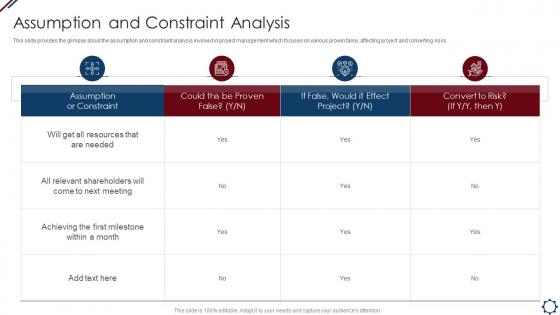
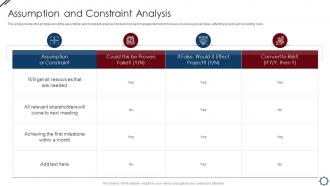
This slide provides the glimpse about the assumption and constraint analysis involved in project management which focuses on various proven false, affecting project and converting risks.
People who downloaded this PowerPoint presentation also viewed the following :
Assumption And Constraint Analysis Project Management Professional Tools with all 6 slides:
Use our Assumption And Constraint Analysis Project Management Professional Tools to effectively help you save your valuable time. They are readymade to fit into any presentation structure.





FAQs for Assumption And Constraint Analysis Project
Assumptions are beliefs about project conditions that haven't been verified, such as resource availability or stakeholder support, while constraints are confirmed limitations like budget caps, deadlines, or regulatory requirements. Assumptions require ongoing validation and present risk if proven incorrect, whereas constraints define firm project boundaries, with many project managers finding that clearly distinguishing between these elements streamlines planning and enhances risk management strategies.
Effectively identifying assumptions involves conducting stakeholder interviews, reviewing historical project data, analyzing resource availability and market conditions, and documenting dependencies between project components. Through systematic brainstorming sessions and risk assessment workshops, project managers can uncover hidden assumptions about timelines, budgets, and deliverables, while engaging cross-functional teams ensures comprehensive assumption mapping, ultimately delivering greater project predictability and strategic alignment.
Assumption validation techniques include stakeholder interviews, data analysis, prototype testing, scenario planning, and expert consultations. These methods help project managers systematically challenge initial beliefs by gathering empirical evidence, testing hypotheses in controlled environments, and leveraging diverse perspectives, with many organizations finding that structured validation processes significantly reduce project risks and enhance decision-making accuracy.
Constraints significantly impact project timelines and deliverables by limiting resource availability, extending development phases, and requiring alternative approaches that may demand additional time or budget adjustments. Through effective constraint management, project teams streamline planning processes, optimize resource allocation, and maintain realistic delivery schedules, with many organizations finding that proactive constraint identification ultimately delivers more accurate timelines and higher-quality outcomes.
Mismanaging assumptions can cause project failure through inadequate validation, poor stakeholder communication, insufficient documentation, and lack of regular reviews throughout project lifecycles. When assumptions prove incorrect, organizations face budget overruns, timeline delays, resource misallocations, and deliverable gaps, with many project managers finding that systematic assumption tracking and validation processes significantly reduce these risks while enhancing overall project success rates.
Stakeholder input provides critical insights into realistic assumptions, identifies hidden constraints, and validates project feasibility from multiple organizational perspectives. Through structured interviews, workshops, and feedback sessions, project managers gather essential knowledge about resource limitations, regulatory requirements, and operational realities, while stakeholders help prioritize constraints and assumptions based on business impact, ultimately ensuring more accurate project planning and risk mitigation.
Teams prioritize assumptions to test by assessing business impact, probability of being wrong, and cost of validation through risk matrices and stakeholder input. High-impact, high-uncertainty assumptions affecting critical path decisions should be tested first, while lower-risk assumptions can be validated later, with many project teams finding this approach reduces costly pivots and accelerates delivery timelines.
Common pitfalls include being too vague about constraint details, failing to prioritize constraints by impact, overlooking interdependencies between different limitations, and not establishing clear ownership for constraint management. These documentation gaps create confusion during project execution, with many organizations finding that poorly documented constraints lead to scope creep, budget overruns, and missed deadlines, ultimately compromising strategic project outcomes.
Scenario planning helps analyze assumptions and constraints by testing different future conditions, identifying potential roadblocks, and revealing hidden dependencies across various business environments. Through strategic modeling, organizations can evaluate how key assumptions hold under different scenarios, stress-test operational constraints, and develop contingency strategies, ultimately delivering more resilient planning and competitive advantage in an increasingly uncertain marketplace.
Metrics for evaluating constraint impact include schedule variance, budget overruns, resource utilization rates, quality deviation scores, and scope change frequency. These measurements enable project managers to quantify how constraints affect delivery timelines, cost efficiency, and deliverable quality, with many organizations finding that systematic constraint tracking ultimately enhances project predictability and stakeholder satisfaction.
Assumptions and constraints should be revisited at every major project milestone, during scope changes, and when new risks emerge or external factors shift. Many project managers conduct formal reviews monthly or quarterly, while also monitoring them continuously through regular team meetings, stakeholder check-ins, and performance assessments, ultimately ensuring project adaptability and strategic alignment in an increasingly dynamic business environment.
**INPUT**: What tools or software can assist in tracking and analyzing project assumptions and constraints? **OUTPUT**: Project management tools for tracking assumptions and constraints include Microsoft Project, Asana, Jira, Smartsheet, and Monday.com, along with specialized risk management platforms like RiskWatch and @RISK. These solutions streamline project oversight by centralizing documentation, automating status updates, and providing real-time dashboards, with many organizations finding that integrated tracking ultimately delivers better risk mitigation and improved project outcomes. [Word count: 60 words]
Cultural differences significantly impact assumption interpretation through varying communication styles, risk tolerance levels, hierarchical expectations, and decision-making processes among global teams. While Western teams might explicitly state constraints, Asian teams often communicate assumptions indirectly, and European teams may prioritize regulatory compliance differently, with many multinational organizations finding that structured cross-cultural workshops and standardized documentation frameworks help bridge these interpretation gaps, ultimately delivering more cohesive project outcomes.
Effective communication strategies include visual documentation through stakeholder matrices, regular assumption review meetings, constraint impact assessments, risk registers, and transparent reporting dashboards. These approaches streamline stakeholder alignment by providing clear visibility into project limitations, facilitating proactive decision-making, and enabling collaborative constraint management, with many organizations finding that structured communication reduces project delays and enhances strategic outcomes.
Risk management intersects with assumption and constraint analysis through validation processes, uncertainty assessment, and contingency planning that help organizations identify potential failure points. By systematically examining underlying assumptions and resource limitations, companies can anticipate operational disruptions, market shifts, and compliance challenges, ultimately enabling more robust strategic decisions and enhanced business resilience.
-
Colors used are bright and distinctive.
-
SlideTeam makes creating presentations easy. Unlimited products, premium quality designs and affordable.