


Types Of Event Risk And Management Planning Initiatives




Try Before you Buy Download Free Sample Product
 Impress Your
 Audience
 100%
100% Editable
 Save Hours
 of Time


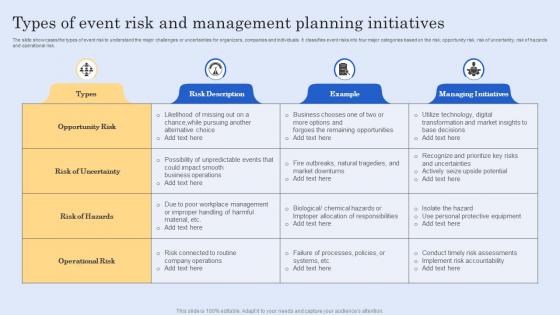
The slide showcases the types of event risk to understand the major challenges or uncertainties for organizers, companies and individuals.It classifies event risks into four major categories based on the risk opportunity risk, risk of uncertainty, risk of hazards and operational risk.
People who downloaded this PowerPoint presentation also viewed the following :
Types Of Event Risk And Management Planning Initiatives with all 6 slides:
Use our Types Of Event Risk And Management Planning Initiatives to effectively help you save your valuable time. They are readymade to fit into any presentation structure.





FAQs for Types Of Event Risk And
Primary event risks include operational failures, weather disruptions, security threats, vendor issues, technology malfunctions, health emergencies, and financial shortfalls. These risk categories impact events across industries, from corporate conferences to music festivals, with many organizers finding that proactive identification and mitigation strategies ultimately deliver smoother operations, enhanced attendee experiences, and stronger financial performance.
Event planners can effectively identify potential risks by conducting comprehensive venue assessments, analyzing weather patterns, reviewing vendor reliability histories, evaluating security requirements, and examining logistical dependencies. Through systematic risk audits and stakeholder consultations, planners anticipate challenges across operations, safety, and compliance, ultimately enabling proactive mitigation strategies that ensure seamless event execution and enhanced attendee experiences.
Real-time risk monitoring tools include IoT sensors, surveillance cameras with AI analytics, crowd density monitors, weather tracking systems, and mobile alert platforms. These technologies enhance event safety by detecting potential hazards early, monitoring crowd movements and environmental conditions, and enabling rapid response coordination, ultimately delivering safer experiences and reducing liability for organizers.
Effective communication strategies mitigate attendee safety risks by establishing clear emergency protocols, providing real-time updates through multiple channels, and ensuring consistent messaging across all staff members. These approaches enable event organizers to quickly disseminate critical information, coordinate evacuations if necessary, and maintain attendee confidence, with many large-scale events finding that proactive communication significantly reduces panic and enhances overall safety outcomes.
Insurance policies serve as critical financial protection within event risk management, covering potential losses from cancellations, liability claims, property damage, weather disruptions, and vendor failures. These policies enable event organizers to transfer significant financial risks to insurers, providing peace of mind and ensuring business continuity, while maintaining budget predictability and protecting stakeholder investments across various event types.
Event planners can involve stakeholders through collaborative risk workshops, structured surveys, regular communication meetings, and shared assessment documentation that captures diverse perspectives. This inclusive approach enhances risk identification by leveraging expertise from vendors, venue managers, sponsors, and attendees, while building consensus around mitigation strategies, ultimately delivering more comprehensive event protection and stronger stakeholder buy-in throughout the planning process.
Financial risk management strategies for events include comprehensive insurance coverage, diversified revenue streams, contingency fund allocation, flexible vendor contracts, and dynamic pricing models. These approaches streamline financial exposure by protecting against cancellations, weather disruptions, and attendance shortfalls, while enabling event organizers to maintain profitability and deliver successful experiences even when facing unexpected challenges.
Contingency planning enhances event resilience by identifying potential disruptions, establishing response protocols, and creating backup solutions for critical operations. Through comprehensive risk assessment and alternative arrangements, event organizers can quickly adapt to weather changes, vendor failures, or technical issues, ultimately minimizing downtime and maintaining attendee satisfaction while protecting their reputation and financial investment.
Managing reputational risk involves proactive stakeholder communication, comprehensive crisis response protocols, social media monitoring, and transparent messaging strategies. Organizations enhance their reputation resilience by establishing clear communication channels, training spokespersons for various scenarios, and implementing real-time feedback systems, with many finding that swift, authentic responses and post-event follow-up ultimately strengthen stakeholder trust and competitive positioning.
Event organizers should prepare for natural disasters through comprehensive emergency planning, venue risk assessments, weather monitoring systems, evacuation procedures, and backup logistics arrangements. These strategies enable organizations to protect attendees while maintaining operational continuity, with many conferences and festivals finding that proactive disaster planning ultimately delivers enhanced safety protocols, reduced liability, and stronger stakeholder confidence in increasingly unpredictable environments.
Event risk management legal implications include liability coverage, contract provisions, permit compliance, insurance requirements, and duty of care obligations. These considerations protect planners by establishing clear responsibility frameworks, ensuring regulatory adherence, and minimizing litigation exposure, with many event organizations finding that comprehensive legal preparation ultimately delivers stronger stakeholder confidence and operational protection.
Feedback from previous events enhances risk management by identifying overlooked vulnerabilities, validating mitigation strategies, and revealing operational gaps that standard planning might miss. Organizations analyzing post-event data can refine contingency protocols, improve resource allocation, and strengthen stakeholder communication processes, with many finding that systematic feedback loops ultimately deliver more resilient events and reduced insurance costs.
Staff should receive comprehensive training in emergency response protocols, crowd management techniques, communication procedures, hazard identification, and crisis decision-making skills. This training enables teams to quickly assess situations, coordinate evacuations if needed, and maintain clear communication channels, with many event organizations finding that well-prepared staff significantly reduce incident severity and enhance overall attendee safety.
Cultural factors significantly influence international event risk management through varying communication styles, regulatory expectations, safety protocols, and stakeholder engagement preferences across different regions. Events in Asia may prioritize hierarchical decision-making and face-saving measures, while Western markets often emphasize direct communication and liability concerns, with many global event organizers finding that localized risk frameworks ultimately deliver better compliance and attendee experiences.
Post-event risk management effectiveness can be measured through incident response time, financial impact versus projected losses, stakeholder satisfaction scores, media sentiment analysis, and recovery duration metrics. These measurements enable organizations to assess their preparedness across operational, financial, and reputational dimensions, with many event organizers finding that comprehensive metric analysis ultimately delivers improved risk strategies and enhanced future event resilience.
-
What an exhaustive collection of templates you guys have there in slideteam. Impressive!!!
-
The way SlideTeam professionals work is exceptional. Thanks for being so helpful!