

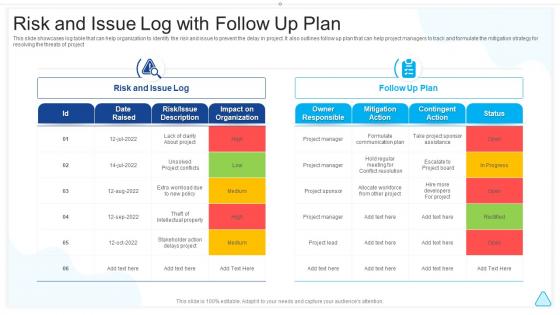
Risk And Issue Log With Follow Up Plan




Try Before you Buy Download Free Sample Product
 Impress Your
 Audience
 100%
100% Editable
 Save Hours
 of Time


This slide showcases log table that can help organization to identify the risk and issue to prevent the delay in project. It also outlines follow up plan that can help project managers to track and formulate the mitigation strategy for resolving the threats of project
People who downloaded this PowerPoint presentation also viewed the following :
Risk And Issue Log With Follow Up Plan with all 6 slides:
Use our Risk And Issue Log With Follow Up Plan to effectively help you save your valuable time. They are readymade to fit into any presentation structure.





FAQs for Risk And Issue Log With
So you'll want to start by figuring out what could actually go wrong - map out all the potential disasters, basically. Then rate each one on how likely it is and how badly it'd mess things up. I know it feels super pessimistic, but trust me on this! After that, create action plans for preventing or dealing with each risk. Put someone in charge of tracking each one too. Oh, and don't just set it and forget it - you need regular check-ins to update everything as new stuff pops up.
Honestly, I'd just start with risk workshops in each department. Get people to map out what scares them - operational stuff, money problems, compliance nightmares, whatever. Teams brainstorm what could blow up in their daily work, then you rate everything by how likely it is and how bad it'd be. High/medium/low grids work fine, nothing fancy. Don't forget cross-department sessions though - that's where you catch the weird connections. Like when IT gets hacked and suddenly marketing can't launch their big campaign. Put it all in some shared doc so everyone can see patterns. Review quarterly or it'll just collect dust.
Look, tech has completely transformed how we handle risk management. AI and machine learning can catch patterns and predict problems way faster than any team doing it by hand. Real-time monitoring gives you instant heads-ups when things start going wrong. Automated reporting keeps compliance happy too. Data analytics actually let you put numbers on risks instead of guessing - which honestly feels like magic sometimes. The changes in just the past few years have been crazy. My advice? Figure out where your biggest blind spots are first, then find specific tech that tackles those exact problems.
Start with a risk matrix - plot everything by how likely it is vs how bad it'd be. The high probability, high impact stuff gets your money and attention first, obviously. Medium risks just need watching. Low ones? Honestly just accept them - you can't fix everything anyway. Focus on maybe the top 20% that could actually wreck your business. Don't rely on gut feelings though - make a simple scoring system. I'd start by picking your worst 5 risks and figuring out what it'd cost to fix each one. Forces you to make real decisions about trade-offs instead of just worrying about everything equally.
Honestly, the three big killers are market risk (turns out nobody wants what you're building), running out of money, and team drama when key people bail or just suck at their jobs. Do crazy amounts of customer research before you build anything - like, way more than feels necessary. Keep 6+ months of cash around and get proper founder agreements signed early. Trust me on this one, I've seen friendships implode over equity splits. Competition and regulatory stuff will bite you too, but don't stress about every possible disaster. Just focus on your top 3 risks first and make actual plans for those.
So basically, risk management totally depends on what industry you're in. Finance guys are constantly stressed about market crashes and credit defaults - honestly seems exhausting. Healthcare worries about patient safety and getting sued (which makes sense). Construction? They're dealing with actual physical dangers plus equipment breaking down. The regulatory stuff changes everything too. What works for a bank won't work for a hospital. Same core ideas, but you've got to figure out what's actually gonna hurt your specific business and plan around that.
So it really depends on your industry, but finance is probably the worst - they've got Basel III, Sarbanes-Oxley, all that fun stuff requiring constant reporting. Healthcare deals with HIPAA and patient safety rules. Manufacturing? OSHA and environmental regs mostly. The whole thing can be pretty overwhelming tbh. Most industries now want documented risk assessments and incident reports, plus regular audits. I'd start by figuring out which regulatory bodies actually govern your sector, then work backwards from their main requirements. Way easier than trying to guess what applies to you.
Honestly, just track your incident rates and how fast you spot problems before they blow up. Response times matter too. Check if your risk tolerance actually matches what's happening in reality - that gap tells you everything. Boring stuff like audit scores and compliance ratings? Yeah, those count unfortunately. Survey your teams to see if they actually get the procedures or just nod along in meetings. Here's the thing though - if you're not catching issues before they cost you serious money, none of this matters. Pick maybe 3-4 metrics that actually relate to your business and check them monthly. Don't go crazy with dashboards right away.
Honestly depends on what you're working with budget-wise. ServiceNow and MetricStream are solid GRC platforms if you've got the cash. Resolver and LogicGate work well too. But real talk - a good Excel template can do wonders when you're starting out. @RISK is my go-to for Monte Carlo stuff, though it's pricey. Heat maps in PowerBI or Tableau are pretty slick for showing leadership what's going on. Here's the thing though - whatever your team will actually stick with is probably your best bet. I've seen fancy software collect dust while people keep using their trusty spreadsheets.
Honestly, you've gotta weave risk awareness into daily stuff, not just boring boardroom talk. Train your people to spot problems and speak up without getting their heads chopped off - because let's be real, nobody wants that drama. Regular team check-ins work great where everyone mentions one thing that's bugging them or seems off. Leadership needs to jump in these conversations too, not just delegate it. Reward the people who flag issues early instead of punishing them. Oh, and make it super clear that catching problems before they explode is actually helpful, not annoying.
Look, companies without risk management are just asking for trouble. Financial hits, legal problems, bad PR - you name it. I've watched businesses get completely wrecked by stuff they could've planned for. The really frustrating part is missing out on good opportunities because you can't tell what risks are actually worth taking. When something does go wrong, you're just panicking and making it up as you go. Nobody wants that stress, trust me. Start simple - figure out your biggest 3-5 risks and make some basic plans for handling them.
So basically you're running "what if" scenarios through your risk models instead of just looking at old data. Think interest rates going crazy, supply chain disasters, competitors doing something wild - all that fun stuff. Way better than staring at historical trends honestly. You'll spot weak points before they bite you and can prep for different situations. I'd pick your top 3-5 risk factors first. Then map out best case, worst case, and realistic scenarios for each one. Sounds boring but it's actually pretty useful once you get into it.
Dude, these big global crises basically blow up your whole risk planning. COVID showed us how naive our "worst case" scenarios actually were - suddenly supply chains that seemed solid just fell apart overnight. The scary part? Everything's way more connected than we thought. When geopolitical stuff hits, markets can tank instantly and regulations go haywire. You really need to stress-test the scenarios that make you uncomfortable, because that's probably where you're most vulnerable. Don't just look at direct impacts either - it's those cascading second and third-order effects that'll get you. Honestly, if a scenario feels too wild to plan for, that's exactly what you should be planning for.
Honestly, your past data is like a crystal ball for this stuff. Grab 3-5 years of incident reports, financials, whatever operational records you have lying around. Map out the trends - you'll start seeing patterns in seasonal risks, payment delays, supply chain hiccups. Way better than just winging it. I've watched too many companies get blindsided by stuff their own history literally warned them about. The cool part? You can actually put numbers on probability and impact instead of playing guessing games. Your industry probably has specific patterns - financial crashes, disruptions, the usual suspects. Build your risk models from there.
Know your audience first - executives care about money, tech people want the details. Skip the jargon and lead with impact: how does this actually mess with their goals? Dashboards are your friend because honestly, who reads 20-page reports anymore? Give them concrete action items with names and dates, not fluffy suggestions. Oh, and follow-up is huge - keep sending progress updates or they'll forget about it completely. The trick is making risks feel real and fixable, not some vague threat they can push off until later. Works every time.
-
Editable templates with innovative design and color combination.
-
Illustrative design with editable content. Exceptional value for money. Highly pleased with the product.