

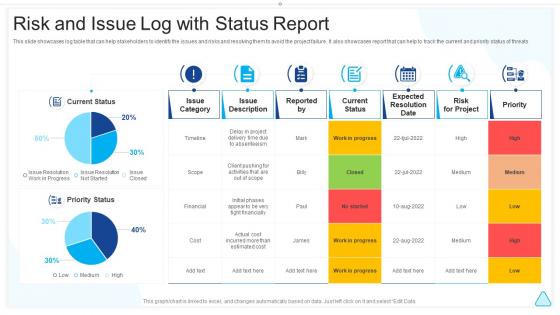
Risk And Issue Log With Status Report




Try Before you Buy Download Free Sample Product
 Impress Your
 Audience
 100%
100% Editable
 Save Hours
 of Time


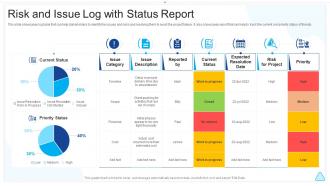
This slide showcases log table that can help stakeholders to identify the issues and risks and resolving them to avoid the project failure. It also showcases report that can help to track the current and priority status of threats
People who downloaded this PowerPoint presentation also viewed the following :
Risk And Issue Log With Status Report with all 7 slides:
Use our Risk And Issue Log With Status Report to effectively help you save your valuable time. They are readymade to fit into any presentation structure.






FAQs for Risk And Issue Log
Honestly, cybersecurity and cash flow problems are the big scary ones. Supply chain stuff too - COVID really showed how that can mess you up overnight. If you're in healthcare or finance, regulatory compliance will keep you up at night. Social media disasters? Those spread like wildfire and can wreck your reputation fast. Market shifts happen constantly - competitors, economic downturns, customers wanting different things. I'd probably focus on whatever could actually kill your business first, not just the annoying stuff that causes headaches.
Figure out what could really hurt your business first - losing your best customer, running out of cash, your star employee quitting. Rank those by how likely they are and how much damage they'd do. Honestly, a basic spreadsheet beats any fancy tool for this stuff. Pick your worst 3-5 risks and write down what you'd actually do if they happened. Have someone check on each one regularly. Most people way overcomplicate this and then never look at it again. Keep it dead simple so you'll actually use it. Update it every few months or when something big shifts.
Honestly, tech has completely changed the game for risk management. AI can spot warning signs months before they'd pop up in old-school reports - it's pretty wild actually. Real-time alerts mean you're not finding out about problems three weeks too late. Automated dashboards track everything without you having to manually pull reports (thank god). Data analytics finally lets you put actual numbers on risks instead of just gut feelings. The whole approach shifts from reactive to proactive, which is huge. I'd start by looking at whatever manual risk stuff you're still doing and see what could be automated first.
So basically you wanna look at two things - how likely is this bad thing to actually happen, and how screwed would you be if it does? Most people just make a simple grid thing with probability on one side and how bad the impact is on the other. Whatever lands in that top right corner is your "we're totally fucked" zone that needs fixing ASAP. Think about costs, how it'd mess up your operations, reputation hits, delays - the usual suspects. Definitely ask people from other departments too since they'll catch stuff you missed. Oh and obviously start with the high-risk, high-impact ones first because... well, duh.
Look, you need five key things for risk management: spot potential problems, figure out how likely/bad they'd be, plan how to handle them, keep monitoring stuff, and assign actual people to own each risk. Most teams totally blow it on the first part - they rush through identifying risks when that's literally the foundation of everything else. Don't just say "the team" handles something, that never works. Each risk needs a real person's name on it. Honestly, if you just map your top 10 risks this week and give them owners, you'll be doing better than like 90% of companies out there.
Think of risk management as your "what if" filter before making big moves. You're basically asking yourself what could go wrong and whether you can actually handle it if it does. Don't try avoiding every single risk though - that's impossible and honestly pretty boring. Instead, take the smart ones that match what your company can stomach. The trick is baking this thinking right into your decision process from day one. New project? Investment opportunity? Major pivot? Run it through the risk lens first. Way better than scrambling to fix things after they've already gone sideways.
So qualitative is basically "high/medium/low" gut-check stuff, while quantitative gets into actual numbers and probabilities. When you don't have solid data yet, go qualitative - it's way faster for spotting risks upfront. Numbers come later with statistical models and cost breakdowns. Most teams I know do it backwards though, which is kinda frustrating to watch. Start broad with qualitative across your whole project. Then drill down with the heavy math only on risks that'll actually wreck your timeline or budget. No point calculating probabilities for every tiny thing.
Honestly, the biggest thing is getting people comfortable talking about risks without feeling like they'll get in trouble. I'd start with quick risk chats during regular team meetings - nothing formal, just "hey, what could go wrong this week?" Share actual stories too, even the close calls. Way better than boring policy docs. Your managers need to do this themselves or it won't stick. Maybe try a weekly risk topic or set up anonymous reporting? I dunno, something low-pressure. The whole point is making it normal conversation, not this scary compliance thing that everyone dreads.
Honestly, most places still rely on Excel or Google Sheets - don't laugh, but spreadsheets work. ServiceNow and MetricStream are the big enterprise players if you've got budget. RSA Archer's solid too. Monte Carlo simulators are great for number-crunching, though that might be overkill depending on your situation. You could even use Asana or Monday.com for basic tracking. My old company swore by integrated platforms that pulled data from everywhere, but we were pretty mature risk-wise. Start small with whatever you can afford and build from there.
Honestly, just throw everything into a risk matrix - likelihood vs impact. Tackle the high-probability, high-damage stuff first since that's obviously your biggest headache. Those crazy unlikely but catastrophic risks? Don't ignore them completely, they're basically insurance policies. Medium stuff can wait unless you've got time to burn (which you probably don't). Oh, and definitely check this quarterly because things change fast. I'd start by writing down your worst 5 risks right now and pick the nastiest one to deal with this week. Trust me, it feels good to cross something off.
So compliance is basically your safety net for managing risk. It gives you minimum standards to hit so you don't get hit with legal or financial nightmares. Regulations are like guardrails - they stop you from driving straight off a cliff (okay, maybe that's dramatic but whatever). Following these rules automatically covers tons of operational, legal, and reputation risks that could wreck your business. Regulators have seen every disaster possible, so they've thought of risks you probably haven't. Start by figuring out where you're not compliant yet - that's where your biggest exposures are lurking.
Look, good communication is basically what makes risk management actually work. Your team catches problems way earlier when everyone's talking openly about potential issues. Stakeholders don't get blindsided either - which honestly saves you so much drama later. You'll want regular check-ins and some kind of standard way to report risks. Clear escalation paths help too, so people aren't just panicking when stuff hits the fan. Oh, and ditch the jargon - simple language means better decisions when everyone's stressed. Start small with weekly team updates and build from there.
Look, insurance and financial tools are basically ways to dump risks you can't handle onto someone else. Buy insurance for stuff like property damage or getting sued. Derivatives help with market swings and currency changes - though that gets messy quick, not gonna lie. You're paying small predictable amounts now instead of getting destroyed later. Start by figuring out what would actually screw over your business. Then see what coverage won't break the bank. I'd honestly map out your biggest threats first before diving into options.
Honestly, start by listing everything that could screw you over - supply chain issues, hackers, your best people quitting, whatever. Then figure out backup plans for each mess. I get it, feels like homework nobody wants to do. But diversify your income sources and suppliers if you can. Keep some emergency cash sitting around too. The annoying part? You've got to review this stuff every few months since new problems keep popping up. Seriously, put quarterly reviews on your calendar right now or you'll forget.
Honestly, just be straight up about risks - don't sugarcoat stuff to make the numbers prettier. Leadership hates surprises way more than bad news upfront. Think about who actually gets screwed if things go sideways. Like, are you protecting the executives while regular employees or customers deal with the mess? That's pretty messed up if you ask me. Fairness matters too - make sure your risk tolerance actually matches what the company claims to stand for. Oh and transparency is huge. I always ask myself "who's gonna get hurt here?" before making any risk calls. Sounds obvious but you'd be surprised how often people skip that step.
-
Colors used are bright and distinctive.
-
Understandable and informative presentation.