


Project Status Report With Key Issues Risks Project Management Bundle




Try Before you Buy Download Free Sample Product
 Impress Your
 Audience
 100%
100% Editable
 Save Hours
 of Time


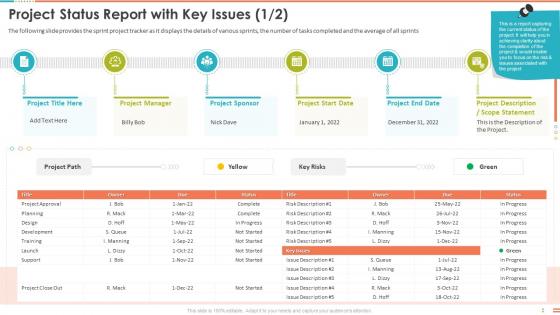
The following slide provides the sprint project tracker as it displays the details of various sprints, the number of tasks completed and the average of all sprints.
People who downloaded this PowerPoint presentation also viewed the following :
Project Status Report With Key Issues Risks Project Management Bundle with all 6 slides:
Use our Project Status Report With Key Issues Risks Project Management Bundle to effectively help you save your valuable time. They are readymade to fit into any presentation structure.





FAQs for Project Status Report With Key Issues Risks
A comprehensive project status report should include project timeline and milestones, budget analysis and financial tracking, risk assessment and mitigation strategies, resource allocation updates, and deliverable progress summaries. These elements enable project managers to streamline communication, enhance stakeholder transparency, and maintain operational efficiency, with many organizations finding that structured reporting ultimately delivers better project outcomes and competitive advantage.
Project status reports should typically be updated weekly for most projects, though frequency depends on project complexity, duration, and stakeholder needs, with critical projects requiring daily updates and longer initiatives using bi-weekly cycles. Many organizations find that consistent weekly reporting strikes the optimal balance between keeping stakeholders informed and avoiding update fatigue, ultimately delivering transparency while maintaining project momentum.
Best practices for visualizing project data include using Gantt charts for timeline tracking, dashboard-style metrics for KPIs, progress bars for milestone completion, color-coded status indicators, and comparative charts for budget versus actual spending. These visualization techniques streamline stakeholder communication by presenting complex information clearly, enabling faster decision-making and enhanced project transparency, with many organizations finding that visual reports significantly improve project oversight and accountability.
Project managers can effectively communicate challenges and risks by presenting them with clear impact assessments, proposed mitigation strategies, and realistic timelines for resolution. Through structured risk matrices and transparent stakeholder updates, organizations streamline decision-making processes, enhance resource allocation, and maintain project momentum, with many finding that proactive communication ultimately delivers stronger stakeholder confidence and improved project outcomes.
Key metrics include schedule variance, budget variance, scope completion percentage, resource utilization rates, and quality indicators like defect rates or customer satisfaction scores. These measurements enable project managers to identify bottlenecks, forecast potential delays, and optimize resource allocation, with many organizations finding that consistent tracking across these areas ultimately delivers improved project outcomes and enhanced stakeholder confidence.
Status reports can be tailored by adjusting detail levels, focus areas, and communication styles based on stakeholder needs and priorities. Executives typically require high-level summaries emphasizing budget impact and strategic outcomes, while team members need operational details and task-specific updates, and clients benefit from progress milestones and deliverable timelines, ultimately ensuring each audience receives relevant, actionable information that drives informed decision-making.
**INPUT**: What tools or software can streamline the creation of project status reports? **OUTPUT**: Project status reporting tools include Microsoft Project, Asana, Trello, Smartsheet, and Monday.com, along with automated dashboard solutions like Tableau and Power BI. These platforms streamline reporting by automating data collection, generating real-time visual updates, and integrating with existing workflows, ultimately delivering faster reporting cycles and enhanced project transparency across organizations.
Project managers can highlight achievements by using visual progress indicators, milestone comparison charts, quantitative metrics showcasing deliverable completion rates, and dedicated achievement sections with specific outcomes. These reporting techniques enable stakeholders to quickly identify project momentum through clear data visualization, percentage completion tracking, and strategic milestone documentation, ultimately delivering enhanced transparency and strengthened stakeholder confidence across complex project portfolios.
Project status reports enhance team accountability by establishing clear visibility into individual contributions, milestone progress, and performance metrics across all project phases. These reports maintain motivation through transparent communication of achievements and challenges, enabling teams to celebrate successes while addressing obstacles collaboratively, ultimately delivering improved team cohesion and project outcomes.
Project status reports facilitate better decision-making by providing comprehensive data on budget utilization, timeline adherence, resource allocation, risk assessment, and milestone completion rates. This strategic information enables project managers and stakeholders to identify potential bottlenecks, reallocate resources proactively, and adjust project scope or timelines, with many organizations finding that data-driven insights ultimately streamline project delivery and enhance overall success rates.
Common pitfalls include being overly technical, lacking clear metrics, missing stakeholder-specific insights, providing outdated information, and focusing solely on problems without solutions. These issues undermine report effectiveness by creating confusion, reducing stakeholder engagement, and limiting actionable decision-making, with many project managers finding that balanced, audience-focused reporting ultimately delivers better project outcomes and enhanced stakeholder confidence.
Feedback integration involves establishing systematic review processes, implementing recommended format changes, adjusting reporting frequency based on stakeholder needs, and incorporating lessons learned from project outcomes. Organizations streamline this by creating feedback loops with project managers, standardizing templates based on user preferences, and leveraging project management software that captures historical insights, ultimately enhancing communication effectiveness and stakeholder engagement.
Storytelling enhances project status reports by transforming dry data into compelling narratives that highlight progress, challenges, and strategic outcomes through context, stakeholder impact, and clear cause-and-effect relationships. This approach enables project managers to communicate complex milestones more effectively, build stakeholder engagement, and ultimately deliver greater transparency and buy-in across organizations.
Project managers should address delays by providing transparent explanations of root causes, revised timelines, and specific mitigation strategies being implemented. This approach builds stakeholder trust while demonstrating proactive leadership, with many organizations finding that honest communication about setbacks, coupled with clear recovery plans, ultimately strengthens project credibility and enables better resource allocation decisions.
Including next steps and action items in project status reports ensures accountability, maintains momentum, and provides clear direction for team members and stakeholders moving forward. These elements transform status reports from passive updates into actionable roadmaps, with project managers finding that explicit action items reduce confusion, accelerate decision-making, and keep projects on track toward successful completion.
-
Much better than the original! Thanks for the quick turnaround.
-
Unique design & color.