

Risk and issue management overview





Try Before you Buy Download Free Sample Product
 Impress Your
 Audience
 100%
100% Editable
 Save Hours
 of Time


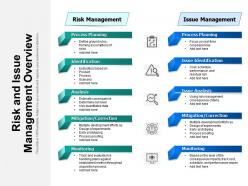
Understand the business framework by incorporating Risk And Issue Management Overview. Define the risk and issue management in brief by employing a project risk and issue PPT theme. List the sources of risk identification and explain the risk management perspective by utilizing the management plan PPT slide. Describe the steps involved in this framework and various arrangements used in managing risks by adopting an issue management PPT slide. Explain the entire process thoroughly using our project risk and issue PPT template. Take the assistance of our enterprise risk management PPT theme to determine the steps involved in the issue management framework. With the help of the enterprise risk management PPT slide, elaborate on threat and opportunity responses. Showcase the relation between transformational flow and issue management by employing our project risk and issue PPT slide. Explicate the responsibilities of the senior responsible owner, program manager, business change manager, and program office in risk and issue management.
People who downloaded this PowerPoint presentation also viewed the following :
Risk and issue management overview with all 2 slides:
Give your audience a fulfilling experience. They will find our Risk And Issue Management Overview elevating.

FAQs for Risk and
So the four main steps are identify, assess, mitigate, and monitor. First you spot what could go wrong, then figure out how likely and bad those risks really are. Put controls in place to reduce them. Most people totally forget about monitoring though - that's honestly where everything falls apart. Risks keep changing so you can't just do this once and forget about it. It's kinda like maintaining your car instead of just having insurance, you know? I'd start with your biggest 5-10 risks and make sure someone actually owns each one.
Honestly, just start with the basics - do a proper risk assessment across everything. Operations, finance, IT, compliance, all of it. Map out what could actually go wrong in each area. Supply chain issues, cyber attacks, new regulations, whatever keeps you up at night. Get your department heads involved because they see the real problems daily. Risk matrices help - score everything on likelihood vs impact. I'd focus on your most critical stuff first rather than trying to boil the ocean. Update it quarterly, or whenever something big changes. Sounds boring but it's worth doing right.
So tech completely changes the game for risk management. AI and machine learning catch patterns you'd miss otherwise - way better than those old spreadsheet days that honestly made me want to pull my hair out. Automated systems ping you when threats pop up. Dashboards give you this amazing overview of everything at once. Predictive modeling's pretty cool too - lets you see problems coming before they actually hit. My advice? Figure out where you're most blind right now, then find tools that tackle those specific issues first.
Honestly, you've gotta get people talking about risks like it's normal conversation, not just buried in some handbook nobody reads. Train your managers to bring it up in regular meetings. I've watched too many teams where everyone stays silent because they think they'll look stupid - so frustrating! Monthly check-ins work great for this. When someone spots a problem early? Celebrate that instead of only focusing on screwups. Make "what could go wrong" discussions feel routine before stuff actually hits the fan. Oh, and risk workshops help too if people will actually show up.
So qualitative risk assessment uses categories like "high," "medium," "low" while quantitative actually crunches numbers and data. Most teams go qualitative first since it's way faster - especially when you don't have much historical data to work with. Quantitative involves more math, statistics, modeling... honestly kind of a pain but you get precise measurements. Takes forever though. I'd probably start qualitative just to see what you're dealing with, then switch to the number-heavy approach for your biggest risks. You'll need solid data for those important decisions anyway.
Look, risk management is basically your early warning system - helps you see problems coming before they smack you in the face. I'd start with the obvious stuff: diversify your investments, build up that emergency fund, get decent insurance coverage. Honestly, most people skip the stress-testing part, but you should regularly check how your portfolio would handle different crash scenarios. That way you're not scrambling when markets tank. Set up some automatic contingency plans too - takes the emotion out of it. Oh, and figure out your biggest weak spots first. No point protecting everything equally when some areas are way more vulnerable.
Risk matrix is your best bet - plot probability vs impact to see what's screaming for attention. Hit the high-probability, high-impact stuff first since that'll actually tank your operations. Medium risks? There's always way too many, so just grab the ones tied to your main goals or anything that might spiral. Low-impact things can wait for quarterly check-ins, honestly. Pick your top 3-5 risks and see if your fixes are doing anything. Oh, and don't get stuck analyzing forever - sometimes you just gotta start somewhere and adjust as you go.
Honestly, the hardest part is just mapping out every single risk you can think of - operational stuff, financial headaches, regulatory nightmares, whatever. Takes forever but you gotta do it right. Then rank them by how likely they are and how much damage they'd cause. For your biggest threats, figure out if you'll avoid them, reduce them, transfer them to someone else, or just accept the hit. Don't forget to actually assign someone to own each risk though - can't just throw it in a spreadsheet and hope for the best. Review quarterly since everything changes constantly.
So basically each industry has totally different rules you've got to follow. Banks deal with crazy strict stuff like Basel III, hospitals worry about HIPAA and patient safety, manufacturing companies focus more on environmental and worker protection. You can't just steal a framework from another sector - honestly learned that the hard way when I tried using a tech company's setup for a client in pharma. Start with whatever regulations hit your industry hardest, build around those first. Then you can layer on the weird company-specific risks that always pop up.
Honestly, most companies just treat it like paperwork - they document everything but don't actually act on it. It's wild how many places have these huge risk registers that nobody looks at. Teams also make it one person's job instead of everyone's, which is backwards if you ask me. Risk moves fast now, way faster than it used to. Oh, and they try to tackle everything at once instead of focusing. Pick your top 3-5 scary risks first and actually build plans around those. Don't overthink it.
So here's what works really well - dig into your historical data and transaction patterns to catch weird stuff early. Machine learning is honestly pretty amazing at spotting things we'd totally miss. Set up real-time dashboards instead of waiting around for those monthly reports (such a game changer). The key thing is making sure your data isn't garbage to begin with. Figure out what "normal" looks like for your business first. Then create automatic alerts when things go sideways. Your team can actually respond fast instead of playing catch-up. Way better than the old-school approach.
Ugh, globalization makes risk management such a nightmare. You're suddenly juggling different regulations, currencies, and political systems everywhere. Your New York playbook? Completely useless in Singapore or São Paulo. Each market needs its own approach, but you still need some kind of overall consistency - which is honestly a balancing act from hell. Then there's the supply chain mess. One factory shuts down in Asia and boom, your European operations are screwed. We all saw how that played out during COVID. The trick is staying flexible enough for local quirks while keeping your eye on the big picture.
Honestly, don't wait for a crisis to figure out your messaging - that's when your brain turns to mush. Pick your top three nightmare scenarios and draft template responses now. Set up who talks to who, which channels you'll use, and make sure your approval process won't become a disaster within a disaster (I've seen companies take hours just to agree on a tweet). Communication isn't some nice-to-have add-on - it's literally damage control. The whole point is having your shit together before everything goes sideways.
So you need to track both the numbers and the softer stuff. Incident frequency, how long it takes to spot problems, costs of actual events vs what you spent preventing them. Near-miss reports are weirdly helpful too - more reports usually means people aren't scared to speak up anymore. Check if your risk predictions are getting better over time. Oh, and if you're in a heavily regulated space, definitely count audit findings and violations. Honestly though? Don't go crazy with metrics. Pick 3-4 that match your biggest headaches and review monthly.
Honestly, just set spending limits upfront - like giving your team a credit card they can use without asking you every damn time. Good risks are calculated bets that might actually grow the business. Bad risks? That's the stuff that'll get you fired. Most companies either approve everything to death (innovation dies) or they go full chaos mode and panic later. Define what you're comfortable with first. Small experiments should move fast with minimal paperwork. Bigger bets need more eyes on them, obviously. I've watched too many teams get stuck in analysis paralysis when they could've just tested something small first.
No Reviews